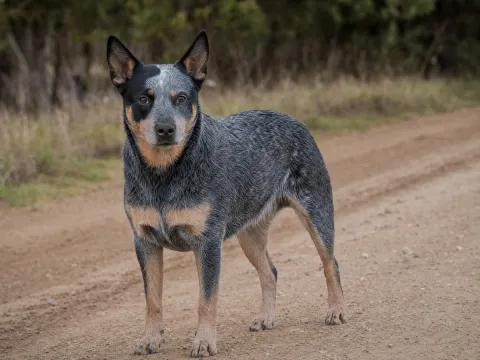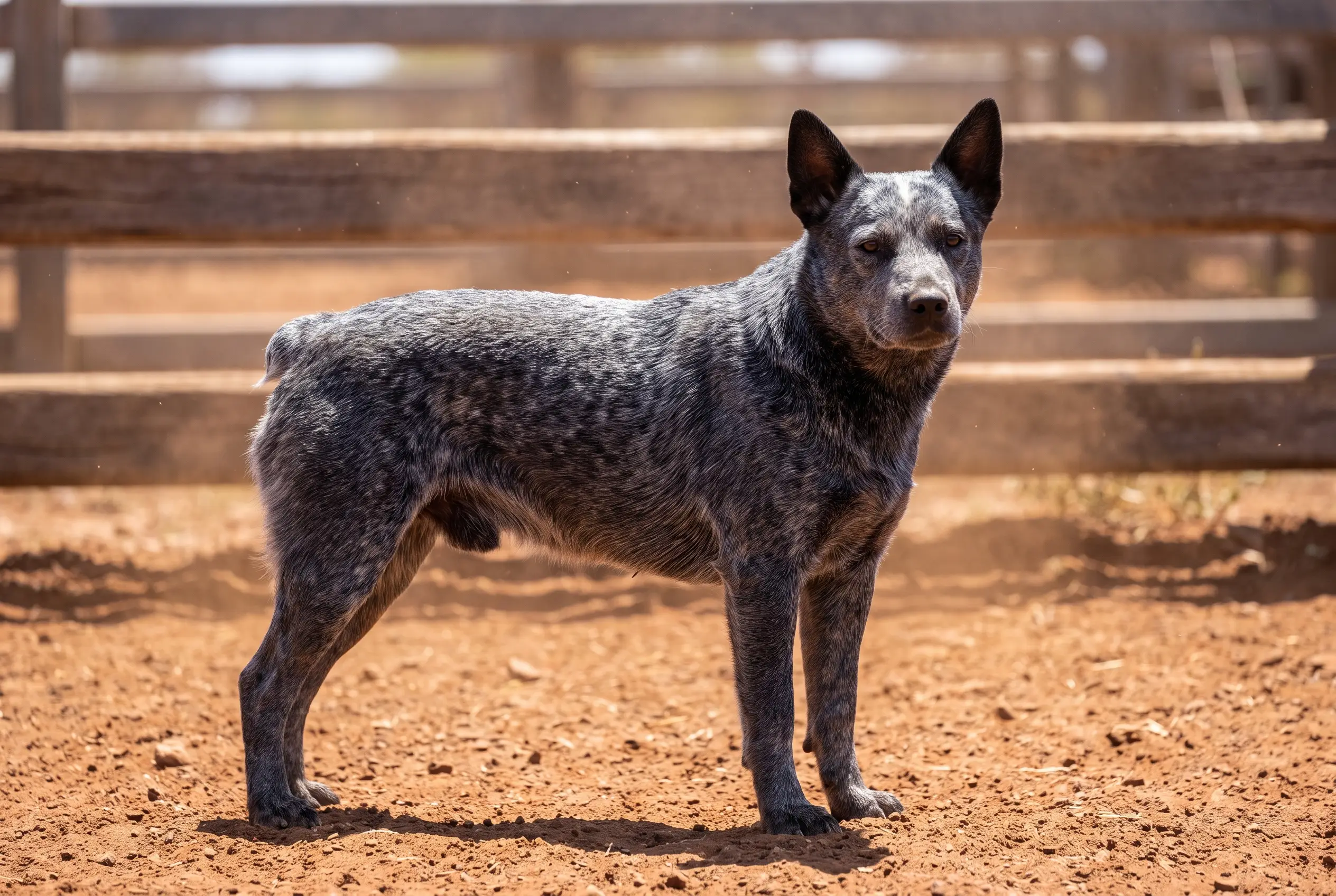
Australian Stumpy Tail Cattle Dog
Nothing was docked. The stump is how this breed arrives.
Vital stats
| Size | Medium · 46–51 cm (dogs), 43–48 cm (bitches) |
| Weight | About 16–23 kg — the standard sets no weight |
| Life expectancy | 12–15 years |
| Energy | Very high — bred to move cattle all day, over distance |
| Shedding | Moderate, with heavy seasonal moults |
| Coat | Short, dense double coat · blue or red speckle, never tan |
| Group | Herding · Cattledogs (FCI №351, Group 1) |
| Origin | Australia |
| FCI group | 1 — Sheepdogs and Cattledogs · FCI 351 |
Breed traits
Friendliness
Care
Mind
The Australian Stumpy Tail Cattle Dog by the numbers
The Australian Stumpy Tail Cattle Dog facts owners search for most — price, lifespan, weight, shedding and colours, in one place.
Less common, so expect a waitlist and some travel to a reputable breeder — which pushes the price up. Plan for steady ongoing costs — mid-range food, routine vet care and insurance.
We don't quote a single figure: the real price swings with breeder, region, bloodline and health testing — and a rescue costs a fraction of a breeder's litter. Adopting is almost always the cheapest route.
Temperament
The standard asks for a dog that is ever alert, watchful and obedient, though suspicious of strangers, with a natural aptitude in the working and control of cattle. That last phrase carries more than it looks. Controlling cattle means biting them: a Stumpy moves stock by coming in low at the heel, and the instinct arrives with the puppy rather than with the training. It is hard, self-directed and used to making decisions without being asked, because a dog working a mob half a paddock away has to. At home it fixes on its own household and gives a stranger nothing until it has watched for a while. Left without a job it takes one, and the job it takes usually involves ankles, the vacuum cleaner, or the wheels of cars going past the gate. This is a working dog before it is anything else, and moving it to a suburb does not change that.
Habits & quirks
Takes the heel
It moves stock by coming in low, taking the heel and dropping flat as the hoof kicks back. The move needs no teaching and shows up in puppies on nothing more than something moving fast. Every Stumpy household ends up giving it a legal target.
Born short
Puppies arrive with the tail they keep, anything from a knob to the full 10 centimetres the standard allows. Longer-tailed pups still turn up in Stumpy litters; a tail over 10 cm is a severe fault in the ring, and shortening it with a knife makes things worse, because a docked tail is a disqualification.
Logs the visitor
Loyalty here is narrow and deep. It attaches to the household, usually to one person inside it, and treats anyone at the gate as something to be watched from a distance and filed, not greeted.
Runs the house instead
With no cattle to move it supervises what is available: children leaving the room, the cat, the car reversing out of the drive. A Stumpy with nothing in its diary writes its own.
Health
Sound and long-lived on the whole, the Stumpy has one issue that deserves real attention: congenital deafness. It runs in the breed, so ask to see BAER hearing certificates on both parents rather than take a breeder's reassurance, and ask twice where the line is red — red dogs are affected markedly more often than blue. Hip scores and a current eye certificate covering progressive retinal atrophy and lens luxation belong in the same folder. Get those checks in hand and you have a tough, hard-wearing dog.
Nutrition
| Exercise | Two hours a day is the floor, and walking alone will not cover it. Herding, dog sport, long runs beside a bike, scent work, anything with a task attached. Physical tiredness comes easily to this breed and means little; the head is what has to be worked. |
| Training | Start on impulse control before adolescence and redirect the bite onto a tug or a ball early, because it will be redirected onto something. It learns fast and holds grudges against boring repetition, so keep sessions short and pay well. Socialise hard from eight weeks: the standard wants suspicion of strangers, not fear of them, and the line between those two is drawn in puppyhood. |
| Grooming | About as easy as a working coat gets. A weekly brush most of the year, daily for the fortnight when the undercoat lets go, and no trimming ever. The short harsh outer coat throws off mud on its own, so bathing is rarely worth the trouble. |
| Health | Sound and long-lived on the whole, with congenital deafness as the one to check properly: ask for BAER certificates on both parents, not reassurance, and ask twice on red lines. Hip scores and a current eye certificate covering progressive retinal atrophy and lens luxation belong in the same folder. |
This is a dog built to trot cattle across dry country all day, so feed it to the work it actually does — the outlet you give it sets the ration more than the scoop does. Weigh the meals, count the training treats you spend redirecting that heel bite, and keep him lean enough to feel the ribs under the short coat. A working frame carries spare weight badly; keeping him trim protects the hips and joints he leans on hardest.
How much should I feed an Australian Stumpy Tail Cattle Dog? →
Puppy guide
A Stumpy puppy is born with its stump and its instincts both — the heel bite shows up on nothing more than something moving fast, long before any training does. Give it a legal target early, a tug or a ball, because it will get redirected onto something. Socialise hard from eight weeks: the breed is meant to be wary of strangers, not frightened of them, and that line is drawn in puppyhood. Keep the body's work light while the joints form, and teach an off switch as carefully as you teach anything else.
Training
The Stumpy learns fast and is used to making its own decisions — bred to work a mob without being told each move — so it will improvise the moment a session bores it. Start impulse control before adolescence, redirect the bite onto a tug or a ball early, and keep sessions short and well paid. It holds a grudge against dull repetition, so vary the work and make it worth doing. Left with nothing in its diary it writes its own, and the job it picks usually involves ankles or the car at the gate — so hand it a real one.
Life expectancy
Australian Stumpy Tail Cattle Dogs live 12–15 years. The Stumpy is sound and long-lived on the whole, and you keep it at the top of that range the working way: a lean weight, parents with clear BAER hearing results and checked hips and eyes, and enough real work each day to keep body and mind sound.
Similar breeds
Breeds with a similar build and background — worth a look if this one isn't quite the fit.
Breeds that look like this
Common questions
Is this just an Australian Cattle Dog with a docked tail?
No, and the docking is backwards. The Australian Stumpy Tail Cattle Dog holds its own FCI standard, No. 351, next to the Australian Cattle Dog's No. 287, and the stump is inherited rather than cut: puppies are born with it, the standard permits up to 10 centimetres of natural tail, and a docked tail is a disqualifying fault. The two breeds do share a start, in Smithfield-type herding dogs crossed onto the Dingo in the early 1800s and then onto the smooth blue merle Collie. From there they separate. The Cattle Dog's standard names a later injection of Dalmatian and black-and-tan Kelpie blood; the Stumpy's names neither, and it rules out tan markings under any circumstances, so a tan-marked Stumpy is telling you something about its parents. They are also built differently. The Stumpy is square, body length equal to height at the withers; the Cattle Dog is longer than tall, 10 to 9. Identical height ranges on paper, a different dog inside them.
Is a Stumpy a good family dog?
For most families, no. It is affectionate and dependable with the people it lives with, tolerant of children it has grown up alongside, and quick to learn. It is also a hard, biting, self-employed cattle dog that was never selected for patience with visitors, small pets or anything that runs. Small children and a strong heeling instinct are a poor combination without steady supervision and early work. Give it stock, a sport, a farm, hours a day and an owner who has handled a driven working breed before, and it is superb. Give it a courtyard and a walk, and you get a loud, destructive dog with a habit of herding the household.
How rare is it, and can I find one outside Australia?
Rare in Australia and rarer everywhere else. By the early 1980s barely any purebred stock remained, with registered breeding down to a single family for a stretch of the 1960s. The ANKC's development register, opened in October 1988, rebuilt the breed by having a panel of three judges grade stumpy-tailed working dogs found around the country into the studbook; from October 2000 only dogs of excellent breed type were admitted, and the scheme closed in 2007. The breed was renamed the Australian Stumpy Tail Cattle Dog in 2001. The UKC recognised it in 1996 and the AKC carries it in its Foundation Stock Service, so a small North American population exists, but numbers remain low and the FCI's recognition is still provisional. Outside Australia, expect a waiting list, expect to import, and expect a breeder to ask what work the dog is going to do.
Does the Australian Stumpy Tail Cattle Dog shed a lot?
Yes — the Australian Stumpy Tail Cattle Dog is a heavy shedder, dropping hair year-round or in big seasonal moults. Brush it several times a week and expect regular vacuuming; it isn't the coat for you if loose fur is a dealbreaker.
Is the Australian Stumpy Tail Cattle Dog hypoallergenic?
Not really. No dog is truly hypoallergenic, and the Australian Stumpy Tail Cattle Dog's shedding coat releases plenty of the dander that sets off allergies. If someone at home is allergic, this isn't the easiest breed to live with — spend time around one first.
Is the Australian Stumpy Tail Cattle Dog easy to train?
Reasonably. The Australian Stumpy Tail Cattle Dog is trainable with consistency and rewards, though it isn't the quickest study. Keep sessions short and positive, and be patient with the basics like recall.