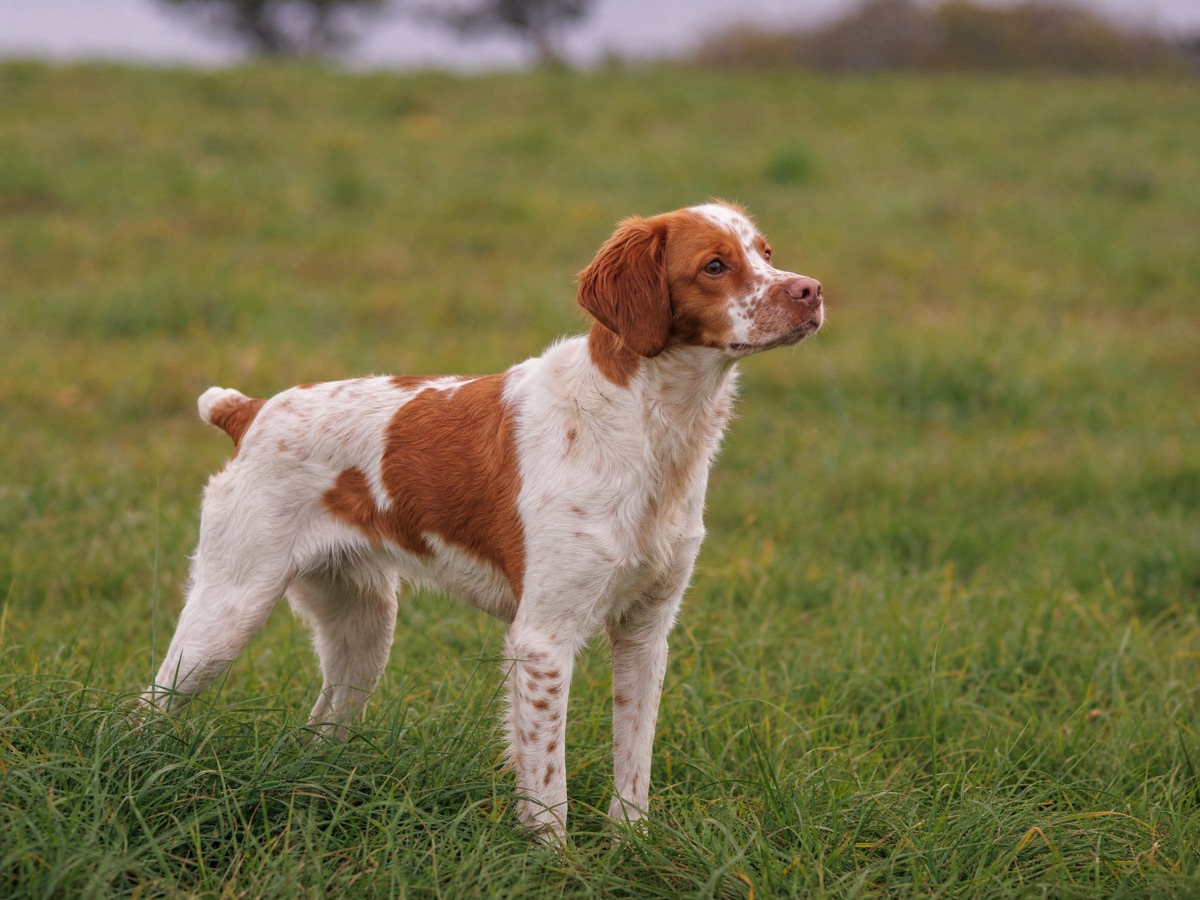
Brittany
A compact, tireless pointing dog — all engine, easy to love.
On these lists: Dogs for runners · Dogs for hunting
Vital stats
| Size | Medium · 44–52 cm |
| Weight | 13–18 kg |
| Life expectancy | 12–14 years |
| Energy | Very high — 1–2 hours/day |
| Shedding | Low–moderate |
| Coat | Dense, flat or wavy coat · orange & white, liver & white |
| Group | Sporting · FCI №95 / AKC |
| Origin | Brittany, France |
| FCI group | 7 — Pointing Dogs · FCI 95 |
Breed traits
Friendliness
Care
Mind
The Brittany by the numbers
The Brittany facts owners search for most — price, lifespan, weight, shedding and colours, in one place.
Widely bred, so you can usually find a litter from a registered breeder without a long wait. Plan for steady ongoing costs — mid-range food, routine vet care and insurance.
We don't quote a single figure: the real price swings with breeder, region, bloodline and health testing — and a rescue costs a fraction of a breeder's litter. Adopting is almost always the cheapest route.
Temperament
Bred by Breton farmer-hunters who needed one modest dog to point, flush and retrieve, the Brittany is the definition of willing. It's high-octane outdoors — quartering ground at speed, freezing on point — and gentle, almost soft, indoors. Deprive it of work and the energy resurfaces as pacing, whining and creative mischief.
Habits & quirks
The freeze
Mid-walk, mid-play, mid-anything: one interesting scent and the whole dog turns to statue.
Happy hum
An under-stimulated Brittany narrates its feelings in whines and warbles.
Bird radar
Pigeons in the park are pointed with complete professional sincerity.
Cuddle switch
After a proper run, the field rocket becomes a lap-sized heat pad.
Health
The Brittany is one of the soundest of the sporting breeds, and a good breeder keeps it that way: even a healthy line is worth screening, so ask about hip scores and eye testing. Beyond that the biggest health lever you hold is exercise, because this is a very high-energy gundog that needs real daily work to stay physically and mentally well. Keep him lean, keep him fit, and a Brittany will spend most of its life as a genuinely robust dog.
Nutrition
| Exercise | One to two hours of hard exercise daily — running, fetch, field work; a merely walked Brittany is an under-exercised one. |
| Training | Quick and eager but soft-tempered; keep sessions short and positive and it learns almost anything. |
| Grooming | A weekly brush and the occasional tidy-up; the flat coat sheds moderately and repels dirt well. |
| Health | A notably healthy sporting breed; good breeders still screen hips and eyes. |
A Brittany runs on a lot of fuel, so feed to the dog's actual workload: a gundog putting in one to two hours of hard exercise a day and a quieter companion don't eat the same. Weigh the meals, count training treats into the day's total, and aim for ribs you can feel under that flat coat. Keep this compact athlete lean, because extra weight on a dog built for tireless drive just gets in the way of the drive.
Puppy guide
A Brittany puppy is quick, willing and more sensitive than it first looks, so the early months set the tone. Socialize him widely and gently, keep first experiences positive, and build training on rewards from day one, because a harsh moment lands harder on this soft-tempered breed than most. Keep the growing joints in mind by going easy on repetitive hard exercise, and start channelling that big engine into games and fetch early, because a Brittany needs a job as much as a walk.
Training
Brittanys are eager, clever and quick to learn, which makes them a joy to train as long as you stay kind. This is a soft-tempered dog: keep sessions short, upbeat and reward-based and it picks up almost anything, but heavy-handed corrections shut it down and are hard to undo. Give the busy mind and body a real outlet, because an under-exercised Brittany turns its frustration into pacing, whining and invented mischief.
Life expectancy
Brittanys live 12–14 years. The Brittany is a hardy, long-lived gundog, and you keep it at the top of that range the same way you keep it happy: lean weight, parents screened for hips and eyes, and a life with enough real exercise and work to keep body and mind sound. A fit, well-fed, well-occupied Brittany is a remarkably durable dog.
Similar breeds
Breeds with a similar build and background — worth a look if this one isn't quite the fit.
Breeds that look like this
Common questions
Are Brittanys good family dogs?
Yes — affectionate, gentle and playful, they suit active families who can give them one to two hours of exercise a day.
Are Brittanys easy to train?
Very — eager and quick, but sensitive, so keep training positive; harsh corrections shut them down.
Do Brittanys bark a lot?
They're moderate barkers but enthusiastic whiners — an under-exercised Brittany vocalises its frustration. Meet the exercise need and they're pleasantly quiet.
Does the Brittany shed a lot?
Moderately. The Brittany sheds a fair amount, steadily through the year with heavier seasonal patches. A weekly brush keeps most of the loose hair off your floors and clothes.
Is the Brittany hypoallergenic?
Not really. No dog is truly hypoallergenic, and the Brittany's shedding coat releases plenty of the dander that sets off allergies. If someone at home is allergic, this isn't the easiest breed to live with — spend time around one first.