Brussels Griffon
A pocket-sized curmudgeon with an almost-human face and a heart set entirely on you.
On these lists: Dogs for seniors
Vital stats
| Size | Toy · 18–25 cm |
| Weight | 3.5–6 kg |
| Life expectancy | 12–15 years |
| Energy | Moderate — 30–45 min/day |
| Shedding | Low (rough coat) to moderate (smooth) |
| Coat | Rough or smooth · red, black & tan, black |
| Group | Toy · FCI №80 / AKC |
| Origin | Brussels, Belgium |
| FCI group | 9 — Companion and Toy Dogs · FCI 80 |
Breed traits
Friendliness
Care
Mind
The Brussels Griffon by the numbers
The Brussels Griffon facts owners search for most — price, lifespan, weight, shedding and colours, in one place.
Widely bred, so you can usually find a litter from a registered breeder without a long wait. Ongoing costs stay modest — it eats little and routine vet care sits at the lower end. Its coat also needs a professional groom every few weeks — a real line in the budget.
We don't quote a single figure: the real price swings with breeder, region, bloodline and health testing — and a rescue costs a fraction of a breeder's litter. Adopting is almost always the cheapest route.
Temperament
It began as a stable ratter in nineteenth-century Brussels, was promoted to the coachman's seat, then to the Belgian court — and has carried itself like minor royalty ever since. Expect terrier spark wrapped in total person-focus: a watchful, sensitive little dog that takes itself seriously and expects you to do the same.
Habits & quirks
The shadow
Wherever you go, it has already decided to come too — bathroom included.
The look
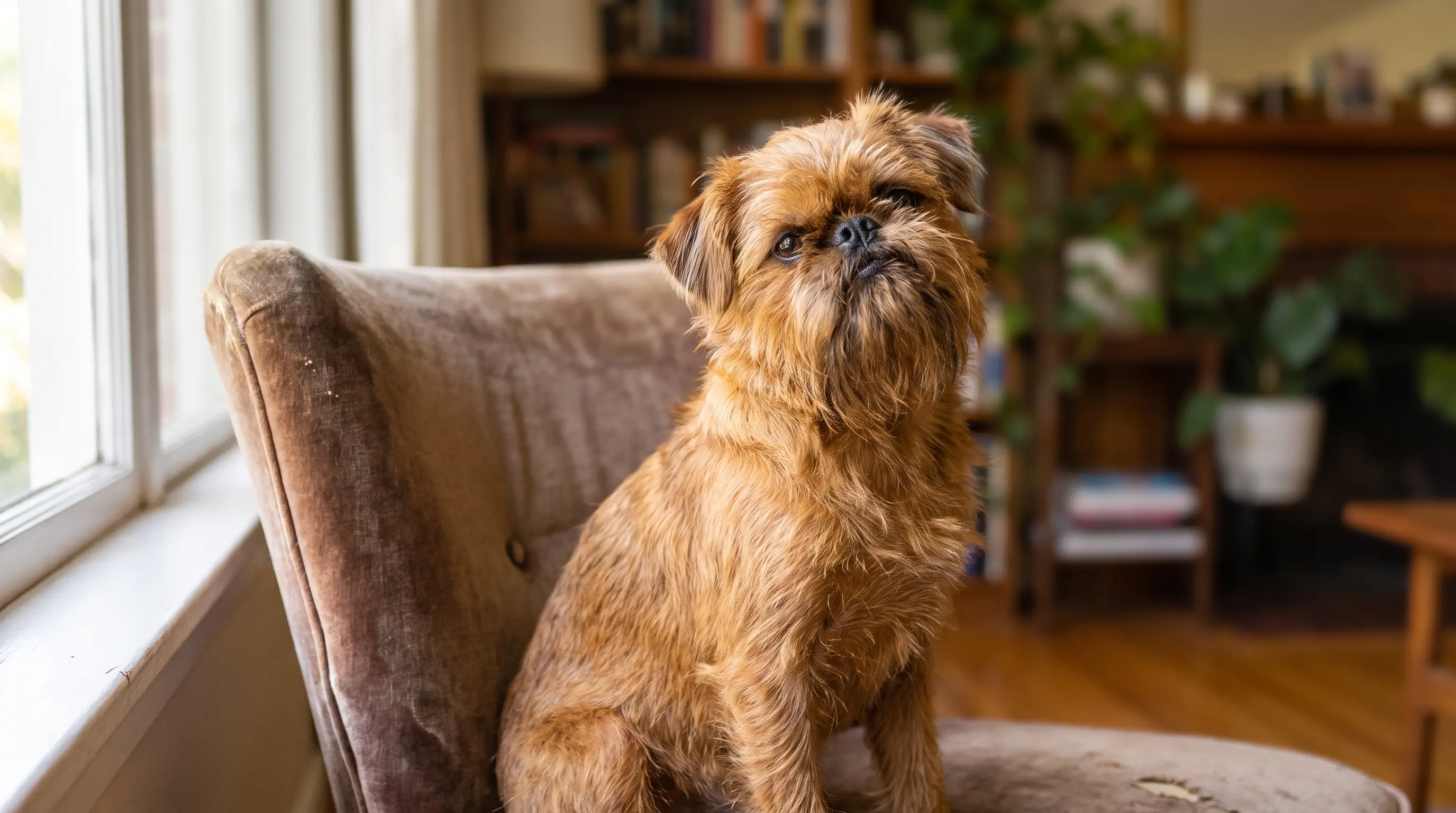
Head tilted, brows knitted: a face that seems permanently mid-opinion.
Perch seeking
The back of the sofa, your shoulder, anywhere with a view of you.
Selective courage
Four kilos of dog, entirely prepared to referee dogs ten times its size.
Health
The Brussels Griffon is a small dog with a short, pushed-in face, and both facts shape its care. The flat face copes badly with heat, so keep summer walks to the cool of the day and never leave it in a warm car or room. Those large, forward-set eyes sit close to the ground and to every bush and table leg — check them regularly for redness or scratches, and see a vet promptly if one starts to water or squint. Beyond that, keep him lean; a little extra weight is a lot on a four-kilo dog, and a slim Griffon breathes and moves more easily. Buy from a breeder who breeds for an open nostril and a face that can breathe, not the most extreme muzzle in the litter.
Nutrition
| Grooming | Rough coats need hand-stripping a few times a year; smooth coats just a weekly brush. |
| Health | The short face means care in heat, and those large eyes are easily scratched — check them regularly. |
| Training | Bright but sensitive: keep sessions short, positive and free of harsh corrections. |
| Exercise | Two short walks and some living-room play cover it — the real need is your company. |
Feed a Brussels Griffon by the dog in front of you, not by the big number on the bag — this is a 3.5–6 kg dog, and the difference between trim and tubby is a spoonful, not a bowlful. Weigh the day's food, count the training treats and table scraps into that total, and aim for a dog you can feel the ribs on under the coat. Small breeds do the begging Olympics from the sofa; the loving answer is a measured meal, because extra weight on this little frame taxes the joints and the short airway both.
Puppy guide
A Griffon puppy is small, sensitive and quick to attach, and the first months set the adult. Socialise widely and gently — people, sounds, other dogs, car rides, the vet — so a naturally watchful dog grows up confident rather than suspicious. Keep handling soft; this is a fragile, easily hurt puppy that does best with calm older children rather than toddlers. Teach it early that being briefly alone is normal, because a Griffon that never learns to settle by itself becomes an adult that panics at a closed door. Train with short, upbeat sessions and food, never with corrections that would bruise such a soft ego.
Training
The Brussels Griffon is bright and reads you closely, which makes it easy to teach and easy to dishearten in the same breath. Keep sessions short, warm and reward-based, and drop harsh corrections entirely — this is a dog that shuts down under pressure and blooms under praise. Two habits are worth building young: a 'quiet' cue, because a Griffon likes to comment on every noise in the hallway, and calm time alone, because the breed's velcro devotion turns into separation distress without it. Work the mind as much as the legs; a clever toy dog with nothing to do invents its own entertainment.
Life expectancy
Brussels Griffons live 12–15 years. The Brussels Griffon is a fairly long-lived little dog, and you hold it at the top of that range with the unglamorous things — a lean weight, genuine care in hot weather for a short-faced breed, those prominent eyes checked and protected, and, at the very start, a breeder who bred for a dog that can breathe.
Similar breeds
Breeds with a similar build and background — worth a look if this one isn't quite the fit.
Breeds that look like this
Common questions
Are Brussels Griffons good apartment dogs?
Excellent — they're small, moderately exercised and glued to their people. They can be vocal about hallway noises, so teach quiet early.
Can Brussels Griffons be left alone?
Not for long, and not happily. This is a velcro breed that does best with owners who are home most of the day or can take the dog along.
Are Brussels Griffons good with children?
Better with gentle older children than toddlers — they're small, easily injured and dislike rough handling. Supervise and teach respect on both sides.
Does the Brussels Griffon shed a lot?
Moderately. The Brussels Griffon sheds a fair amount, steadily through the year with heavier seasonal patches. A weekly brush keeps most of the loose hair off your floors and clothes.
Is the Brussels Griffon hypoallergenic?
Not really. No dog is truly hypoallergenic, and the Brussels Griffon's shedding coat releases plenty of the dander that sets off allergies. If someone at home is allergic, this isn't the easiest breed to live with — spend time around one first.
Is the Brussels Griffon easy to train?
Reasonably. The Brussels Griffon is trainable with consistency and rewards, though it isn't the quickest study. Keep sessions short and positive, and be patient with the basics like recall.