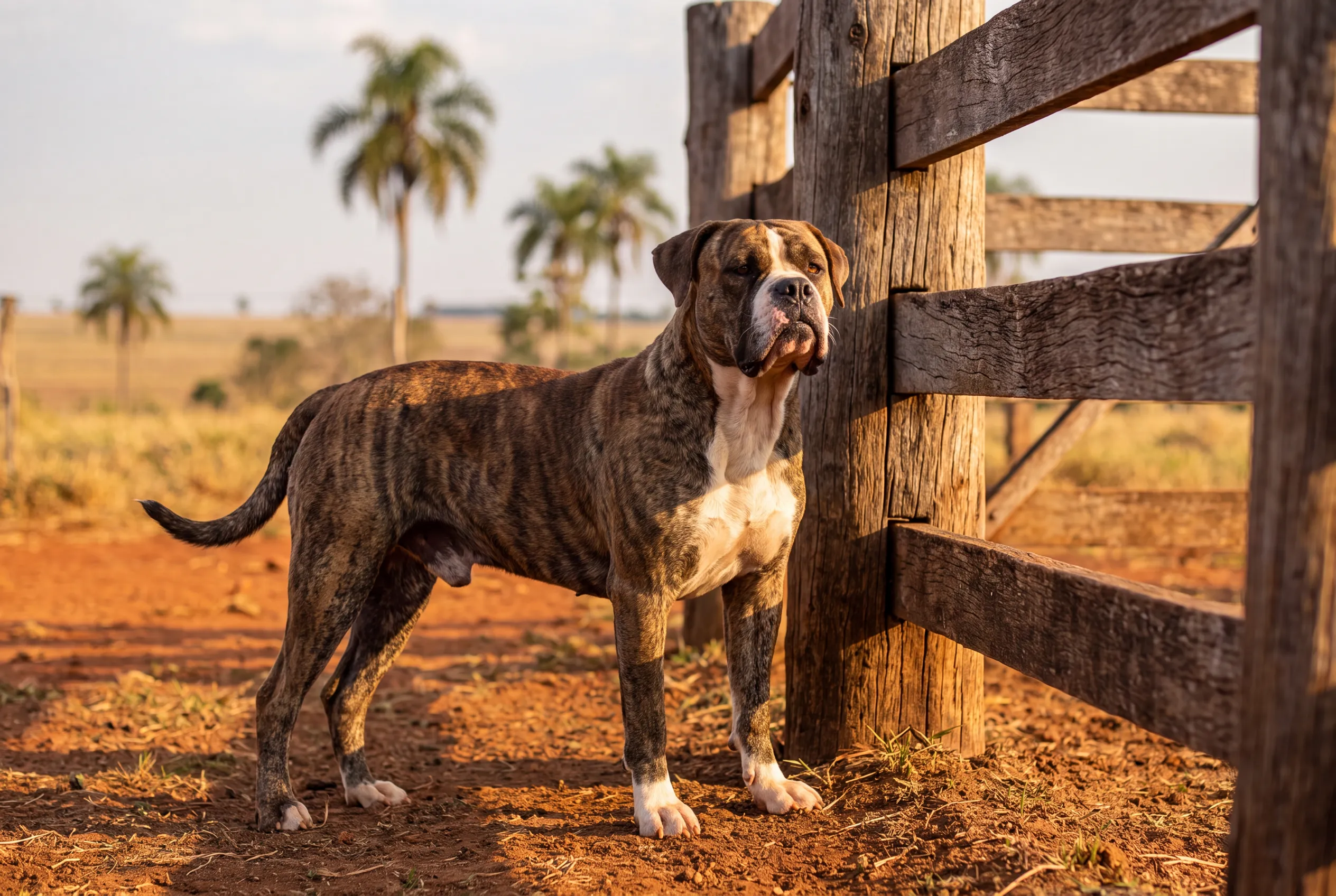
Buldogue Campeiro
Brazil's cattle bulldog: bred for grip, never for colour.
Vital stats
| Size | Medium · 51–58 cm (males) · 49–56 cm (females) |
| Weight | 35–45 kg (males) · 30–40 kg (females) — breed sources; the standard sets no figure |
| Life expectancy | 10–12 years — breed-source estimate, no published data |
| Energy | Moderate — long walks, no interest in sprinting |
| Shedding | Low — short smooth coat, no undercoat to blow |
| Coat | Short, smooth, medium texture · every colour except merle |
| Group | Working · Mastiff (FCI №374, Group 2) |
| Origin | Southern Brazil (Rio Grande do Sul and Santa Catarina) |
| FCI group | 2 — Pinscher and Schnauzer, Molossoid and Swiss Mountain Dogs · FCI 374 |
Breed traits
Friendliness
Care
Mind
The Buldogue Campeiro by the numbers
The Buldogue Campeiro facts owners search for most — price, lifespan, weight, shedding and colours, in one place.
Less common, so expect a waitlist and some travel to a reputable breeder — which pushes the price up. Ongoing costs run high — more food, bigger doses at the vet, and pricier insurance.
We don't quote a single figure: the real price swings with breeder, region, bloodline and health testing — and a rescue costs a fraction of a breeder's litter. Adopting is almost always the cheapest route.
Temperament
The standard asks for vigilant, calm and persevering, adds very docile and easily adaptable, and then writes in something you rarely find in a molosser standard: barks little. Owners describe roughly that. A Campeiro spends the day near whoever it belongs to, registers everything and comments on almost none of it, so people underestimate how much it has clocked. Visitors get watched rather than greeted, and the dog waits for its person to settle the question. Aggressive and overly shy dogs are both disqualified, and the standard's own history section presses the point that the temperament has to be firm and controlled, which is how a dog this heavy stayed usable around livestock and around children. What is not settled is other dogs. Brazilian breed sources and the English-language literature both report thin tolerance of strange dogs, especially between males, and none of it has been measured. Socialise early and widely, manage honestly on lead, and treat a relaxed adult as something you built rather than something you were handed.
Habits & quirks
Watches and says nothing
Barks little sits in the standard as a required trait, which is unusual for a guarding breed. A Campeiro picks the spot where it can see you and the gate at the same time, lies down in it, and leaves the announcing to somebody else.
Travels at a walk
Half its height is leg, and the standard asks for free movement with good ground coverage and the head carried low. It will keep that going for hours over open ground and has nothing at all above that speed.
Attaches to the person doing the work
Fidelity is the first thing the standard names. Day to day it means a dog that moves from room to room and yard to yard behind one person, without needing to be given a part in whatever is happening.
Slow to start, slow to stop
Persevering is the standard's word for it. Getting a Campeiro off something it has already decided to do takes a while, which was the point in a stockdog and is a nuisance in a kitchen.
Health
There is no published health data for the Buldogue Campeiro, so with this breed you buy on evidence rather than reputation. Two things sit at the top of the list. First, breathing: the muzzle is broad but short, the FCI standard treats respiratory distress as a disqualifying fault, and heat is a genuine risk — watch how both parents breathe after exercise, not just at rest, and take shade, water and early-morning outings seriously in summer. Second, the gene pool: everything alive today descends from a small group of dogs gathered in the late 1970s, so ask a breeder about hip and elbow scores, inbreeding and pedigree depth. Keep the dog lean, because a heavy bulldog of any nationality pays for it in the joints.
Nutrition
| Exercise | About an hour a day of walking on varied ground, plus something to occupy its head. It has stamina at a walk and none at speed, so long slow outings beat short fast ones, and in summer they belong to the early morning. Keep it lean. A heavy bulldog of any nationality pays for it in joints. |
| Grooming | The easy part of the dog. Short smooth coat, a rubber mitt once a week, low shedding, and skin the standard requires to be tight to the body, so there is no wrinkle to keep clean. Wipe out the dewlap and the lip folds after meals, stay on top of the nails, and keep an eye on nose pigment as the dog ages. |
| Training | Docile and adaptable is what the standard promises and most owners get it, but start early regardless. Loose-lead walking, a settle and a recall matter more here than anything clever, because this is a strong dog built to grip. Short reward-based sessions. Socialise hard with other dogs from eight weeks and keep going right through adolescence. |
| Health | There is no published health data for this breed, so buy on evidence rather than reputation. Ask for hip and elbow scores, watch how both parents breathe after exercise rather than at rest, and take heat seriously: the muzzle is broad but short, and the standard makes respiratory distress a disqualifying fault because it is a real risk to screen for. Everything alive today descends from a small group of dogs collected in the late 1970s, so inbreeding coefficients and pedigree depth are fair questions to put to a breeder. |
Feed the Buldogue Campeiro to keep it lean, full stop — this is a 35–45 kg working molosser, and every extra kilo lands on the joints and the short airway of a dog that already needs watching in the heat. Weigh the meals, count treats into the day's total, and aim for a dog you can feel the ribs on. Match the amount to the actual work: it has real stamina at a walk and none at speed, so a day of long slow outings earns more than a day on the sofa. Wipe the dewlap and lip folds after meals, and keep the bowl honest as the dog ages and slows down.
Puppy guide
A Buldogue Campeiro puppy grows into a large, strong dog built to grip, so the early work is about a solid, sociable temperament, not tricks. The standard promises docile and adaptable and most owners get it, but start young anyway: loose-lead walking, a settle and a reliable recall matter more than anything clever. Socialise hard from eight weeks — especially with other dogs, since breed sources report thin tolerance of strange dogs, most of all between males — and keep it going right through adolescence. Grow the body gently while the joints are forming, keep sessions short and reward-based, and mind the heat on a short-faced puppy.
Training
The Buldogue Campeiro is docile, adaptable and slow to change its mind — persevering is the word the standard uses, and it cuts both ways. Getting a Campeiro off something it has decided to do takes patience, so teach the calm, useful things first: loose-lead walking, a rock-solid settle and a recall you can trust. This is a strong dog, so manners matter more than obedience-ring polish. Keep sessions short and reward-based, and put real hours into dog-to-dog socialisation from puppyhood on, because that is the part breed sources flag and the part you build rather than inherit.
Life expectancy
Buldogue Campeiros live 10–12 years — breed-source estimate, no published data. The Buldogue Campeiro's life expectancy comes from breed sources with no published data behind it, so treat the number as a starting point rather than a promise. You give the dog its best shot the same way you keep it comfortable day to day: a lean weight off the joints, real respect for heat and breathing in a short-faced dog, and, at the outset, a breeder who health-tests a gene pool rebuilt from very few dogs.
Similar breeds
Breeds with a similar build and background — worth a look if this one isn't quite the fit.
Breeds that look like this
Common questions
How is it different from an English Bulldog?
They share ancestry and very little build. The Campeiro comes from the older working bulldog Europeans took to Brazil, and the standard holds that shape: 51–58 cm at the withers, ground to elbow at half the height, skin tight to the body without wrinkling, a naturally short tail, and free movement with good ground coverage. The muzzle is still short, a quarter to a third of the head's length, so this is a short-faced dog and nobody should sell it to you as though it were not. What the standard does is put a floor under it. A head-to-muzzle ratio outside 1:4 to 1:3 disqualifies, so does respiratory distress, and slightly open nostrils is a severe fault. Those are rules about the airway. They are not evidence about outcomes, and nobody has measured this breed's breathing at population scale. Expect a dog that walks a great deal further than an English Bulldog and still wants shade and an early start in summer.
Who is this dog actually for?
Someone with land, stock or a proper yard, who has kept a large guarding dog before and will put the first two years into socialisation. The rest is the honest version. It weighs 35–45 kg, it was built to hold cattle by the head, breed sources report it is poor with strange dogs, and the job it was made for stopped existing fifty years ago. In the house it is quiet, undemonstrative and firmly attached to its people, and experienced owners describe it as straightforward company. People who wanted a family bulldog and ended up with a stockdog do not. If you live in a flat, this is a breed to read about.
Is it recognised, and where do puppies come from?
Brazil got there first: the CBKC recognised the breed in 2001. The FCI followed on 6 August 2025, on a provisional basis, as standard No. 374 in Group 2, which means internationally registrable but not definitively recognised, and that status runs a minimum of ten years. The AKC does not recognise the breed and it is not in the Foundation Stock Service either, so no American puppy comes with an AKC pedigree. Nearly all breeding sits in southern Brazil, mostly Rio Grande do Sul and Santa Catarina, on CBKC registration. Anything offered elsewhere as a Brazilian Bulldog without CBKC papers behind it has no breed record at all.
Does the Buldogue Campeiro shed a lot?
Not much. The Buldogue Campeiro is a low-shedding breed, so loose hair around the home stays minimal. It still needs regular grooming, but you won't be fighting drifts of fur.
Is the Buldogue Campeiro hypoallergenic?
No dog is truly hypoallergenic, but the Buldogue Campeiro comes closer than most: its low-shedding coat releases less of the dander that triggers allergies. Many allergy sufferers manage well with this breed, but spend time around one before committing.
Is the Buldogue Campeiro good with children?
They can be. The Buldogue Campeiro is reasonably sociable and can be good with children in the right home, especially when socialised early. Supervise around young kids and teach dog and child to respect each other.
Is the Buldogue Campeiro easy to train?
Reasonably. The Buldogue Campeiro is trainable with consistency and rewards, though it isn't the quickest study. Keep sessions short and positive, and be patient with the basics like recall.