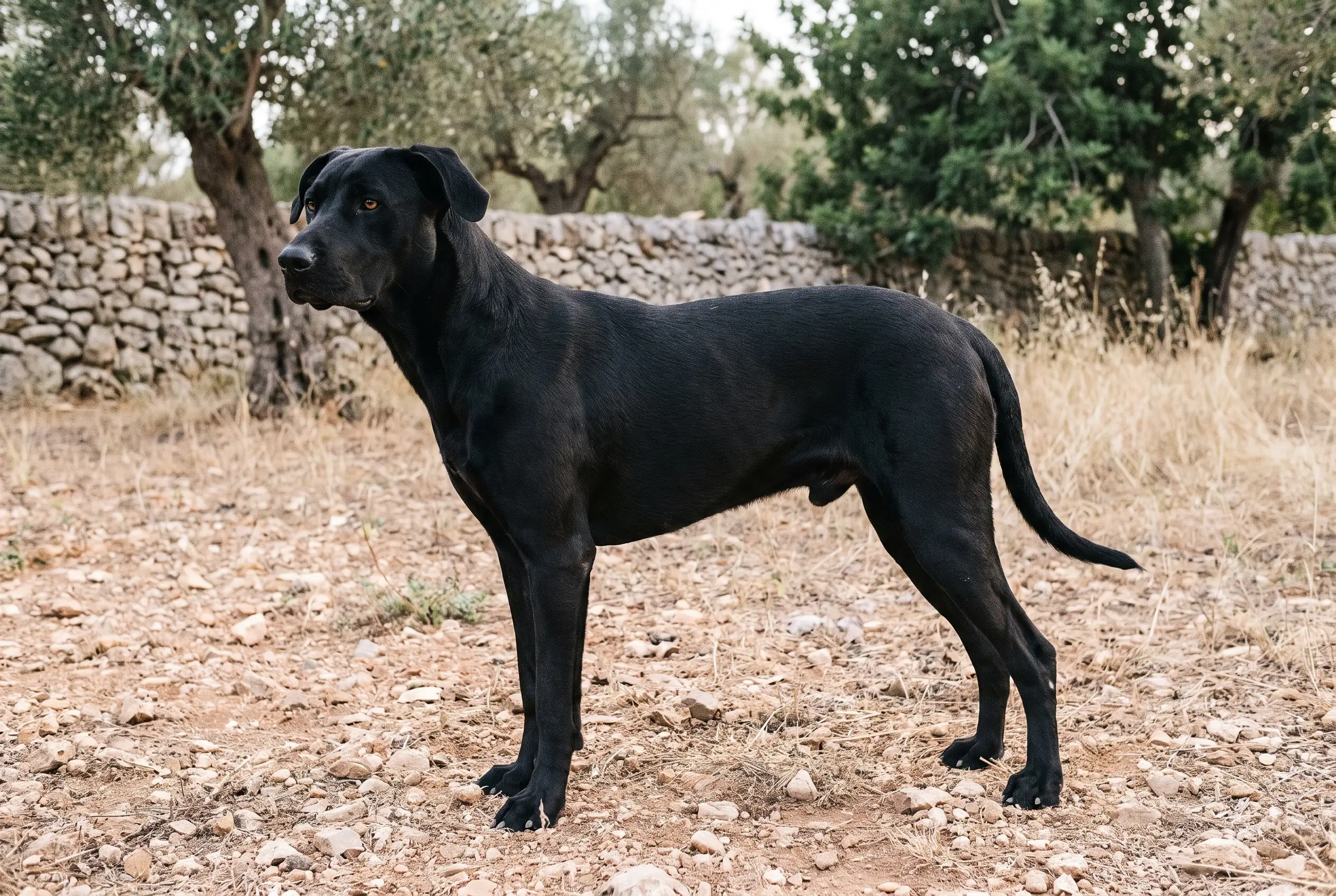
Ca de Bestiar
Mallorca's black farm dog, and the only sheepdog whose standard prefers a gallop.
Vital stats
| Size | Large · 66–73 cm (dogs), 62–68 cm (bitches) |
| Weight | Around 40 kg — the standard's ideal male is 41 kg at 71 cm |
| Life expectancy | 11–13 years — breed literature, not survey data |
| Energy | High — the standard names the gallop as the preferred and working gait |
| Shedding | Moderate · the fine undercoat is thin, so there is no seasonal blowout |
| Coat | Black only, in jet, ordinary and sooty shades · short (1.5–3 cm) or long (over 7 cm, the 'Ca cabrer') |
| Group | Herding · Sheepdogs, without working trial (FCI №321, Group 1) |
| Origin | Mallorca, Balearic Islands, Spain |
| FCI group | 1 — Sheepdogs and Cattledogs · FCI 321 |
Breed traits
Friendliness
Care
Mind
The Ca de Bestiar by the numbers
The Ca de Bestiar facts owners search for most — price, lifespan, weight, shedding and colours, in one place.
Less common, so expect a waitlist and some travel to a reputable breeder — which pushes the price up. Ongoing costs run high — more food, bigger doses at the vet, and pricier insurance.
We don't quote a single figure: the real price swings with breeder, region, bloodline and health testing — and a rescue costs a fraction of a breeder's litter. Adopting is almost always the cheapest route.
Temperament
The 1982 standard describes the character at unusual length and in language no modern standard would use: a dog of great nobility, of one owner only, who accepts the approaches of strangers with difficulty; intelligent, docile, affectionate, extremely timid and reserved in its youth, and sentimental beyond what anyone would suspect; faithful to its master unto death; brave and quarrelsome. Owners describe roughly the same dog forty years on. It attaches to one person and treats the rest of the household as staff. It is quiet with what it knows and immovable about what it does not, and it does not need to be taught to guard — that part arrives on its own somewhere in the second year, whether or not anyone asked for it. Males are territorial with other males and will settle the question physically. The timidity in youth is the part people underestimate: a Ca de Bestiar that meets nothing before six months becomes an adult that suspects everything.
Habits & quirks
Works at a gallop
Almost every herding standard describes the trot and stops there. This one specifies both, then says plainly that the preferred gait and the working gait is the gallop, hind legs set wide and swung outside the front, more or less bounding. On the island that is how the dog covers dry ground between stock.
The ears fold and unfold
The ears are small, high-set and broken, with a crosswise fold about a third of the way up. At rest they lie back against the head. When something happens the dog raises them at that fold and lifts them clear of the muzzle, which is the whole warning you get.
Picks one person
The standard says a dog of one owner, and breeders say the same. It will live politely with a family and work for one member of it. Rehoming an adult is genuinely hard, which is worth knowing before you take one on.
Males take exception to males
Adult males are territorial with each other and settle it with contact rather than posture. Two entire males in one yard is a plan that needs a real answer, not optimism.
Health
No breed health survey exists for the Ca de Bestiar, and no inherited disease is well documented in it — but that says as much about how few dogs there are as about how sound the breed is. Fewer than a thousand are registered a year, and it sits on Spain's list of vulnerable breeds, so pedigree depth and genetic diversity are fair, important questions to put to a breeder, along with hip and elbow scores on both parents. One management point matters more than any diagnosis: this is a big black dog bred for a Mallorcan climate, and it will keep working past the point it should stop. In hot weather, exercise it at the cool ends of the day and give it shade and water — heat is the real everyday risk, not a rare gene.
Nutrition
| Exercise | A big, athletic dog with a real engine, kept for centuries on land where the work happened in the cool hours. Give it two long outings, and in summer take them at either end of the day: the coat is black, Mallorca is hot, and the dog will keep going past the point where it should stop. Space matters more than distance — this is a patrol dog, not a jogging partner. |
| Grooming | The easy part in the short variety: 1.5 to 3 cm of flat hair over a thin, fine undercoat, a brush every week or two, no heavy moult. The long-coated Ca cabrer carries more than 7 cm on the loin with feathering on the tail, ears and the back of the legs, and needs a proper going-over. Neither variety is a stripping or clipping breed. |
| Training | Start early, because the standard's word for the young dog is 'extremely timid'. Puppies need people, traffic, other dogs and other animals before six months, or the adult reads all of it as a threat. It is intelligent and it is not biddable in the retriever sense; it works out what you want and then decides. Build recall and a reliable settle before the guarding switch flips in the second year. |
| Health | No breed health survey exists, and no inherited disease is well documented in it. Treat it as you would any large working dog: hip and elbow scores on the parents, and honest questions about the pedigree, which matters more than usual in a population of a few hundred registrations a year. Life expectancy figures in breed literature cluster at 11–13 years; none of them come from a study. |
The Ca de Bestiar is a big, athletic working dog of around 40 kg, and it does best fed to what it actually does. Weigh the meals, count treats into the day's total, and keep it lean and hard-muscled — a patrol dog carrying extra weight loses the very agility the breed is for, and the joints of a large dog pay for every spare kilo. Feed more on the days it works the land and less on the quiet ones, and keep fresh water in front of it, especially in summer, when a black-coated dog on a hot island needs it more than most.
Puppy guide
With a Ca de Bestiar, the early social work is not optional — the breed standard's own word for the young dog is 'extremely timid,' and a puppy that meets little before six months becomes an adult that suspects everything. Fill those first months with people, traffic, other dogs and other animals, gently and positively, and keep the experiences good. Grow a large-breed puppy carefully, going easy on hard exercise while the joints form. And get the foundations down early — a solid recall and a reliable settle — because the guarding instinct switches on by itself somewhere in the second year, ready or not, and it lands more smoothly on a dog that already listens.
Training
The Ca de Bestiar is intelligent but not biddable in the retriever sense: it works out what you want, then decides whether to agree. Train with that, not against it — reward-based sessions, fairness and patience earn a cooperation that pressure never will. Build a dependable recall and a calm off switch before the second year, when the guarding instinct arrives on its own. Two things need honest management rather than training away: it bonds hard to one person and stays reserved with strangers, and adult males are territorial with other males. Early, thorough socialisation is what keeps the natural wariness from curdling into suspicion of everything.
Life expectancy
Ca de Bestiars live 11–13 years — breed literature, not survey data. The Ca de Bestiar is a hardy large working breed with no documented inherited disease, and you keep it sound the ordinary way: a lean, muscled weight, room and real work for a patrol dog, and genuine care with heat for a black-coated dog on hot days. At the start, choose a breeder who guards the health and diversity of a small population. The life figures in breed literature aren't survey data, so read them as a guide rather than a guarantee.
Similar breeds
Breeds with a similar build and background — worth a look if this one isn't quite the fit.
Breeds that look like this
Common questions
Is the Ca de Bestiar the same as the Ca de Bou?
No, and the two get mixed up constantly because both are black-ish Mallorcan dogs whose names start with Ca. The Ca de Bestiar is the shepherd: FCI 321, Group 1, 66–73 cm, black, built long and agile. The Ca de Bou is the Perro Dogo Mallorquín, FCI 249, a molossoid in Group 2, shorter and much heavier in the head, and it comes in fawn and brindle as well as black. Same island, different jobs, different groups.
Does the long-haired variety still exist?
Barely, if at all. The FCI recognises both varieties and awards them separate CACIBs, and the standard describes the long coat in detail down to the feathering on the tail. In practice the short coat is what people breed and show, and the long-coated Ca cabrer is reported as very rare or gone. If you are told a puppy is one, ask to see the pedigree and the club paperwork.
Is it a good family dog?
For the right household, in the right house. It is affectionate at home and steady with children it grew up with, and it asks for very little grooming. But it bonds to one person, it is reserved to the point of suspicion with strangers, males are difficult with other males, and it will guard your property whether or not that is on your list. It needs land, an early and thorough social education, and someone who wants a guardian rather than a companion who also barks.
Does the Ca de Bestiar shed a lot?
Moderately. The Ca de Bestiar sheds a fair amount, steadily through the year with heavier seasonal patches. A weekly brush keeps most of the loose hair off your floors and clothes.
Is the Ca de Bestiar hypoallergenic?
Not really. No dog is truly hypoallergenic, and the Ca de Bestiar's shedding coat releases plenty of the dander that sets off allergies. If someone at home is allergic, this isn't the easiest breed to live with — spend time around one first.
Is the Ca de Bestiar easy to train?
Reasonably. The Ca de Bestiar is trainable with consistency and rewards, though it isn't the quickest study. Keep sessions short and positive, and be patient with the basics like recall.