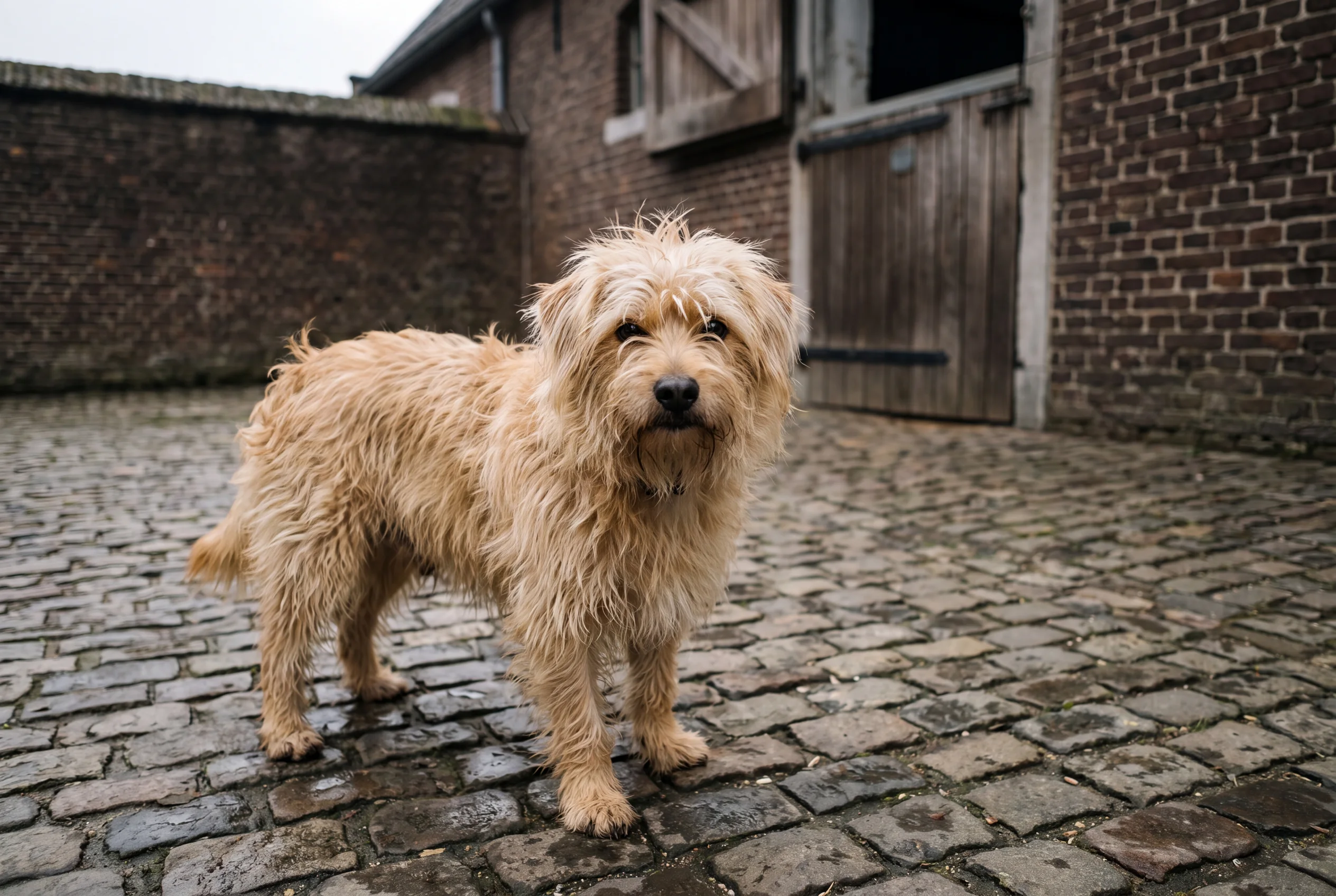
Hollandse Smoushond
The stable dog that died out in 1949 and was found again through the newspapers.
Vital stats
| Size | Small · 37–42 cm (males) · 35–40 cm (females) |
| Weight | 7–11 kg |
| Life expectancy | 13–14 years, often longer |
| Energy | Moderate — a walking dog, not a running one |
| Shedding | Low — the harsh coat is plucked out, not shed |
| Coat | Coarse, wiry, 4–7 cm · straw yellow only, dark straw preferred |
| Group | Terrier · Schnauzer type (FCI №308, Group 2) |
| Origin | Amsterdam, Netherlands |
| FCI group | 2 — Pinscher and Schnauzer, Molossoid and Swiss Mountain Dogs · FCI 308 |
Breed traits
Friendliness
Care
Mind
The Hollandse Smoushond by the numbers
The Hollandse Smoushond facts owners search for most — price, lifespan, weight, shedding and colours, in one place.
Less common, so expect a waitlist and some travel to a reputable breeder — which pushes the price up. Ongoing costs stay modest — it eats little and routine vet care sits at the lower end. Its coat also needs a professional groom every few weeks — a real line in the budget.
We don't quote a single figure: the real price swings with breeder, region, bloodline and health testing — and a rescue costs a fraction of a breeder's litter. Adopting is almost always the cheapest route.
Temperament
The FCI standard asks for a dog that is affectionate, friendly and free-spirited, lively without being nervously over-active, and not easily frightened. That last clause is doing real work: the people rebuilding the breed from 1973 had almost nothing to choose from and still refused to breed on from nervy dogs, and it shows in what the Dutch clubs report now. Most Smoushonden are open with visitors rather than watchful, easy with other dogs, and patient with children who are not rough. They are sensitive to tone, so a raised voice costs more than it buys. What survived intact from the stable is the interest in rats. Hedges, sheds and the gap behind the sofa get checked, and a hamster or a house rabbit needs to live behind a door.
Habits & quirks
Yellow or nothing
The standard admits self-coloured yellow in any shade, with a preference for dark straw, and allows the ears, moustache, beard and eyebrows to run a darker yellow. Any other colour is undesirable. There is no black Smoushond and no brindle one, which makes the breed unusually easy to identify and unusually easy to fake badly.
Built to keep up, then stop
The job was trotting beside a carriage for hours and then working the stable. It gives you a dog with real staying power on a walk that switches off completely indoors, which is why it does well in a flat.
Checks the corners
Rat work was half the contract and the instinct is intact. Give it a hedge, a woodpile or a shed and it will search them properly, which is also the cheapest way to tire it out.
The face is the breed
Beard, moustache and shaggy eyebrows that may fall over the eyes as long as they do not block the sight. The standard calls the garnishing very characteristic, and it is the first thing a judge looks at and the first thing a careless groomer removes.
Health
The Smoushond is, as far as a screening review from Utrecht University could find, a genuinely sound little dog: that review turned up nothing hereditary serious enough to warrant a compulsory test panel, and the Dutch club mandates none. The real question with this breed isn't a disease, it's the gene pool. Everything alive today traces back to a handful of dogs found by newspaper advert in the 1970s, so the number that matters is the inbreeding coefficient of the litter. Ask the Stichting Terugfokprogramma what a planned mating's figure is, because that, not a hip score, is what this breed actually manages.
Nutrition
| Exercise | About an hour a day, spread out, with sniffing and searching rather than distance. It has more stamina than its size suggests but no need to run: long walks, a long line in rough ground and a hunt for hidden food cover it. |
| Grooming | Hand-strip twice a year. The dead outer coat is plucked out by hand while the undercoat stays, and a full session takes a few hours. In between, leave it alone apart from checking the longer hair for mats. Clippers cut the harsh hair instead of removing it, which softens the texture and washes out the colour, and it does not recover on its own. |
| Training | Rewards, short sessions, no pressure. It picks things up quickly and wants to be near you, so most of the work is easy. Recall near rodents is the exception and stays unreliable, so keep a long line where there is wildlife. |
| Health | A screening review by Utrecht University found nothing hereditary needing a compulsory test panel, so the Dutch club mandates none. The live issue is the narrow founder base: ask the Stichting Terugfokprogramma about the inbreeding coefficient of a planned litter, because that is the number this breed actually manages. |
This is a small dog with a moderate appetite to match: a Smoushond is a walker, not an athlete, so it doesn't burn food the way a working gundog does. Feed a good complete food in measured amounts, count the training treats you hand out for rat games and recall into the day's total, and keep a waist you can feel under all that coat. The shaggy outline hides weight well, so go by hands on the ribs rather than by eye.
Puppy guide
A Smoushond puppy comes from a very small breed, so it usually arrives through one Dutch waiting list rather than a local litter, and it comes with the interest in small furry things already switched on. Socialise it early and gently: the breed is sensitive to tone, and a puppy handled roughly turns wary rather than bold. Get it used to visitors, other dogs and everyday noise while it's young, teach a reliable recall before the rat drive fully wakes up, and leave the harsh coat alone beyond a check for mats, since the first proper hand-stripping can wait.
Training
Keep it kind and keep it short. The Smoushond learns quickly and wants to be near you, so most of the everyday manners come easily and a raised voice only sets you back: this is a dog that reads your tone and shuts down under pressure. The one honest exception is recall around wildlife. The stable-ratter instinct is intact, and a hedge or a scurrying rabbit will out-argue you, so keep a long line where there's something to chase.
Life expectancy
Hollandse Smoushonds live 13–14 years, often longer. This is a long-lived little dog, with plenty reaching the far end of that range and beyond. There's no breed-specific disease driving the number down, so what keeps a Smoushond going is ordinary: a lean weight, teeth and ears kept clean, enough daily walking and sniffing to stay fit, and a breeder who watches the inbreeding coefficient so the whole population stays as healthy as the dog in front of you.
Similar breeds
Breeds with a similar build and background — worth a look if this one isn't quite the fit.
Breeds that look like this
Common questions
Can you get one outside the Netherlands?
Rarely, and not quickly. Almost the whole breed lives in the Netherlands, and puppies go through one waiting list run by the Stichting Terugfokprogramma Hollandse Smoushond rather than through independent kennels. The club's own published wait is around three years for a male and four for a female, for people already in the country. Litters abroad happen occasionally, in single figures. If you are outside the Netherlands, treat this as a breed you join a list for and wait years on, or pick something else honestly.
Does the coat need hand-stripping?
Yes, twice a year, and it is not optional if you want the coat the standard describes. The hair is coarse, wiry and 4 to 7 cm long over a soft undercoat; stripping pulls out the dead outer hairs so new harsh ones grow in. Clipping cuts them instead, and the regrowth comes back softer, paler and inclined to mat. You can learn to do it yourself over a couple of sessions, or pay a groomer who strips terrier coats. Between strips the dog needs almost nothing, and baths are rarely worth it.
Is today's Smoushond the same dog as the old one?
Not by descent. The original line ended with the 1949 litter, and the FCI standard says plainly that the 1973 reconstruction started with crossbreeds that looked like the Dutch Smousdog: animals answering newspaper appeals, chosen on appearance and type rather than pedigree. What exists now is a breed rebuilt to a written description of a dog that had gone. It is a real, registered, FCI-recognised breed with a stud book of its own, and it is also a recreation. Both things are true, and the Dutch club has never pretended otherwise.
Does the Hollandse Smoushond shed a lot?
Not much. The Hollandse Smoushond is a low-shedding breed, so loose hair around the home stays minimal. It still needs regular grooming, but you won't be fighting drifts of fur.
Is the Hollandse Smoushond hypoallergenic?
No dog is truly hypoallergenic, but the Hollandse Smoushond comes closer than most: its low-shedding coat releases less of the dander that triggers allergies. Many allergy sufferers manage well with this breed, but spend time around one before committing.
Is the Hollandse Smoushond good with children?
Generally yes. The Hollandse Smoushond is a friendly, people-loving breed that usually does well with children when raised and socialised well. As with any dog, teach children to be gentle and supervise around toddlers.
Is the Hollandse Smoushond easy to train?
Reasonably. The Hollandse Smoushond is trainable with consistency and rewards, though it isn't the quickest study. Keep sessions short and positive, and be patient with the basics like recall.