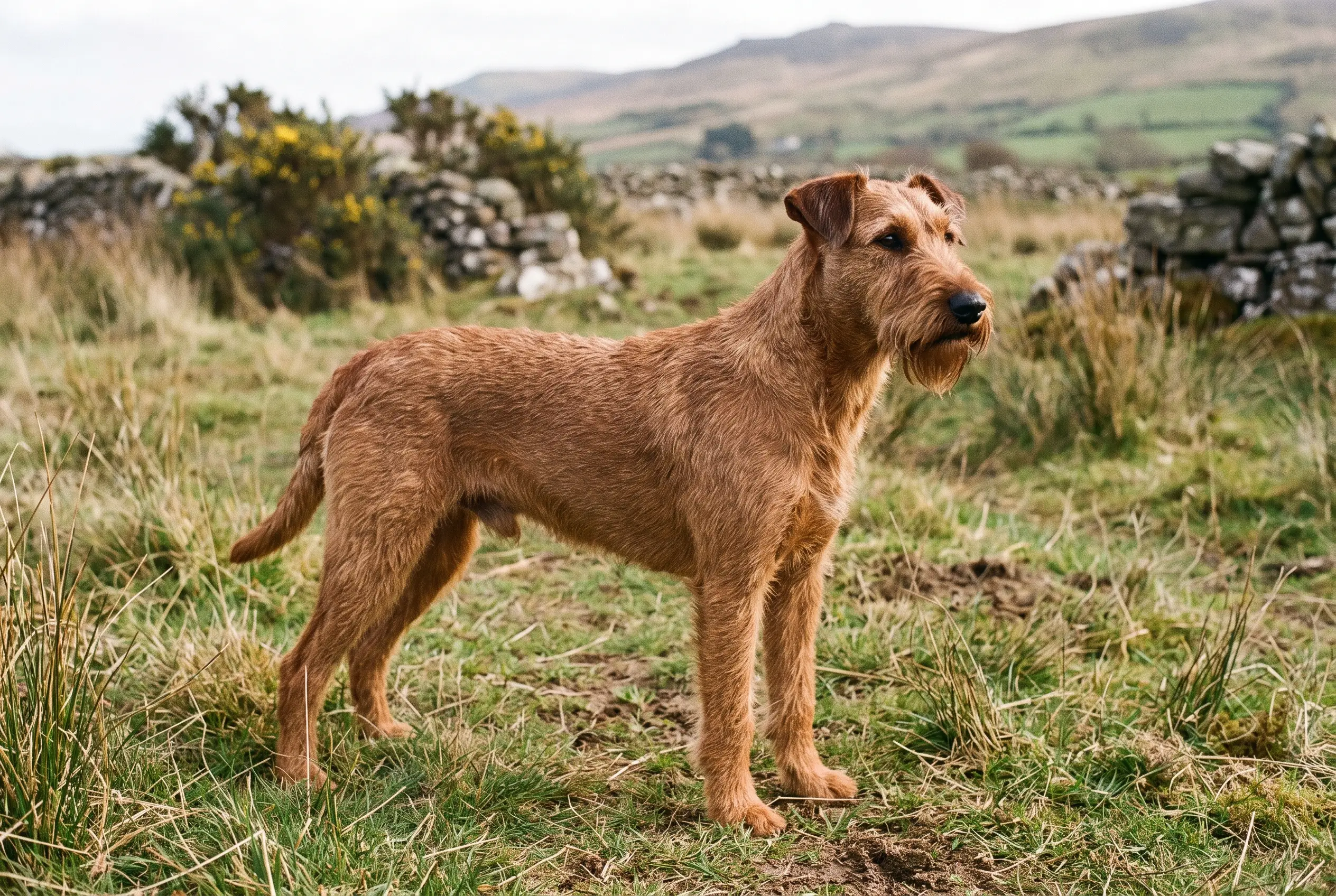
Irish Terrier
The Daredevil — a flame-red heart that never learned the meaning of retreat.
Vital stats
| Size | Medium · 45–48 cm |
| Weight | 11–12 kg |
| Life expectancy | 13–15 years |
| Energy | High — 60 min/day |
| Shedding | Low — wire coat, hand-stripped |
| Coat | Dense wiry coat · solid red to red-wheaten |
| Group | Terrier · FCI №139 / AKC |
| Origin | Ireland |
| FCI group | 3 — Terriers · FCI 139 |
Breed traits
Friendliness
Care
Mind
The Irish Terrier by the numbers
The Irish Terrier facts owners search for most — price, lifespan, weight, shedding and colours, in one place.
Widely bred, so you can usually find a litter from a registered breeder without a long wait. Ongoing costs stay modest — it eats little and routine vet care sits at the lower end.
We don't quote a single figure: the real price swings with breeder, region, bloodline and health testing — and a rescue costs a fraction of a breeder's litter. Adopting is almost always the cheapest route.
Temperament
Bred as an Irish farm all-rounder — ratter, watchdog, hunting companion — the Irish Terrier earned its 'Daredevil' nickname honestly: it simply does not do fear. With its family it is warm, loyal and surprisingly soft; with vermin, uninvited dogs, and physical danger it maintains a policy of magnificent, unbudging defiance.
Habits & quirks
The sentry stance
Chin up, tail up, surveying the territory — every garden becomes a post to be held.
Selective hearing
Recall works beautifully until something furry runs; terrier priorities are ancient and firm.
The velcro rebel
Fiercely independent outdoors, then glued to your side on the sofa all evening.
Grudge management
Rarely starts trouble with other dogs — but never, ever backs down from it.
Care
| Exercise | An hour of brisk walking and vigorous play daily; a bored Daredevil freelances. |
| Grooming | Hand-strip the wire coat two or three times a year to keep its colour and texture; minimal shedding between. |
| Training | Confident and clever but independent — keep sessions short, fair and interesting. |
| Socialising | Meet plenty of polite dogs young; same-sex scrappiness is the breed's classic flaw. |
Life expectancy
This breed has a typical life expectancy of 13–15 years.
Similar breeds
Breeds with a similar build and background — worth a look if this one isn't quite the fit.
Breeds that look like this
Common questions
Do Irish Terriers shed?
Very little — the wiry coat holds dead hair until it's stripped out. Hand-stripping a few times a year keeps it tidy and vivid red.
Are Irish Terriers good with other dogs?
With family dogs they're usually fine; with strange, same-sex dogs they can be fiery. Early and ongoing socialising matters more than with most breeds.
Are Irish Terriers healthy?
One of the healthier pure breeds — hardy, long-lived, and with few widespread hereditary problems. Buy from health-tested lines all the same.
Is the Irish Terrier hypoallergenic?
No dog is truly hypoallergenic, but the Irish Terrier comes closer than most: its low-shedding coat releases less of the dander that triggers allergies. Many allergy sufferers manage well with this breed, but spend time around one before committing.
Is the Irish Terrier good with children?
They can be. The Irish Terrier is reasonably sociable and can be good with children in the right home, especially when socialised early. Supervise around young kids and teach dog and child to respect each other.
Is the Irish Terrier easy to train?
Reasonably. The Irish Terrier is trainable with consistency and rewards, though it isn't the quickest study. Keep sessions short and positive, and be patient with the basics like recall.