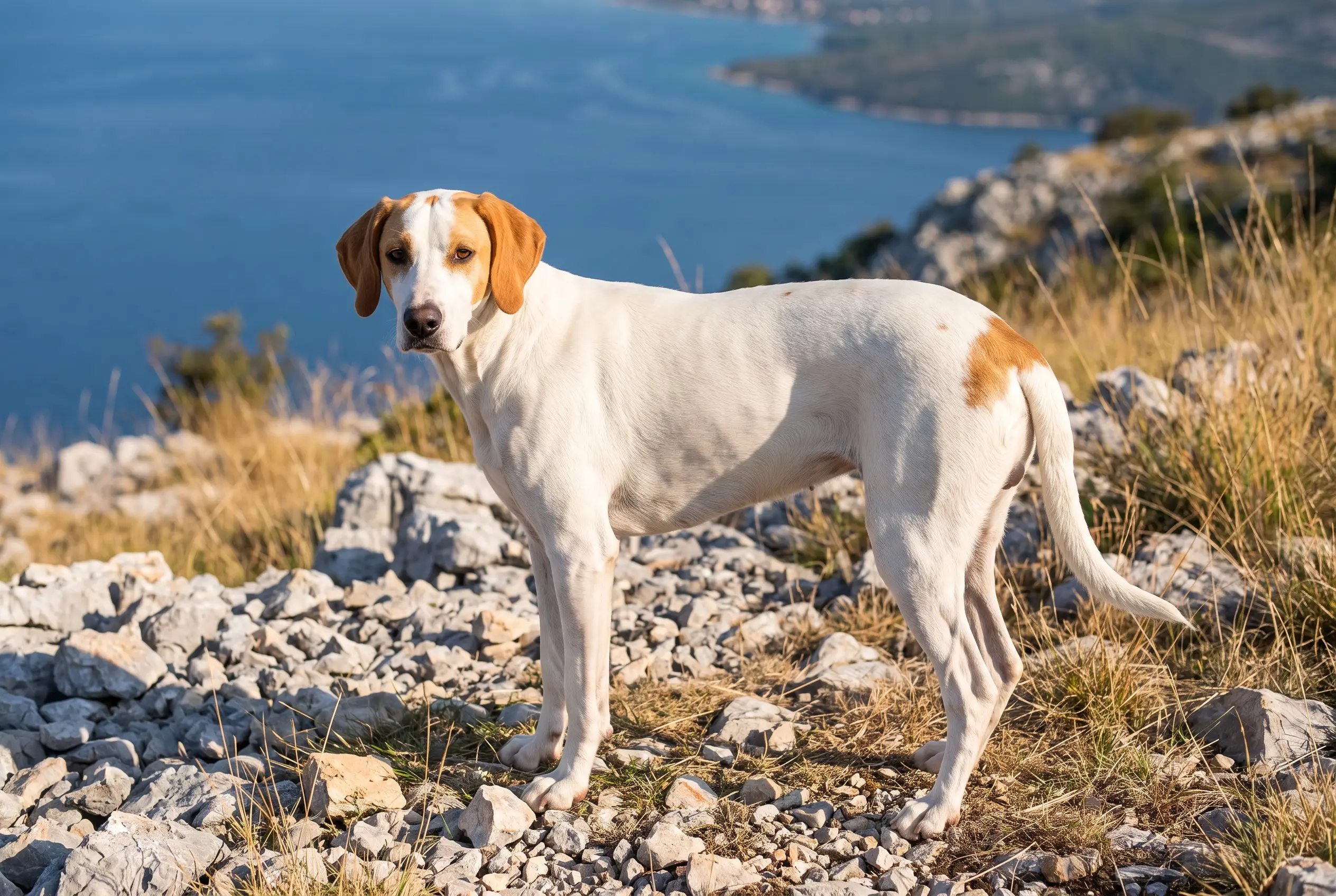
Istarski Kratkodlaki Gonič
Snow-white with orange spots, built to hunt Istria's Karst on stamina and a strong, melodic voice.
Vital stats
| Size | Medium · 49–53 cm (males), 47–51 cm (females) |
| Weight | 16–20 kg — breed literature; the standard sets none |
| Life expectancy | 12–13 years — breed literature, not survey data |
| Energy | High — built for hours of stamina hunting over rough ground |
| Shedding | Low to moderate — short, dense coat, brushed weekly |
| Coat | Short, hard, dense · 1–2 cm · never longer than 2.5 cm |
| Group | Hound · Medium-sized Hounds (FCI №151, Group 6) |
| Origin | Istria, Croatia |
| FCI group | 6 — Scent hounds and related breeds · FCI 151 |
Breed traits
Friendliness
Care
Mind
The Istarski Kratkodlaki Gonič by the numbers
The Istarski Kratkodlaki Gonič facts owners search for most — price, lifespan, weight, shedding and colours, in one place.
Less common, so expect a waitlist and some travel to a reputable breeder — which pushes the price up. Plan for steady ongoing costs — mid-range food, routine vet care and insurance.
We don't quote a single figure: the real price swings with breeder, region, bloodline and health testing — and a rescue costs a fraction of a breeder's litter. Adopting is almost always the cheapest route.
Temperament
The standard's own words: “Of lively temperament, gentle, docile, obedient, neither nervous nor aggressive. Devoted to his owner. Wary of strangers.” It adds that the breed is easy to train for hunting and very popular with huntsmen for its hunting ability, with a voice described as strong and melodic — the dog is meant to be followed by ear as much as by sight. It's particularly suited to rough, stony Karst terrain, though the standard notes it adapts to other hunting grounds too. That wariness toward strangers is written into the standard, not incidental; expect a dog that is soft and attached at home and reserved, not hostile, with people it doesn't know.
Habits & quirks
A voice bred to be heard
The standard calls its voice strong and melodic. Trailing hare, fox or boar across the Istrian Karst, the dog gives tongue continuously, so a hunter out of sight over the rocks still knows exactly where the chase has gone.
Orange, capped at a third
Orange markings can't cover more than one third of the body, and the standard wants them as clean spots, clearly separated and even in shade, not smudged or paler at the edges. A dog with too much orange, or with patches that blend into each other, is faulted.
Grey ghosts under the white
Its skin often carries greyish-black, sometimes brownish mottling that shows faintly through the white coat. The standard names this directly and permits it, rather than treating the shadowing as something to breed away from.
A sabre tail, never a ring
At rest the tail runs as a straight continuation of the croup down to the hock. It may lift when the dog gets excited, but a tail curled into a ring or carried above the back disqualifies outright.
Care
| Exercise | This is a stamina hound built to run rough ground for hours, not a dog content with a lead walk around the block. Give it long off-lead time on safe, enclosed land, scent work, or real hunting; a strong nose left with nothing to do tends to go looking for a trail on its own. |
| Grooming | The coat is short, hard and dense, 1–2 cm long, and a weekly brush with a hound mitt or bristle brush keeps it in order. Bathing is rarely needed. Check the wide-open, pigmented nostrils and skin regularly instead. |
| Training | The standard itself says the breed is easy to train for hunting, and instinct-led work is where it's most willing. General obedience takes more patience: like most scent hounds, its nose can override a recall, so start that training early and keep sessions short and reward-based. Since the standard flags it as wary of strangers by nature, early exposure to visitors and new places matters just as much. |
| Health | The standard's only health clause is a requirement that breeding dogs be functionally and clinically healthy; there's no breed-wide survey behind the 12–13 years usually quoted in breed literature. The population outside Croatia and its neighbours is small, so ask breeders about hip soundness and pedigree depth, as you would for any working scent hound with a limited gene pool. |
Life expectancy
This breed has a typical life expectancy of 12–13 years — breed literature, not survey data.
Similar breeds
Breeds with a similar build and background — worth a look if this one isn't quite the fit.
Breeds that look like this
Common questions
Is the Istarski Kratkodlaki Gonič just the wire-haired Istrian hound with short fur?
No. They are two separate FCI breeds with two separate standards, not coat varieties of one dog. The Istarski Kratkodlaki Gonič (short-haired, FCI No. 151) and the Istarski Oštrodlaki Gonič (wire-haired, FCI No. 152) both descend from the same white-and-orange East Adriatic hound stock, and the FCI standardised them four days apart in 1955: the short-haired on 2 April, the wire-haired on 6 April. Each has its own coat rules (short and hard, 1–2 cm, on No. 151; longer and coarse, with a moustache and beard, on No. 152) and its own registration. A dog is bred and shown as one or the other, never as an interchangeable coat type.
Are Istarski Kratkodlaki Gonič good family dogs?
At home, yes, within limits. The standard calls it gentle, docile and devoted to its owner. But it's still first a working hunting hound in Croatia, wary of strangers by standard, and built for hours of stamina work. A bored, under-exercised one tends to find its own outlet, usually a scent trail leading off the property. Early socialisation and a real daily exercise budget matter more here than with a breed developed mainly as a companion.
Is the Istrian Shorthaired Hound recognised outside Croatia?
It carries FCI standard No. 151, so it's recognised anywhere FCI member clubs operate, but it stays rare outside Croatia and its Balkan neighbours, where it's still kept mainly for hunting rather than as a pet. The AKC does not recognise it, and outside its home region, finding a breeder, or even seeing one in person, is genuinely hard.
Does the Istarski Kratkodlaki Gonič shed a lot?
Moderately. The Istarski Kratkodlaki Gonič sheds a fair amount, steadily through the year with heavier seasonal patches. A weekly brush keeps most of the loose hair off your floors and clothes.
Is the Istarski Kratkodlaki Gonič hypoallergenic?
Not really. No dog is truly hypoallergenic, and the Istarski Kratkodlaki Gonič's shedding coat releases plenty of the dander that sets off allergies. If someone at home is allergic, this isn't the easiest breed to live with — spend time around one first.
Is the Istarski Kratkodlaki Gonič easy to train?
Reasonably. The Istarski Kratkodlaki Gonič is trainable with consistency and rewards, though it isn't the quickest study. Keep sessions short and positive, and be patient with the basics like recall.