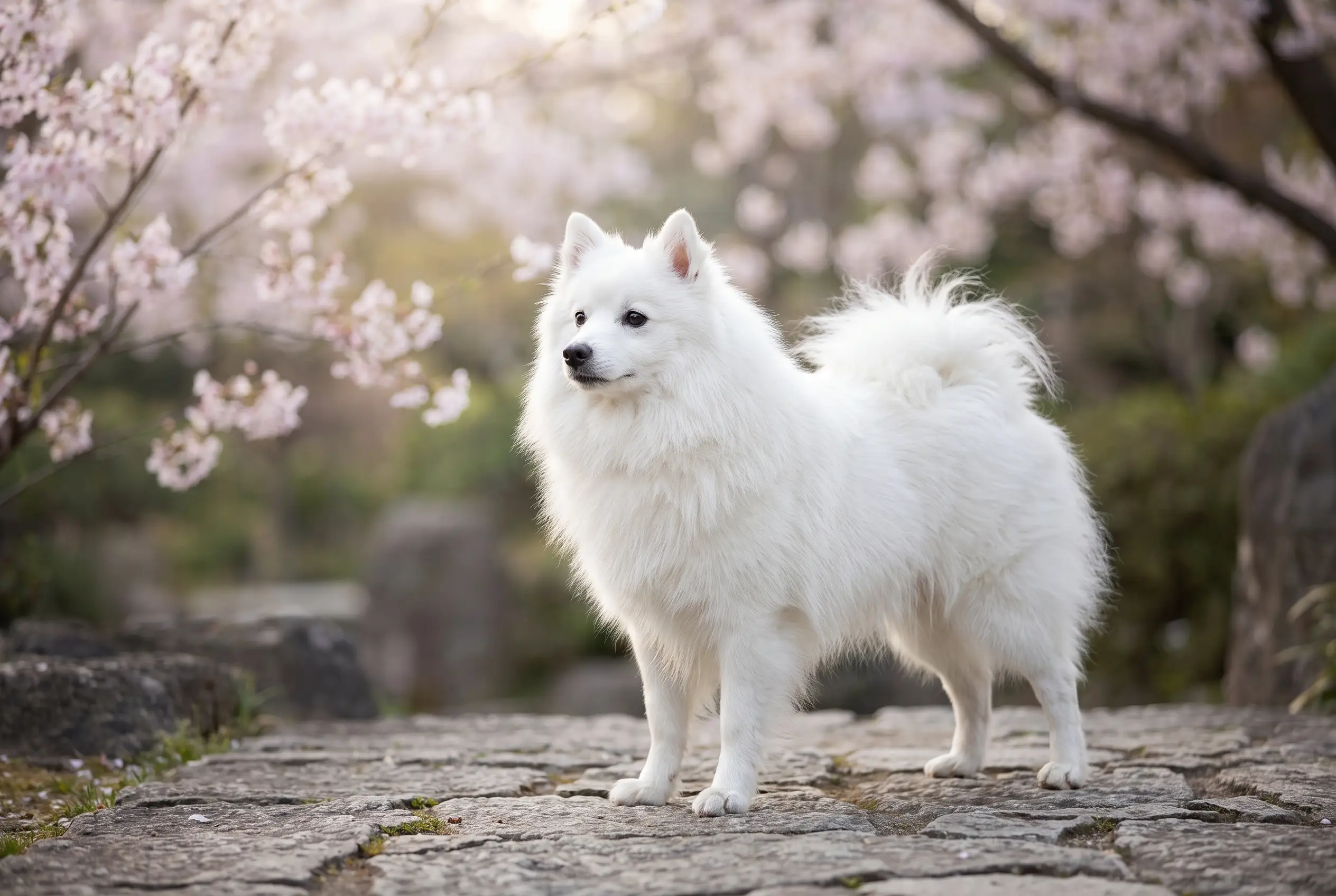
Japanese Spitz
Tokyo's pure-white companion spitz, with 'noisy not permitted' written into its standard.
Vital stats
| Size | Small · 30–38 cm (dogs); bitches 'slightly smaller' — the standard gives no female range |
| Weight | 5–11 kg — breed literature; the standard sets none |
| Life expectancy | 10–14 years — breed literature, not survey data |
| Energy | Moderate — 30–60 minutes a day, plus play |
| Shedding | Heavy in two seasonal blows, lighter in between |
| Coat | Profuse stand-off double coat with a frill · pure white, the only colour allowed |
| Group | Non-Sporting · Asian Spitz (FCI №262, Group 5) |
| Origin | Japan |
| FCI group | 5 — Spitz and primitive types · FCI 262 |
Breed traits
Friendliness
Care
Mind
The Japanese Spitz by the numbers
The Japanese Spitz facts owners search for most — price, lifespan, weight, shedding and colours, in one place.
Widely bred, so you can usually find a litter from a registered breeder without a long wait. Ongoing costs stay modest — it eats little and routine vet care sits at the lower end.
We don't quote a single figure: the real price swings with breeder, region, bloodline and health testing — and a rescue costs a fraction of a breeder's litter. Adopting is almost always the cheapest route.
Temperament
The standard's whole temperament clause is eight words: 'Intelligent, cheerful, keen in sense. Noisy not permitted.' That last part is the surprise — a small spitz bred against yapping, with noisiness and shyness both listed among the faults. In the home that reads as a bright, affectionate dog that wants to be where its people are, learns quickly, and takes well to children, other dogs and even cats when socialised early. It still watches the door: breed literature describes a dog that announces strangers and then warms up, and how short the announcement stays depends on training and on how much of its day you fill. Left bored, it finds its voice like any spitz.
Habits & quirks
One colour, two words
The standard's colour section reads, in full: 'Pure white.' No cream, no biscuit shading, no markings. Against that white, the standard asks for black — nose, lips, eye rims, and desirably the pads and nails too.
The quiet spitz
'Noisy not permitted' sits in the temperament clause, and noisiness appears again under faults. Breeders have selected against the yap for decades; a well-bred, well-occupied one alerts and then stops.
Dirt doesn't stick
Owners' standing claim, and grooming guides back it: let mud dry and it brushes out of the stand-off coat. The face, ears, fronts of the forearms and lower hind legs are short-haired by standard, which keeps the messiest parts easy.
Tail on the back, ears up
The outline is non-negotiable: a tail not carried on the back is a disqualifying fault, and so are drop ears. Even a strongly curled tail is faulted — the feathering should lie over the back, not corkscrew.
Care
| Exercise | 30–60 minutes a day plus play covers it. The standard files this as a companion dog, quick and active on the move — walks, garden games and trick training suit it better than a working breed's mileage. |
| Grooming | A thorough weekly brush, switching to daily for a few weeks during the two seasonal blows, when the undercoat leaves in handfuls. Bathe rarely and never clip: the stand-off coat releases dry dirt on its own and insulates against heat as well as cold. |
| Training | Quick to learn and keen to work with its people. Teach quiet early all the same — an under-occupied one appoints itself doorbell — and socialise young so watchfulness with strangers stays polite. Shyness is a fault in this breed, not a temperament. |
| Health | A generally sound small breed with no breed-wide health survey. Patellar luxation is the joint to ask breeders about; runny eyes with tear staining are common enough to be a breed talking point, and a small jaw makes dental care matter. |
Life expectancy
This breed has a typical life expectancy of 10–14 years — breed literature, not survey data.
Similar breeds
Breeds with a similar build and background — worth a look if this one isn't quite the fit.
Breeds that look like this
Common questions
Is a Japanese Spitz a small Samoyed?
No — and not a big Pomeranian or a renamed American Eskimo Dog either, though all four wear white-spitz looks. The standard's own history traces this breed to large white German Spitz brought to Japan around 1920, bred on with white spitz imported from Canada, the US, Australia and China; Japan unified the type in 1948 and the FCI recognised it in 1964. Size settles most doubts: at 30–38 cm it stands well below a Samoyed and well above a Pomeranian.
Are they yappy like other small spitz?
The standard is unusually blunt about this: 'Noisy not permitted', with noisiness listed again among the faults. Breeders select against the yap, and a well-bred, well-occupied Japanese Spitz announces a visitor and stops. It is still a watchful little dog — bored and undertrained, it will find its voice.
How hard is it to keep the coat white?
Easier than it looks. The stand-off coat lets dried dirt brush out, so routine care is one thorough weekly session rather than constant bathing — frequent baths actually work against the coat. The real bill arrives twice a year, when the undercoat blows and daily brushing takes over for a few weeks.
Does the Japanese Spitz shed a lot?
Yes — the Japanese Spitz is a heavy shedder, dropping hair year-round or in big seasonal moults. Brush it several times a week and expect regular vacuuming; it isn't the coat for you if loose fur is a dealbreaker.
Is the Japanese Spitz hypoallergenic?
Not really. No dog is truly hypoallergenic, and the Japanese Spitz's shedding coat releases plenty of the dander that sets off allergies. If someone at home is allergic, this isn't the easiest breed to live with — spend time around one first.
Is the Japanese Spitz good with children?
Generally yes. The Japanese Spitz is a friendly, people-loving breed that usually does well with children when raised and socialised well. As with any dog, teach children to be gentle and supervise around toddlers.
Is the Japanese Spitz easy to train?
Yes. The Japanese Spitz is one of the more trainable breeds — quick to learn and keen to work with you, which makes reward-based training straightforward. Start early, keep it positive, and it picks things up fast.