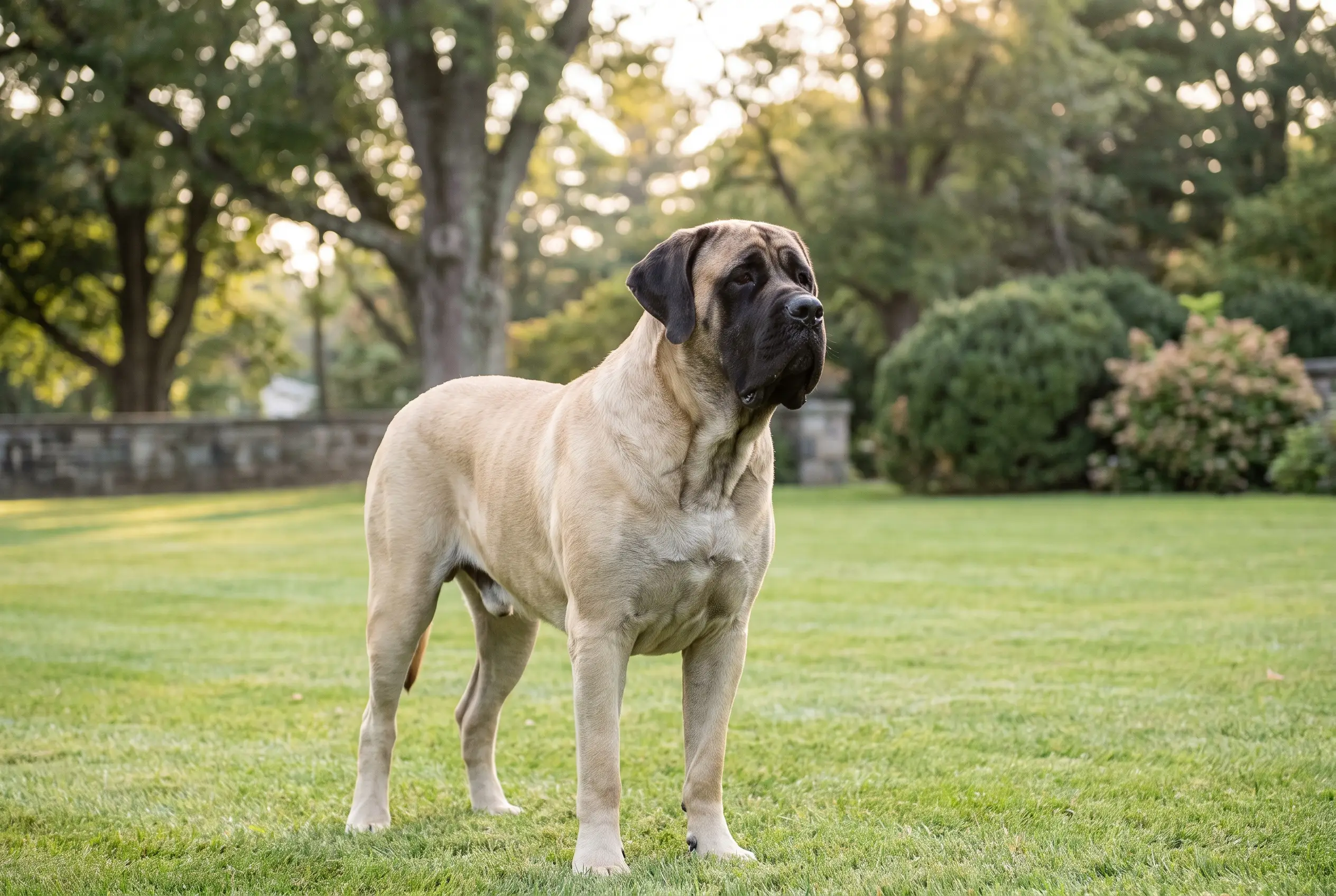
Mastiff
England's ancient colossus — gravity made gentle.
Vital stats
| Size | Giant · 70–91 cm |
| Weight | 68–100 kg |
| Life expectancy | 6–10 years |
| Energy | Low — 30–45 min/day |
| Shedding | Moderate |
| Coat | Short double coat · fawn, apricot, brindle, with black mask |
| Group | Working · FCI №264 / AKC |
| Origin | England |
| FCI group | 2 — Pinscher and Schnauzer, Molossoid and Swiss Mountain Dogs · FCI 264 |
Breed traits
Friendliness
Care
Mind
The Mastiff by the numbers
The Mastiff facts owners search for most — price, lifespan, weight, shedding and colours, in one place.
Less common, so expect a waitlist and some travel to a reputable breeder — which pushes the price up. Ongoing costs run high — more food, bigger doses at the vet, and pricier insurance.
We don't quote a single figure: the real price swings with breeder, region, bloodline and health testing — and a rescue costs a fraction of a breeder's litter. Adopting is almost always the cheapest route.
Temperament
Guardian of English estates since before written records of the breed, the Mastiff protects by presence rather than aggression: a watchful, deeply calm dog that plants itself between its family and anything uncertain. At home it is docile, patient and quietly clingy — a wall of loyalty that follows you from room to room.
Habits & quirks
The lean
Affection is expressed in kilograms, applied steadily to your legs until acknowledged.
Slobber physics
One head-shake redecorates a room — Mastiff households keep towels within reach as policy.
Threshold duty
Settles where every door and window can be monitored, then guards mostly by snoring.
Slow-motion shadow
Never hurries, never leaves — an unhurried escort between sofa, kitchen and garden.
Health
Almost everything about a Mastiff's health follows from its size. This is a giant, deep-chested dog, so bloat — where the stomach fills with gas and can twist — is a real emergency whose signs you should learn before you ever need them. The heavy frame also means hips and elbows can develop dysplasia, and the heart deserves attention too, so buy from a breeder who screens hips, elbows and hearts. Feed a Mastiff puppy to grow slowly, keep the adult lean, and know where your nearest emergency vet is.
Nutrition
| Feeding | Raise puppies slowly on measured large-breed rations — rapid growth harms joints — and split adult meals to reduce bloat risk. |
| Exercise | Two moderate daily walks; no forced running or stairs marathons while the skeleton is still growing, up to about two years. |
| Health | Budget for hips, elbows, heart and bloat vigilance — know the emergency signs of gastric torsion before you need them. |
| Space | Not a flat dog: it needs sprawling room, a cool floor in summer, and a car it actually fits in. |
Feed a Mastiff puppy slowly on a large-breed diet — a giant that grows too fast stores up joint trouble it can't undo — and never push one to bulk up. Split adult meals into two or more rather than one huge bowl, keep feeding calm, and rest the dog around mealtimes, because a deep-chested giant is the classic shape for bloat. Weigh the food, count the treats, and keep this heavy dog lean its whole life; the joints will thank you.
Puppy guide
A Mastiff puppy grows for a long time and turns into a great deal of dog, so the early work matters twice over. Grow it slowly on a large-breed food, go easy on the developing joints — no forced running or stair marathons while the skeleton is still forming, up to around two years — and start gentle manners straight away. A bouncing puppy is charming when it's small and a genuine hazard when it's enormous, so teach calm greetings and lead manners early, and socialise it often so it grows up steady.
Training
The Mastiff is calm, sensitive and eager to please, and it responds to quiet, consistent, reward-based training far better than to any heavy hand. Start early, while the dog is still a size you can manage, and teach the everyday manners a giant has to have — greeting people without leaning or jumping, walking nicely on the lead. Socialise it well from puppyhood; a well-mannered Mastiff guards by calm presence alone, while an untrained one is simply too big to argue with.
Known health issues
No breed is problem-free. These are the conditions most worth knowing about for this breed — with what a good breeder screens for and what an owner watches. General guidance, not a substitute for your vet.
Hip dysplasia
A poorly fitting hip joint that wears early and can cause pain and arthritis, most common in larger breeds. Good breeders screen: Hip-scored parents (BVA/OFA/FCI). Watch for: Stiffness, a bunny-hop run, or reluctance on stairs.
Elbow dysplasia
A developmental fault in the elbow that leads to lameness and arthritis, seen in fast-growing large breeds. Good breeders screen: Elbow-scored parents. Watch for: Front-leg limping that worsens after exercise.
Bloat (GDV)
A sudden, life-threatening twisting of the stomach, mostly in deep-chested breeds — a true emergency. Good breeders screen: Ask about family history; discuss preventive gastropexy for high-risk lines. Watch for: A swollen belly, unproductive retching, restlessness — go to a vet at once.
Life expectancy
Mastiffs live 6–10 years. Like most giant breeds the Mastiff is short-lived, but good breeding and steady care push toward the better end of that range. Buy from lines that screen hips, elbows and hearts, feed for slow growth and a lean adult weight, and know the signs of bloat cold — the emergency you catch in time is the one your dog survives. A lean body and health-tested parents are the two biggest levers you control.
Popular Mastiff mixes
Mastador
A very large, friendly, family-focused cross — more active than a purebred Mastiff and easy to train. Watch the growing joints and the appetite, and give giant-breed care throughout.
Similar breeds
Breeds with a similar build and background — worth a look if this one isn't quite the fit.
Breeds that look like this
Common questions
Are Mastiffs aggressive?
No — the standard calls for calm dignity, and a well-bred, well-socialised Mastiff deters intruders by sheer presence. Early socialisation matters precisely because the dog will end up enormous.
How long do Mastiffs live?
Typically six to ten years, the common trade-off of giant breeds. Lean body condition and health-tested parents are the two biggest levers you control.
How much does a Mastiff eat?
Less per kilo than you'd fear, but the totals are still substantial and the food bills real. More important than quantity is routine: measured meals, no gulping, and rest around feeding times.
Does the Mastiff shed a lot?
Moderately. The Mastiff sheds a fair amount, steadily through the year with heavier seasonal patches. A weekly brush keeps most of the loose hair off your floors and clothes.
Is the Mastiff hypoallergenic?
Not really. No dog is truly hypoallergenic, and the Mastiff's shedding coat releases plenty of the dander that sets off allergies. If someone at home is allergic, this isn't the easiest breed to live with — spend time around one first.
Is the Mastiff good with children?
Generally yes. The Mastiff is a friendly, people-loving breed that usually does well with children when raised and socialised well. As with any dog, teach children to be gentle and supervise around toddlers.
Is the Mastiff easy to train?
Reasonably. The Mastiff is trainable with consistency and rewards, though it isn't the quickest study. Keep sessions short and positive, and be patient with the basics like recall.