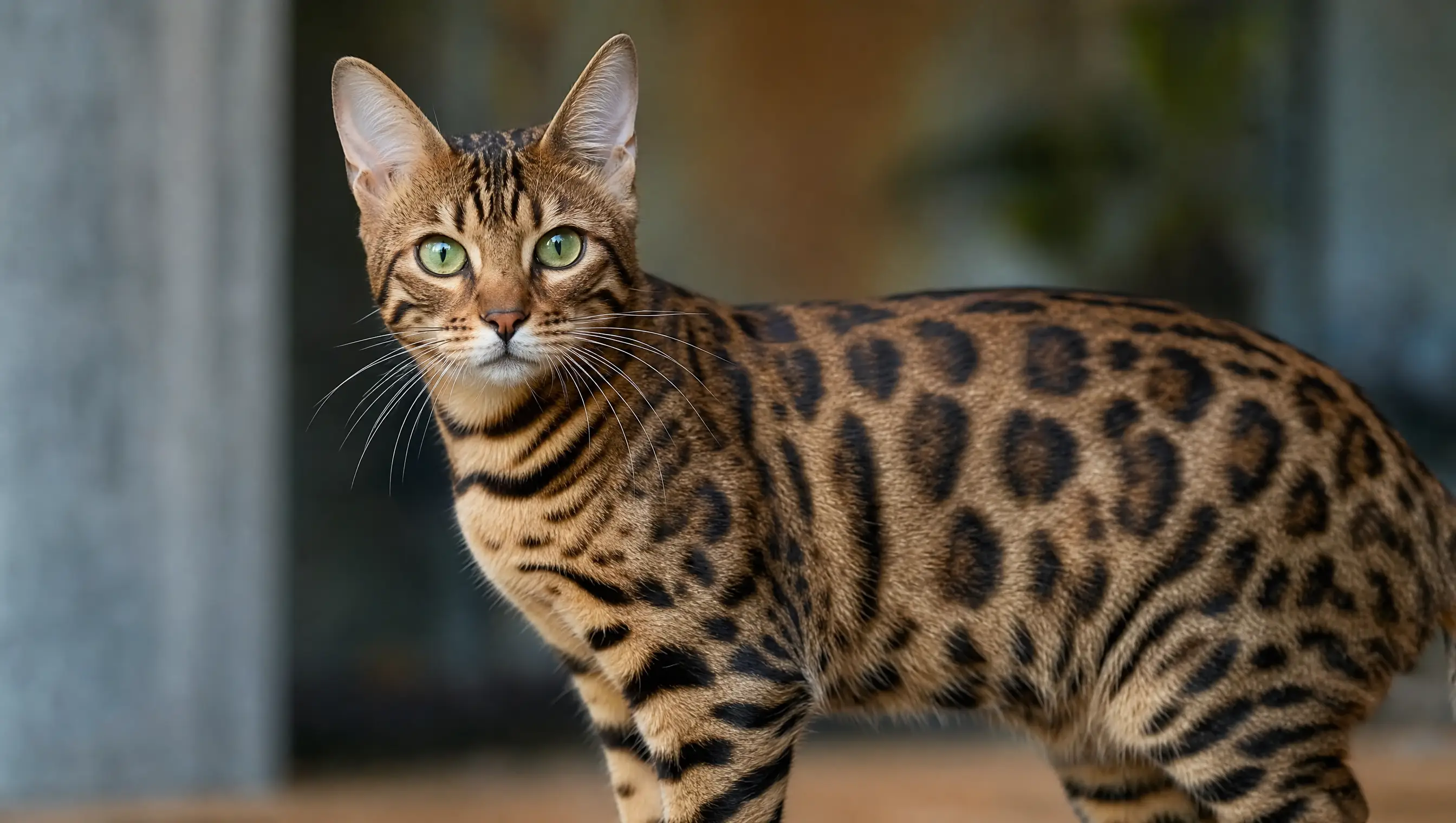
Bengal
A house cat with a wild-cat coat and the energy bill to match.
Vital stats
| Size | Medium–large · long, muscular frame |
| Weight | 4–7 kg · males heavier |
| Life expectancy | 12–16 years |
| Energy | Very high — needs a real outlet |
| Shedding | Low, coat is short and close-lying |
| Coat | Short, dense, spotted or marbled |
| Group | Shorthair |
| Origin | United States |
Breed traits
Friendliness
Care
Mind
The Bengal by the numbers
The Bengal facts owners search for most — price, lifespan, weight, shedding and colours, in one place.
Less common, so expect a waitlist and some travel to a reputable breeder — which pushes the price up. Ongoing costs stay modest — it eats little and routine vet care sits at the lower end.
We don't quote a single figure: the real price swings with breeder, region, bloodline and health testing — and a rescue costs a fraction of a breeder's litter. Adopting is almost always the cheapest route.
Temperament
Bengals are demanding in the way a smart dog is demanding: they need a job, and if you don't give them one they'll invent it, usually involving your countertops. They climb everything, learn to open cupboards and light switches, and many are genuinely fascinated by water — expect a paw in your glass or company in the shower. They bond hard to their people and want to be involved in everything, but they are not cuddle-on-command cats; affection tends to arrive on their terms, between sprints. They're chatty and can be loud when they want something. Put simply, a bored Bengal is a destructive Bengal, and that's the trait that most often lands them in rescue.
Habits & quirks
Water obsession
Many Bengals dunk toys, paw at running taps and join you at the sink or shower — a quirk you rarely see in other breeds.
Vertical living
They treat the top of the fridge, the door frames and the curtain rail as normal terrain; if there's a high point, they're on it.
Little escape artist
Sharp enough to work levers, handles and latches — child locks on cupboards are a fair investment.
Fetch and leash
Trainable to a genuinely high level: fetch, clicker tricks and harness walks all land well with a Bengal.
Health
Bengals are athletic, robust cats, but the breed carries three inherited conditions a good breeder tests for. Bengal PRA-b is a form of progressive retinal atrophy that causes blindness, and pyruvate kinase deficiency affects the red blood cells — both have straightforward DNA tests. The third, hypertrophic cardiomyopathy (HCM), is a heart-muscle disease picked up by an ultrasound scan rather than a gene test. Ask a breeder for all three directly, and treat a breeder who can't produce them as a reason to walk away. Otherwise the main risk is behavioural, not medical: a Bengal with nothing to do finds trouble.
Nutrition
| Exercise & enrichment | This is the whole job. Daily interactive play, tall climbing structures, puzzle feeders and rotated toys — under-stimulation is the number-one reason Bengals get rehomed. |
| Health screening | The breed carries Bengal PRA-b (progressive retinal atrophy causing blindness) and pyruvate kinase deficiency, both DNA-testable, plus HCM (a heart condition) screened by scan. Ask a breeder for these results directly. |
| Grooming | Easy — the short coat needs little more than a weekly once-over and sheds lightly, so grooming is the least of your Bengal commitments. |
| Household setup | Secure the high-value spaces, give them legitimate places to climb and scratch, and never leave a Bengal alone all day with nothing to do; a second active pet often helps. |
Cats are obligate carnivores, and a busy, muscular Bengal in particular does well on a meat-based diet with plenty of real protein rather than a filler-heavy kibble. This is a high-energy cat that burns a lot, but an indoor Bengal can still gain weight if food is left down all day, so measure meals and count treats — many people use part of the daily food in puzzle feeders to make the cat work for it. Wet food, or wet mixed with dry, keeps water going in, which is sound practice for any cat. Aim for the lean, athletic build the breed is meant to have, with ribs you can feel under that short coat.
Kitten guide
A Bengal kitten arrives busy and stays that way, so the work starts on day one. Handle it constantly and introduce it to visitors, other pets and everyday life, and channel that early energy into play rather than letting it climb the curtains. This is the breed to kitten-proof thoroughly: secure high shelves and windows, tidy away anything that dangles, and fit child locks on cupboards, because a Bengal learns to open handles and latches faster than you'd expect. Give it height to climb, a tall scratching post and puzzles from the start, so the good habits form early. Book an early vet visit for vaccinations, a microchip, a neutering plan, and a look at the parents' PRA-b, PK and heart results.
Training
Bengals are among the most trainable cats there are, which is a good thing, because a bored Bengal is a destructive one — this is the trait that most often lands them in rescue. Litter training is usually quick; keep a clean tray in a settled spot and most Bengals need little more. The real work is enrichment: give them a tall scratching post and climbing tower next to the furniture you want spared, puzzle feeders that make them earn their food, and rotated toys so novelty doesn't run out. Channel that sharp brain into clicker tricks, fetch and harness walks, all of which a Bengal takes to at a genuinely high level. Fit child locks on cupboards you'd rather they didn't open, get the kitten comfortable with the carrier early, and above all commit to daily interactive play — a Bengal that gets a real outlet is a delight, and one that doesn't turns that energy on your home.
Life expectancy
Bengals live 12–16 years. Getting a Bengal to the top of that range is part genetics, part lifestyle. A kitten from parents tested for PRA-b, PK deficiency and HCM starts with the inherited risks stacked in its favour, and a cat that's kept lean, well-exercised and safely occupied avoids most of the rest. Regular vet checks, including the odd heart look as the cat ages, catch the things that are easiest to manage early.
Similar breeds
Breeds with a similar build and background — worth a look if this one isn't quite the fit.
Common questions
Are Bengals part wild cat?
The foundation cats were hybrids of the Asian leopard cat, but a modern pet Bengal is several generations removed (F4 and later) and is a fully domestic cat. Early-generation (F1–F3) Bengals are a different matter and are restricted or banned in some places — check your local laws. The same question comes up about the Cheetoh, a Bengal crossed with an Ocicat, first bred in 2001 by Carol Drymon: it carries only the wild ancestry the Bengal side contributes, nothing more, and TICA registers it purely as an experimental breed, with no championship status anywhere. In registry terms, a cat sold as a Cheetoh is a Bengal-Ocicat cross.
Are Bengals hypoallergenic?
No. They shed little and produce a bit less loose hair, but they still make the Fel d 1 protein that triggers most cat allergies. No breed is truly hypoallergenic.
Do Bengals get along in a normal home?
Yes, if the home meets their energy. They can be great with older kids and other active pets, but they're a poor fit for someone wanting a quiet, low-effort cat — an under-exercised Bengal turns that energy on your furniture.
Does the Bengal shed a lot?
Not much. The Bengal is a low-shedding breed, so loose hair around the home stays minimal. It still needs regular grooming, but you won't be fighting drifts of fur.
Are Bengal cats good with children?
Often, in the right home. The Bengal is reasonably sociable and can settle well with children who already know how to handle a cat gently. Give it high perches and a room the kids don't own, and introductions go far better.
How much grooming does a Bengal need?
A weekly comb is usually enough for the Bengal, with a second pass during a seasonal moult. That keeps loose hair off your furniture and cuts down on hairballs, since everything the cat doesn't shed onto the sofa it swallows while washing.
Stories featuring this breed
All stories →
Why is my cat spraying? What it means and how to stop it
Spraying isn't a litter-box failure — it's a message about territory, written in urine. How to tell it from peeing, what's behind it, and the fixes that hold.
Zoomies: why your cat sprints through the house at 3am
The wall-of-death lap around the living room has a name, a mechanism, and a fix for the 3am edition. Why a predator that sleeps sixteen hours a day sometimes has to spend the surplus all at once.
How to train a cat to walk on a harness
Some cats take to a harness and some never will — and forcing it backfires. How to introduce one properly, the gear that matters, and the honest limits.