Why is my cat spraying? What it means and how to stop it
A cat that sprays usually still uses its litter tray perfectly well. The jet of urine on your wall is a different behaviour with a different job: it is a scent message, aimed at a vertical surface, about territory that suddenly feels contested. The distinction matters because everything that fixes toileting accidents — a cleaner tray, a better litter — does nothing for marking, and everything that fixes marking starts with working out what your cat feels threatened by. Here is how to tell the two apart, what the message means, and how to make it stop.
Spraying or peeing? Read the posture, not the puddle
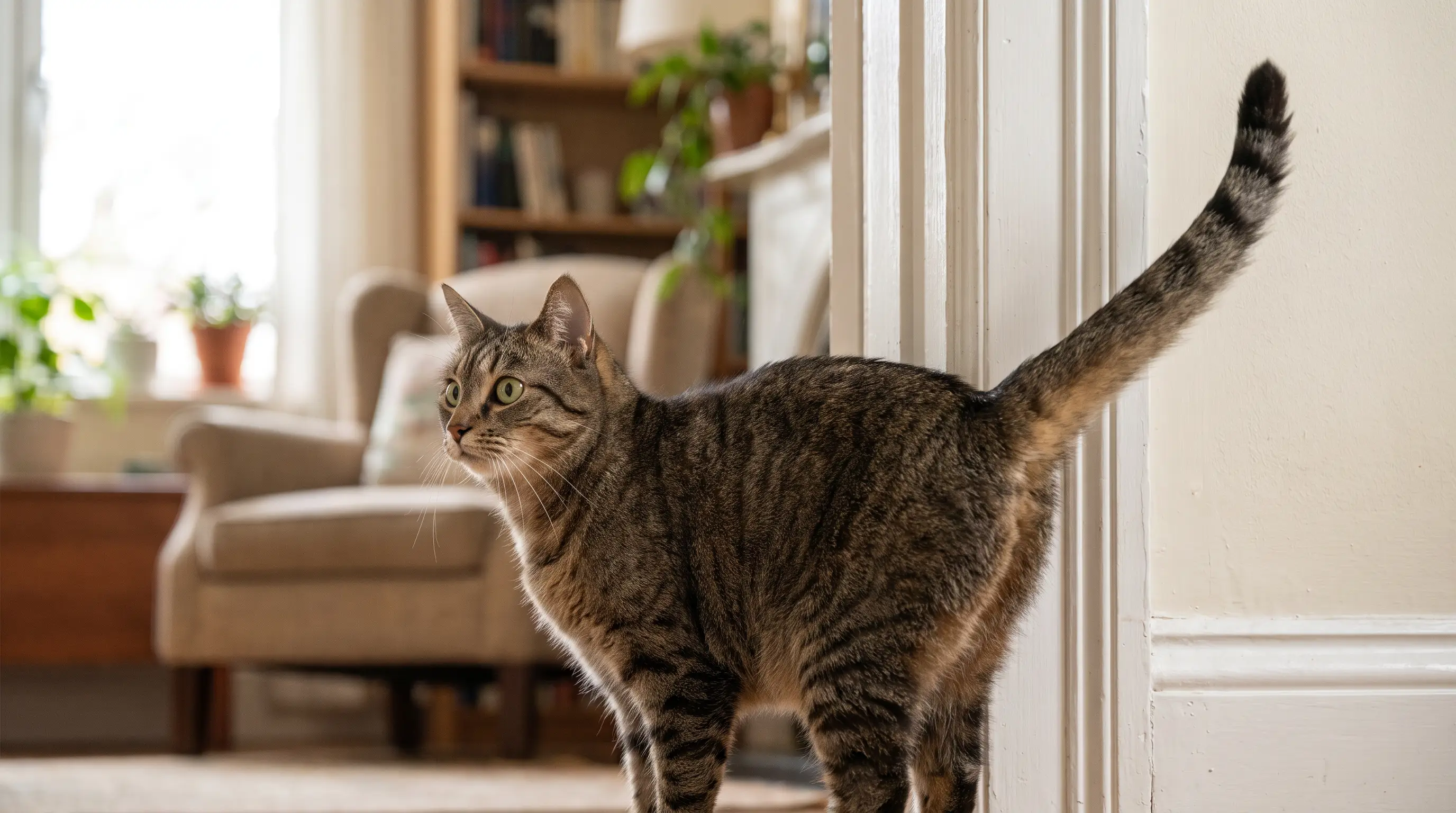
A spraying cat stands. It backs up to something vertical — a wall, a doorframe, the arm of the sofa, the shopping bag that arrived yesterday — raises its tail straight up, quivers it, often treads with its back feet, and releases a small amount of urine at roughly cat-nose height. A cat with a toileting problem squats, and leaves a larger puddle on a horizontal surface: the floor, the bath mat, your bed. Posture, surface and volume are the tell. Marking means small amounts, on upright surfaces, often at several spots, and the spots are socially loaded: doorways, windows, new furniture, your side of the bed. Sprayed urine also smells harsher than a normal accident, dramatically so from an unneutered tom.
If your cat is squatting and puddling on the flat, you are dealing with something else — quite often something medical — and the guide to peeing outside the litter box is the one you want, including the one pattern that is a same-day emergency.
Why cats spray

Spraying is communication, not toileting. Cats negotiate space by scent: a spray mark is a signed notice that tells other cats who was here, how recently, and — from an intact cat — whether they are advertising for mates. Free-living cats mark boundary lines and shared paths this way as a matter of routine. Indoor spraying is the same software running in a flat, and it switches on when the territory stops feeling settled.
In unneutered cats the driver is usually sexual: males spray to advertise, and females in heat spray too. In neutered cats, the trigger is almost always a perceived threat to the territory — a new cat, dog or baby in the home, a house move, renovation, a changed routine, simmering tension between resident cats, or neighbourhood cats strolling past the window or coming in through the flap. A confident Bengal watching a rival across the garden and a timid rescue listening to the new flatmate's dog are running the same calculation: this space is contested, so put it in writing. What it is not is revenge. A cat that sprays your bed or your gym bag is mixing its scent with yours at the heart of its safest place, which is an anxious move, not an angry one. Scratching, incidentally, is the other half of the same signage system — the scratching guide covers that channel.
Rule out a medical problem first
Before any behaviour plan, one vet visit. Cystitis and the wider cluster of feline lower urinary tract disease can make a cat pass small, urgent amounts of urine in odd places, sometimes even from a standing position, and it looks enough like marking to fool experienced owners. Feline idiopathic cystitis is itself stress-linked, so the anxious cat most likely to mark is also the cat most likely to have an inflamed bladder — the two problems travel together. And any male cat straining and producing nothing is the blocked-bladder emergency measured in hours, not days. A urine test buys certainty, and every step that follows works better on a cat that is not in pain.
How to stop spraying
If your cat is intact, neutering is the single most effective fix and it is not close: in Benjamin Hart's studies at UC Davis, castration stopped or sharply reduced spraying in roughly nine out of ten male cats, and spaying has a similar record in females. For everyone else, the plan has four parts. Clean properly: use an enzymatic or biological cleaner on the mark and the area around it, and never ammonia or bleach-based products — ammonia reads as urine to a cat and turns your cleaning into an invitation to top the mark up. Remove the trigger: if outside cats are the problem, frost the lower half of the window they patrol past and fit a microchip cat flap so no intruder can come in and mark your hallway. Make nothing contestable: in multi-cat homes, run one of everything per cat plus one spare — trays, bowls, beds, scratching posts — spread through the house rather than clustered. Change what the spot means: feed or play at a favourite marking site, because cats rarely spray where they eat. A synthetic facial-pheromone diffuser is a reasonable add-on — a placebo-controlled trial by Daniel Mills found fewer marks with one running — but treat it as support, not the fix. And never punish. Punishment adds exactly the threat that fuels marking; the reliable result is a cat that still sprays, out of your sight.
When the spraying doesn't stop
Persistent spraying in a neutered cat is nearly always an anxiety problem with a source you haven't found yet, and in multi-cat homes the source is usually each other. Watch for the quiet warfare — staring, blocking the stairs, ambushes at the flap, one cat that always eats last. If that is the picture, the marking is a symptom: separate the cats and run a proper reintroduction, and audit the household against the signs of a stressed cat. Some cats keep the habit regardless — in Hart's follow-up work about one castrated male in ten and one spayed female in twenty went on spraying — and those cats respond to environment work, not to waiting. If you have removed the triggers you can find and the marks keep coming, ask your vet for a referral to a qualified behaviourist, and if a previously settled older cat starts spraying out of nowhere, go back to the vet first: in a senior, new marking is a medical question until proven otherwise.
Common questions
Why is my cat spraying all of a sudden?
Something changed in how safe the territory feels: a new pet or person, a move, building work, tension with another cat, or neighbourhood cats appearing at the window or coming through the flap. In an unneutered cat, reaching sexual maturity is the usual trigger. A sudden change is also worth a vet check, because cystitis can mimic marking.
How do I stop my cat from spraying?
Neuter if your cat is intact, clean marks with an enzymatic cleaner (never ammonia or bleach), and remove the trigger — block views of outside cats, fit a microchip flap, and give multi-cat homes one of every resource per cat plus a spare. Never punish a spraying cat; it adds the stress that drives the marking.
Do female cats spray?
Yes. It's most common in unneutered females in heat, but spayed females spray too when the territory feels threatened. Males are the more frequent sprayers, and unneutered males the most frequent of all — but no sex or neuter status rules it out.
Will my cat stop spraying after being neutered?
Very likely. In Benjamin Hart's UC Davis studies, castration stopped or sharply reduced spraying in roughly nine out of ten males, and spaying shows a similar success rate in females. The effect is often quick, though a long-established habit can take weeks to fade — and about one male in ten continues and needs the stress-and-territory work instead.
How can I tell if my cat is spraying or peeing?
By posture and surface. Spraying is done standing, tail up and quivering, releasing a small amount of urine backwards onto a vertical surface like a wall or doorframe. Peeing is done squatting, leaving a larger puddle on a horizontal surface. Small marks on upright surfaces mean marking; puddles on the floor mean a toileting or medical problem.
Why is my neutered cat spraying?
Because something is making the territory feel contested — usually another cat, inside the home or visible outside it. A small minority of cats, around one castrated male in ten, keep spraying after neutering, and the fix is finding and removing the stressor. Rule out a urinary problem first, since cystitis can look exactly like marking.
More in Cats
Why is my cat aggressive? Causes and how to calm it
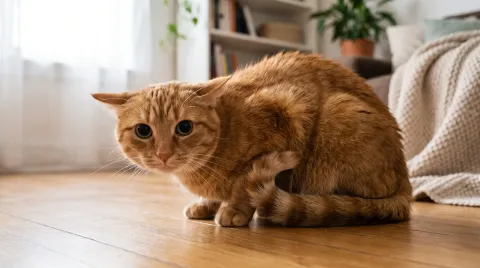
Cat aggression isn't a personality — it's a diagnosis with about six usual suspects, and each one has a different fix. Work through them in order and the biting usually explains itself.
Why do cats hiss? What it means and what to do
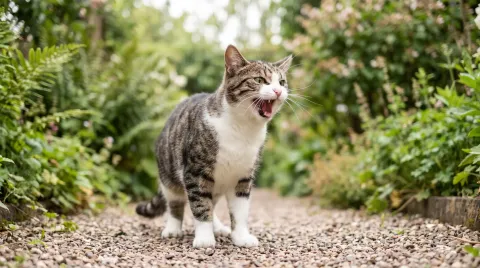
A hiss is not an attack — it's the thing a cat does to avoid one. What the sound actually is, what triggers it, and why the polite answer is always to back off.
Why are my cats fighting? How to restore the peace
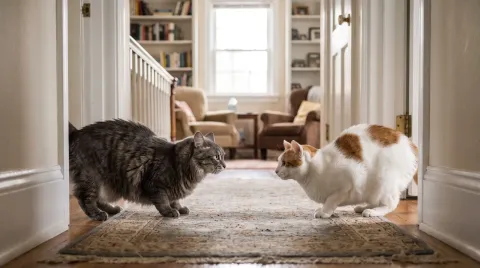
Two cats that shared a bed for years can turn into enemies in an afternoon. What breaks a feline relationship, why 'letting them fight it out' entrenches the war, and the reset that works.
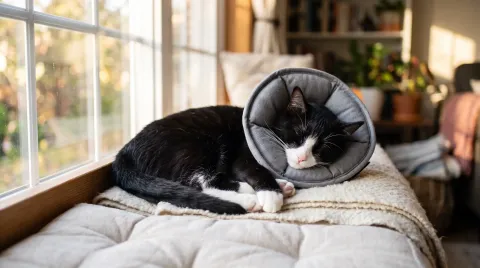
How neutering changes cat behavior — and what it won't fix
Neutering deletes the hormone-driven behaviours — the roaming, the spraying, the 3am opera — and touches almost nothing else. What changes, what doesn't, and when.
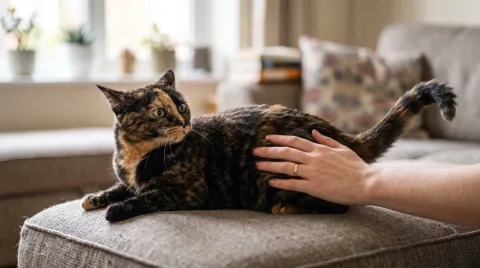
Why your cat bites you mid-stroke
Purring one second, teeth the next — petting-induced aggression is the most misread move in cat ownership. The warnings arrive earlier than you think, and the fix is counting, not forgiveness.
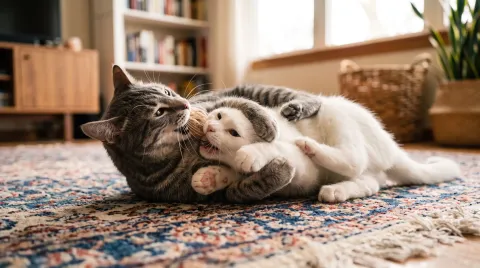
Are my cats playing or fighting? The five reads
Wrestling, neck bites, bunny kicks and thundering chases — most of it is play, some of it isn't, and the difference is visible in five places. What to check, when to step in, and how to step in without getting shredded.