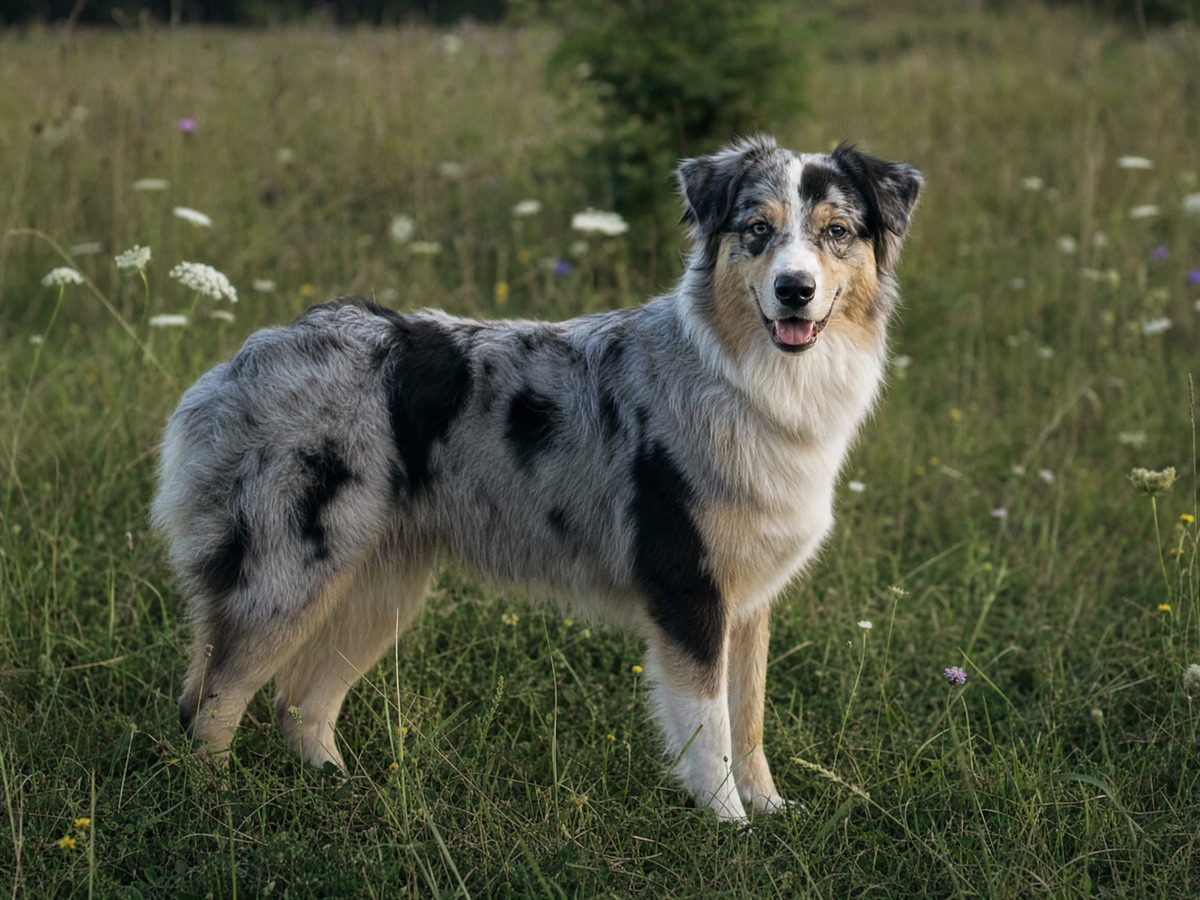
Australian Shepherd
A dazzling merle coat wrapped around a tireless ranch worker.
On these lists: Dogs for runners · Farm dogs · Dogs for hiking
Vital stats
| Size | Medium · 46–58 cm |
| Weight | 16–32 kg |
| Life expectancy | 12–15 years |
| Energy | Very high — 2 hours/day |
| Shedding | Heavy, worse in season |
| Coat | Medium double coat · merle, black, red |
| Group | Herding · FCI №342 / AKC |
| Origin | Western United States |
| FCI group | 1 — Sheepdogs and Cattledogs · FCI 342 |
Breed traits
Friendliness
Care
Mind
The Australian Shepherd by the numbers
The Australian Shepherd facts owners search for most — price, lifespan, weight, shedding and colours, in one place.
Widely bred, so you can usually find a litter from a registered breeder without a long wait. Plan for steady ongoing costs — mid-range food, routine vet care and insurance. Its coat also needs a professional groom every few weeks — a real line in the budget.
We don't quote a single figure: the real price swings with breeder, region, bloodline and health testing — and a rescue costs a fraction of a breeder's litter. Adopting is almost always the cheapest route.
Temperament
Refined on Western ranches — not in Australia — the Aussie was the cowboy's all-rounder: herding stock by day, guarding the wagon by night, performing rodeo tricks at weekends. It remains that dog: clever, athletic, a touch reserved with strangers and intensely bonded to its person, with energy that must go somewhere every single day.
Habits & quirks
Velcro with paws
Follows you room to room; a closed door is taken personally.
The Aussie grin
Many greet beloved people with a toothy, full-body wiggling smile.
Herding the household
Children, cats and dinner guests may be gently circled and steered.
Eye on the horizon
Distant movement — joggers, cyclists, wind-blown leaves — is always noted and often chased.
Health
The Australian Shepherd is a fit, hard-working dog, and its main health concerns are the hips, the eyes and, in some lines, hearing. Hips can develop dysplasia, the breed carries eye problems including progressive retinal atrophy (PRA), and deafness turns up in some dogs. Ask breeders about MDR1, a drug sensitivity common in the breed that changes which medicines are safe. Choose lines screened for eyes and hips, and keep up regular vet checks as your dog ages.
Nutrition
| Exercise | One to two hours of hard activity plus mental work — frisbee, agility, trick training |
| Grooming | Brush twice weekly, more in moulting season, and expect hair regardless |
| Training | Employ the brain daily or it self-assigns — this breed loves having a curriculum |
| Health | Choose lines screened for eyes and hips, and ask breeders about MDR1 drug sensitivity |
An Aussie is a working athlete, so feed enough to match one to two hours of hard activity a day, then adjust with the seasons and the workload. Keep him lean to spare hips that can be prone to dysplasia, weigh the meals rather than guessing, and count training treats into the daily total — with a dog you're rewarding all day, they add up fast.
Puppy guide
An Aussie puppy is clever and busy from day one, and the temptation is to run him hard — resist it while the joints are still forming and keep early exercise moderate. Put the effort into his head instead: early socialization, gentle handling and simple games teach a high-drive puppy that the world is calm and that thinking earns rewards. Ask the breeder about eyes, hips and MDR1 before you choose, because this is a breed where health testing genuinely matters.
Training
The Australian Shepherd is one of the smartest, most trainable dogs there is, which is both the joy and the catch: a brain like that needs a job, or it invents one you won't like. Give him a real outlet — herding, agility, frisbee, trick training, scentwork — and keep teaching, because this breed genuinely loves a curriculum. Reward-based training clicks fast; the work isn't getting him to learn, it's giving him enough to do.
Known health issues
No breed is problem-free. These are the conditions most worth knowing about for this breed — with what a good breeder screens for and what an owner watches. General guidance, not a substitute for your vet.
Hip dysplasia
A poorly fitting hip joint that wears early and can cause pain and arthritis, most common in larger breeds. Good breeders screen: Hip-scored parents (BVA/OFA/FCI). Watch for: Stiffness, a bunny-hop run, or reluctance on stairs.
Inherited eye disease
Progressive retinal atrophy and cataracts run in several breeds and can dim or take sight over time. Good breeders screen: Eye-tested parents and, where available, a DNA test for PRA. Watch for: Night-time bumping, cloudy eyes, or hesitation in dim light.
Congenital deafness
Some mostly-white and merle breeds are born deaf in one or both ears, tied to coat-colour genetics. Good breeders screen: BAER-tested puppies; avoid merle-to-merle matings. Watch for: A pup that doesn't startle at sound or is hard to wake.
Life expectancy
Australian Shepherds live 12–15 years. Aussies are a fairly long-lived, robust breed, and you keep them that way with the same few things: buy from lines screened for eyes and hips, know your dog's MDR1 status so medications are safe, keep him lean and well-exercised, and stay on top of vet checks. A fit body and a busy mind are what keep this breed thriving into old age.
Popular Australian mixes
Aussiedoodle
A clever, lively, lower-shedding mix with energy and brains to match. Needs plenty of exercise and something to think about.
Aussiedor
A friendly, athletic family cross with a strong work ethic. Happiest with a job and a lot of daily activity.
Texas Heeler
A tough, high-drive herding cross bred for real work. Sharp, tireless and best suited to an active, experienced home.
Aussalier
A softer, smaller companion cross with the Aussie's brains and the Cavalier's affection. Gentler in energy than a full Aussie.
Aussiepom
A small, bright, lively mix with a big personality and a fluffy coat. Smart and busy, and needs regular brushing.
Similar breeds
Breeds with a similar build and background — worth a look if this one isn't quite the fit.
Compare this breed
Breeds that look like this
Common questions
Are Australian Shepherds hard to train?
No — they're highly trainable and love learning, but that intelligence means they need consistent jobs or they invent mischief.
Do Australian Shepherds need a yard?
A yard helps but is no substitute for exercise. What they truly need is one to two hours of activity and a daily job.
Do Australian Shepherds shed a lot?
Yes — the double coat sheds year-round with two heavy seasonal blows. Twice-weekly brushing keeps the house liveable.
Is the Australian Shepherd hypoallergenic?
Not really. No dog is truly hypoallergenic, and the Australian Shepherd's shedding coat releases plenty of the dander that sets off allergies. If someone at home is allergic, this isn't the easiest breed to live with — spend time around one first.
Is the Australian Shepherd good with children?
Generally yes. The Australian Shepherd is a friendly, people-loving breed that usually does well with children when raised and socialised well. As with any dog, teach children to be gentle and supervise around toddlers.
Stories featuring this breed
All stories →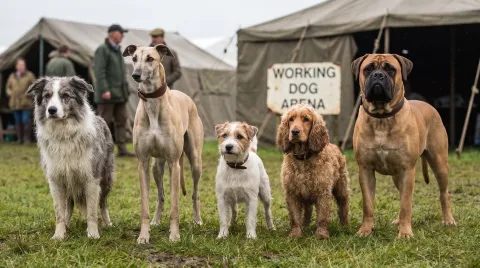
Seven groups, ten groups, three answers: how dog breeds get sorted
Kennel clubs sort several hundred breeds into a handful of groups. Here is how those lines were drawn, why the AKC's seven don't match the FCI's ten, and why the Standard Schnauzer belongs to three groups at once.
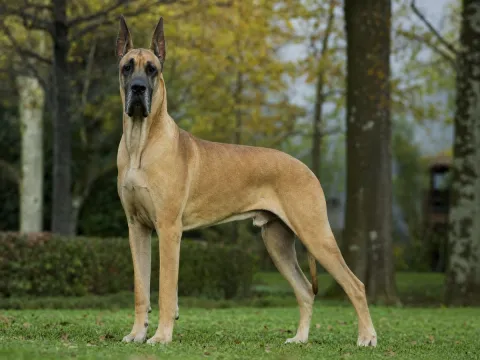
Dog breeds named after the wrong country
The Great Dane is German. The Australian Shepherd is American. Breed names are charming, and they are terrible geography.