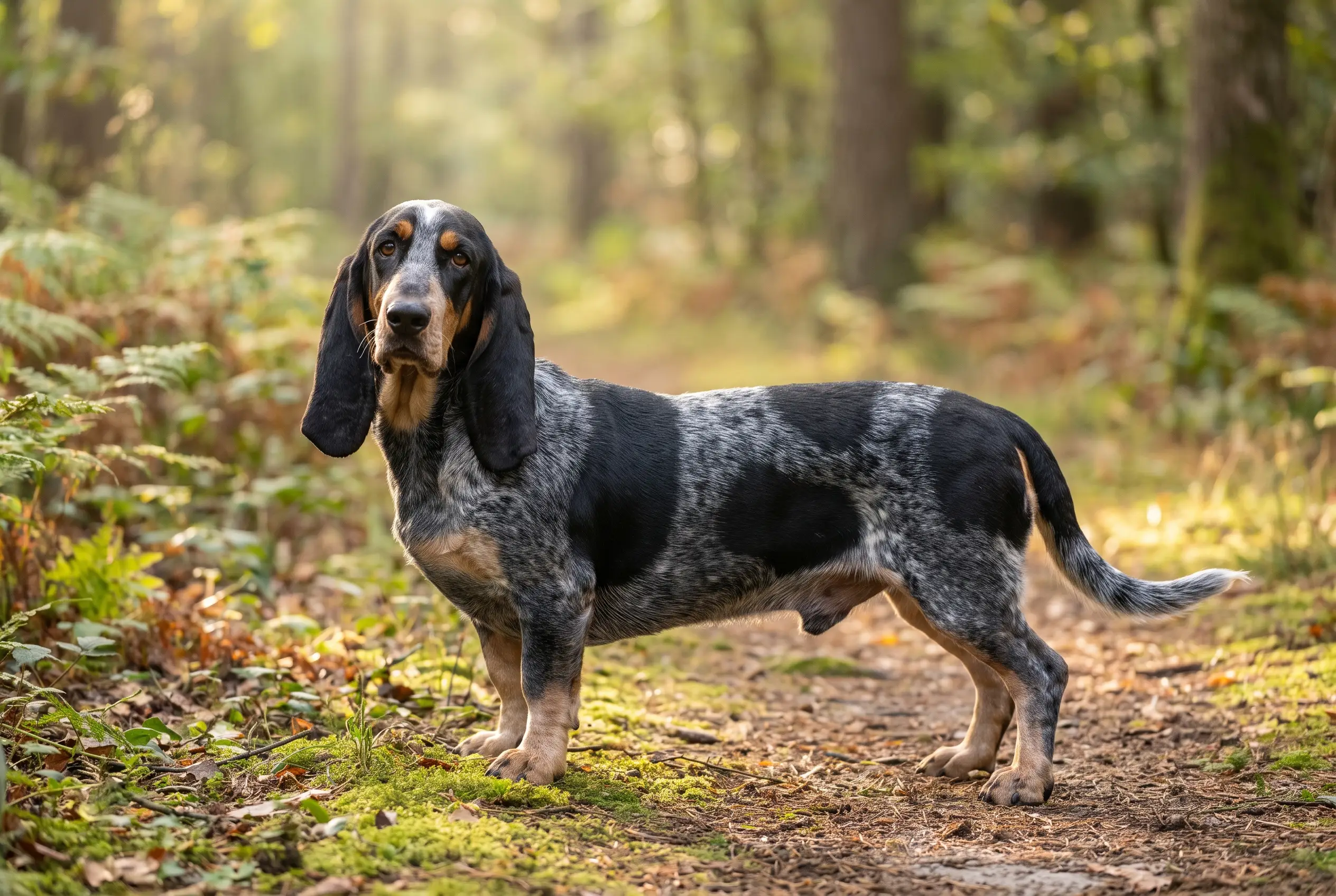
Basset Bleu de Gascogne
A short-legged blue hound built so a hunter on foot could keep up.
Vital stats
| Size | Small · 34–38 cm |
| Weight | 16–18 kg — breed literature; the standard sets none |
| Life expectancy | 12–14 years — breed literature, not survey data |
| Energy | High — 2+ hrs/day, scent work and free running |
| Shedding | Moderate — short coat, sheds year-round |
| Coat | Short, semi-thick, dense · black-and-white mottled, reads slate blue, with tan points |
| Group | Hound · Small-sized Hounds (FCI №35, Group 6) |
| Origin | Gascony, southwestern France |
| FCI group | 6 — Scent hounds and related breeds · FCI 35 |
Breed traits
Friendliness
Care
Mind
The Basset Bleu de Gascogne by the numbers
The Basset Bleu de Gascogne facts owners search for most — price, lifespan, weight, shedding and colours, in one place.
Less common, so expect a waitlist and some travel to a reputable breeder — which pushes the price up. Plan for steady ongoing costs — mid-range food, routine vet care and insurance.
We don't quote a single figure: the real price swings with breeder, region, bloodline and health testing — and a rescue costs a fraction of a breeder's litter. Adopting is almost always the cheapest route.
Temperament
The standard's behaviour clause is short and specific: 'Very fine nose. Active, agile and lively. Intent in his way of hunting; endowed with a beautiful howling voice. Works perfectly in a pack. Affectionate and happy dog; need to frisk about.' That reads like a working hound's résumé before it reads like a pet's: the nose leads, the voice announces every find, and the pack instinct runs deep enough that a lone Basset Bleu genuinely wants canine company. At home the same dog turns soft and demonstrative with its family; breed clubs describe it as reserved rather than outgoing with strangers, and it keeps the frisky, playful streak the standard names outright well past puppyhood.
Habits & quirks
A signature spot
Between the two black patches that cover each ear and eye, the standard asks for a white gap — and inside that gap, a small oval black spot it calls 'typical of the breed.' Not every dog carries a clean one.
Ears past the nose
The ear leather must be fine, curled inward, pointed at the tip, and long enough to reach beyond the end of the nose when drawn forward. Set too high, too broad, too thick or too round all count as faults.
The blue that isn't blue
There is no blue pigment on the dog anywhere. The standard's colour section calls the coat 'entirely mottled (black and white) giving a slate blue effect' — dense black-on-white ticking the eye blends into grey-blue from a few feet away, the same optical trick behind the Bleu d'Auvergne and the Grand Bleu de Gascogne.
A tail that kisses the ground
Carried sabre-fashion and set on strongly, the tail's tip should just touch the ground when the dog stands at rest, and sometimes carries a few coarser, slightly bristling hairs near the tip that the standard compares to ears of grain.
Health
The standard says nothing about health beyond wanting a sound, workmanlike dog, so there's no formal screening list to recite — but the build gives you the care plan. This is a low-slung hound on short legs with a long back, which does best kept genuinely lean and spared a lot of jumping on and off high furniture. The ears are long and fine — the standard asks for ears that reach past the tip of the nose — and ears like that hold warmth and damp, so a regular check and clean belongs in the routine. Add the deep scent drive: a Basset Bleu head-down on a line will follow it a long way, so secure fencing and a trained recall are part of keeping him safe and sound. Choose a breeder who health-tests and can show you the parents.
Nutrition
| Exercise | Breed clubs put the daily minimum past two hours — real scent work and secure off-lead running, not just a lead walk. The standard's own words for the breed are active, agile and lively; a bored Basset Bleu invents its own entertainment. |
| Grooming | The short, semi-thick, dense coat needs only a weekly brush. Check the curled ear leathers and the one or two folds the standard allows on the cheeks, and keep the black nails trimmed. |
| Training | Recall has to be built early and reinforced for life — this is a hound selected for a fine nose and a hunting mind that runs ahead of its ears. Short, reward-based sessions and a securely fenced garden matter more than raw obedience drilling. |
| Health | Breed literature flags intervertebral disc disease from the long back and short legs, angular limb deformities in fast-growing puppies, and ear infections under those long leathers. The standard itself carries only the general FCI soundness clause, not a breed-specific health section. |
This is a high-energy scenthound that will happily spend hours a day working its nose, and it should be fed to match that — but it also has a hound's appetite and a hound's talent for talking you into extra, and a long back that carries any surplus badly. Weigh the food, count every treat toward the daily total, and keep a waist you can see and ribs you can feel. A lean Basset Bleu runs, frisks and works the way the breed is meant to; a heavy one pays for it at both ends of the spine.
Puppy guide
A Basset Bleu de Gascogne puppy comes with the frisky, playful streak the breed keeps well into adulthood, and a nose that switches on early. Keep the exercise gentle and low-impact while the long back and short legs are still growing — no repeated stair-diving or leaping off furniture — and get him used early to having those long ears handled and cleaned. Socialize him broadly, and because this is a pack hound that genuinely likes canine company, time around other steady dogs is part of raising a settled one. Start recall young and keep it fun; you're building it against a scent drive that only gets stronger.
Training
The Basset Bleu de Gascogne is a pack-bred, nose-first hound — affectionate and soft at home, single-minded once a trail is under its feet — so train it accordingly. Reward-based, cheerful, short sessions suit it; drilling and heavy-handed correction do not. Recall is the work that matters, because a dog locked onto a scent can go briefly deaf to everything else, and the melodious voice the standard prizes will get used, so channel it rather than expecting silence. Give the nose real outlets and the rest gets easier.
Life expectancy
Basset Bleu de Gascognes live 12–14 years — breed literature, not survey data. The Basset Bleu de Gascogne is a hardy, athletic hound with a good life ahead of it, and you keep it near the top of that range by respecting what the build needs: a lean weight off a long back, clean ears, and plenty of walking and scent work to keep an active pack hound sound and content.
Similar breeds
Breeds with a similar build and background — worth a look if this one isn't quite the fit.
Breeds that look like this
Common questions
Is a Basset Bleu de Gascogne just a small Basset Hound?
No. Different breed, different standard. The Basset Hound (FCI No. 163) was bred heavier and looser-skinned, with broad, rounded, deeply pendulous ears and a lower, more substantial build. The Basset Bleu de Gascogne's own standard asks for the opposite emphasis, 'quite substantial but yet not too heavy,' with fine, curled, pointed ears that must reach past the tip of the nose rather than droop past it. Both are short-legged hunting hounds built to be followed on foot: 'basset' just means low-slung, not one specific look. The Gascon blue is the leaner, more athletic working end of that idea.
How does it differ from the Grand Bleu de Gascogne and the other blue Gascon hounds?
It is the short-legged branch of the same family. The Grand Bleu de Gascogne (FCI No. 22) is the tall original, standing well above knee height; the Petit Bleu de Gascogne (FCI No. 31) is a smaller standing hound rather than a basset; and the Griffon Bleu de Gascogne (FCI No. 32) carries the same blue-mottled colouring under a rough, wiry coat instead of the Basset Bleu's short one. All four share the black-and-white ticking that reads slate blue and the Gascony hunting heritage; height and coat texture are what separate them.
Why is it called 'blue' if the coat is black and white?
Because of how the eye reads the pattern, not an actual pigment. The standard describes the coat as 'entirely mottled (black and white) giving a slate blue effect' — dense black ticking through white that blends into grey-blue at a normal viewing distance, the same trick behind the name of the Bleu d'Auvergne and the other Gascon 'blues.'
Does the Basset Bleu de Gascogne shed a lot?
Moderately. The Basset Bleu de Gascogne sheds a fair amount, steadily through the year with heavier seasonal patches. A weekly brush keeps most of the loose hair off your floors and clothes.
Is the Basset Bleu de Gascogne hypoallergenic?
Not really. No dog is truly hypoallergenic, and the Basset Bleu de Gascogne's shedding coat releases plenty of the dander that sets off allergies. If someone at home is allergic, this isn't the easiest breed to live with — spend time around one first.
Is the Basset Bleu de Gascogne good with children?
Generally yes. The Basset Bleu de Gascogne is a friendly, people-loving breed that usually does well with children when raised and socialised well. As with any dog, teach children to be gentle and supervise around toddlers.
Is the Basset Bleu de Gascogne easy to train?
Reasonably. The Basset Bleu de Gascogne is trainable with consistency and rewards, though it isn't the quickest study. Keep sessions short and positive, and be patient with the basics like recall.