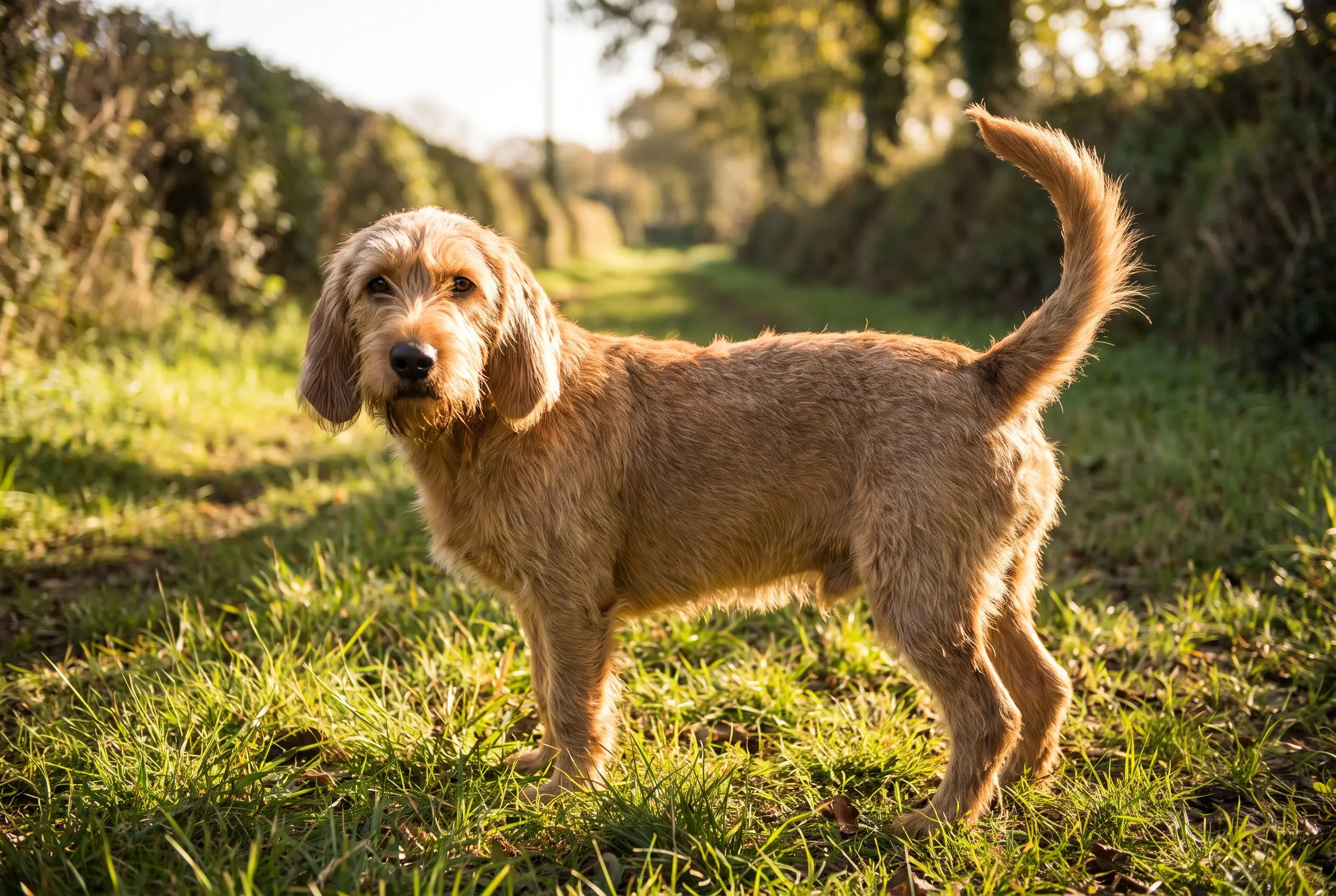
Basset Fauve de Bretagne
A wire-coated rabbit hound bred down from Brittany's taller Griffon Fauve, built low so hunters on foot could keep up.
Vital stats
| Size | Small · 32–38 cm (tolerance to 40 cm for exceptional dogs) |
| Weight | 16–18 kg — breed literature; the standard sets none |
| Life expectancy | 12–14 years — breed literature, estimates range 10–16 years |
| Energy | High — 2+ hrs/day, scent-driven |
| Shedding | Low-moderate — short, wiry coat |
| Coat | Short, rough and harsh, never woolly or curly · fawn, golden wheaten to red brick |
| Group | Hound · Small-sized Hounds (FCI №36, Group 6) |
| Origin | Brittany, France |
| FCI group | 6 — Scent hounds and related breeds · FCI 36 |
Breed traits
Friendliness
Care
Mind
The Basset Fauve de Bretagne by the numbers
The Basset Fauve de Bretagne facts owners search for most — price, lifespan, weight, shedding and colours, in one place.
Less common, so expect a waitlist and some travel to a reputable breeder — which pushes the price up. Plan for steady ongoing costs — mid-range food, routine vet care and insurance.
We don't quote a single figure: the real price swings with breeder, region, bloodline and health testing — and a rescue costs a fraction of a breeder's litter. Adopting is almost always the cheapest route.
Temperament
The FCI standard calls the Basset Fauve de Bretagne an impassioned hunter but also an excellent companion of man, sociable, affectionate and equable, adding that it adapts itself easily to all terrains, even the most difficult, and to all quarry. Hunting brings out a different animal: courageous, wily, and obstinate, which makes them very successful, in the standard's own words — traits that show up at home as a mind of its own once a scent trail is involved. Timid behaviour is a fault under both the FCI and AKC standards, and so is aggression; this is meant to be a dog that meets the world evenly, not one that hides from it or challenges it. Breed clubs on both sides of the Channel add a gentler note the standard doesn't dwell on: intelligent, soft-natured, and happiest treated as a member of the household rather than left to itself.
Habits & quirks
Ears measured to the nose
The standard doesn't leave ear length to guesswork: drawn forward, they should just reach the end of the nose, finely attached, pointed at the tip and turned inward — a specific enough test that judges and buyers actually use it.
Born without dewclaws
The standard disqualifies any Basset Fauve de Bretagne born with dewclaws — "this breed is always free from dewclaws," in its own words. Clean legs from birth, not a groomer's job.
Stripped, never clipped
That harsh, wiry coat only stays harsh and wiry if the dead outer hairs are pulled out by hand or stripping knife, a couple of times a year. Run clippers over it instead and the coat grows back softer and paler with every pass — the opposite of what the standard is judging for.
One colour, wide range
Every Basset Fauve de Bretagne is solid fawn, but that covers a lot of ground, from pale golden wheaten to a deep red brick. A few stray black hairs on the back and ears are tolerated, and so, occasionally, is a small white star on the chest, though the standard is clear it isn't wanted.
Health
There's no official health checklist attached to the standard beyond a general call for a sound, hardy dog — and hardiness is exactly what the Basset Fauve is known for. What its care really turns on is shape and coat. It's a short-legged, deep-chested hound with a long-ish back, so keeping it lean and not encouraging endless jumping on and off furniture protects the frame. The rough, harsh coat sheds little but wants proper attention — regular tidying, and hand-stripping rather than clipping if you want to keep its texture — and the low-set ears want checking and cleaning as routine. Then there's the nose: breed clubs are blunt that without a secure garden this is an accomplished escape artist, so good fencing and a trained recall are as much a health matter as anything. Buy from a breeder who health-tests their stock.
Nutrition
| Exercise | Plan on two hours a day or more, and expect most of it to happen nose-down. This is a scent hound built for a full day's hunting, so route variety and real time to follow a trail matter more than speed; a securely fenced garden is worth more than a long lead, since recall competes with whatever the nose just found. |
| Grooming | A weekly comb and brush keeps the harsh coat tidy, but the real maintenance is hand-stripping: pulling the dead outer hairs by hand or with a stripping knife or stone, done once or twice a year rather than cut with clippers. Clipping softens the coat's texture and dulls its colour over time, which both the FCI and AKC standards penalise, so most owners book a groomer who specifically knows hand-stripping rather than a standard trim. |
| Training | It responds to food and short, upbeat sessions better than to repetition or a firm hand — this is a sociable hound, not a stubborn one, but the nose will always be the loudest voice in the room. Start recall early and keep expectations realistic off-lead near open scent. |
| Health | Breed literature flags intervertebral disc disease and other back or joint problems tied to the long-backed, short-legged build, along with ear infections in those long pendant ears and a reported risk of glaucoma. There's no single mandatory Kennel Club health scheme for the breed, but hip and eye checks are sensible — these figures come from clinical reporting, not a breed-wide health survey. |
The Basset Fauve is a compact, high-energy hound the standard credits with real stamina, and it should be fed for the work it does — but it's a hound, which means an eager eater and a persuasive one. The standard sets no weight, so let body condition be your guide instead of a number: a waist you can see, ribs you can feel under that harsh coat. Weigh the meals, count the treats into the day's ration, and don't let a good beggar talk a long-backed dog into carrying weight it doesn't need.
Puppy guide
A Basset Fauve de Bretagne puppy is sociable and soft-natured, and it does best raised as a full member of the household rather than left to its own devices. Keep the exercise gentle and low-impact while the short legs and long back are still developing, and start early on the handling this breed needs for life — brushing the harsh coat, cleaning the low ears, having its feet and mouth checked. Socialize him widely, and put real work into recall from the beginning: the friendly puppy grows into a nose that, given half a chance and a weak fence, will follow a scent clean out of the neighbourhood.
Training
The Basset Fauve de Bretagne is bright and willing at home and a different animal on a scent — courageous, wily and frankly obstinate once its nose takes over, in the standard's own terms. Train it with that split in mind: reward-based, patient and consistent, with recall as the non-negotiable, because a Fauve on a trail is not really listening. It's soft-natured and dislikes harshness, so keep sessions upbeat and short, and give that hunting drive legitimate outlets — scent games, tracking, a proper walk — so it isn't inventing its own. Timid or aggressive behaviour is a fault in this breed; a steady, sociable dog is what you're raising toward.
Life expectancy
Basset Fauve de Bretagnes live 12–14 years — breed literature, estimates range 10–16 years. The Basset Fauve de Bretagne is a genuinely hardy hound with a good stretch of life in it, and you keep it near the top of that range the way the breed likes best: a lean weight off a long back, the harsh coat and low ears kept up, and enough walking and nose work to keep a working hound sound and satisfied. Treated as one of the family, which is where it wants to be, it ages well.
Similar breeds
Breeds with a similar build and background — worth a look if this one isn't quite the fit.
Breeds that look like this
Common questions
What's the difference between a Basset Fauve de Bretagne and a Griffon Fauve de Bretagne?
Leg length, mostly. The Griffon Fauve de Bretagne (FCI standard No. 66) is the original, standing 48–56 cm; the Basset Fauve de Bretagne (FCI standard No. 36) was bred down from it so hunters on foot could keep up, and stands 32–38 cm. Both carry the same wiry fawn coat and much of the same temperament — the basset is essentially the Griffon's legs shortened for closer work.
Are Basset Fauve de Bretagnes good family dogs?
Yes, with the usual hound caveats. The standard itself calls them sociable, affectionate and equable, and breed clubs describe a soft-natured dog that wants to be part of the household rather than left in a kennel. The trade-off is the nose: without daily exercise and a secure garden, that same sociability turns into an escape artist following a scent out of the neighbourhood.
How easy is it to find a Basset Fauve de Bretagne in the UK?
Not very, though it isn't the rarity it once was. It came off the UK Kennel Club's rare-breed register in 2007, and annual registrations have reportedly stayed under about 140 dogs a year since — enough to support a real breed club, not enough to expect a litter on short notice. Most UK owners wait for a breeder and travel to collect a puppy.
Does the Basset Fauve de Bretagne shed a lot?
Moderately. The Basset Fauve de Bretagne sheds a fair amount, steadily through the year with heavier seasonal patches. A weekly brush keeps most of the loose hair off your floors and clothes.
Is the Basset Fauve de Bretagne hypoallergenic?
Not really. No dog is truly hypoallergenic, and the Basset Fauve de Bretagne's shedding coat releases plenty of the dander that sets off allergies. If someone at home is allergic, this isn't the easiest breed to live with — spend time around one first.
Is the Basset Fauve de Bretagne easy to train?
Reasonably. The Basset Fauve de Bretagne is trainable with consistency and rewards, though it isn't the quickest study. Keep sessions short and positive, and be patient with the basics like recall.