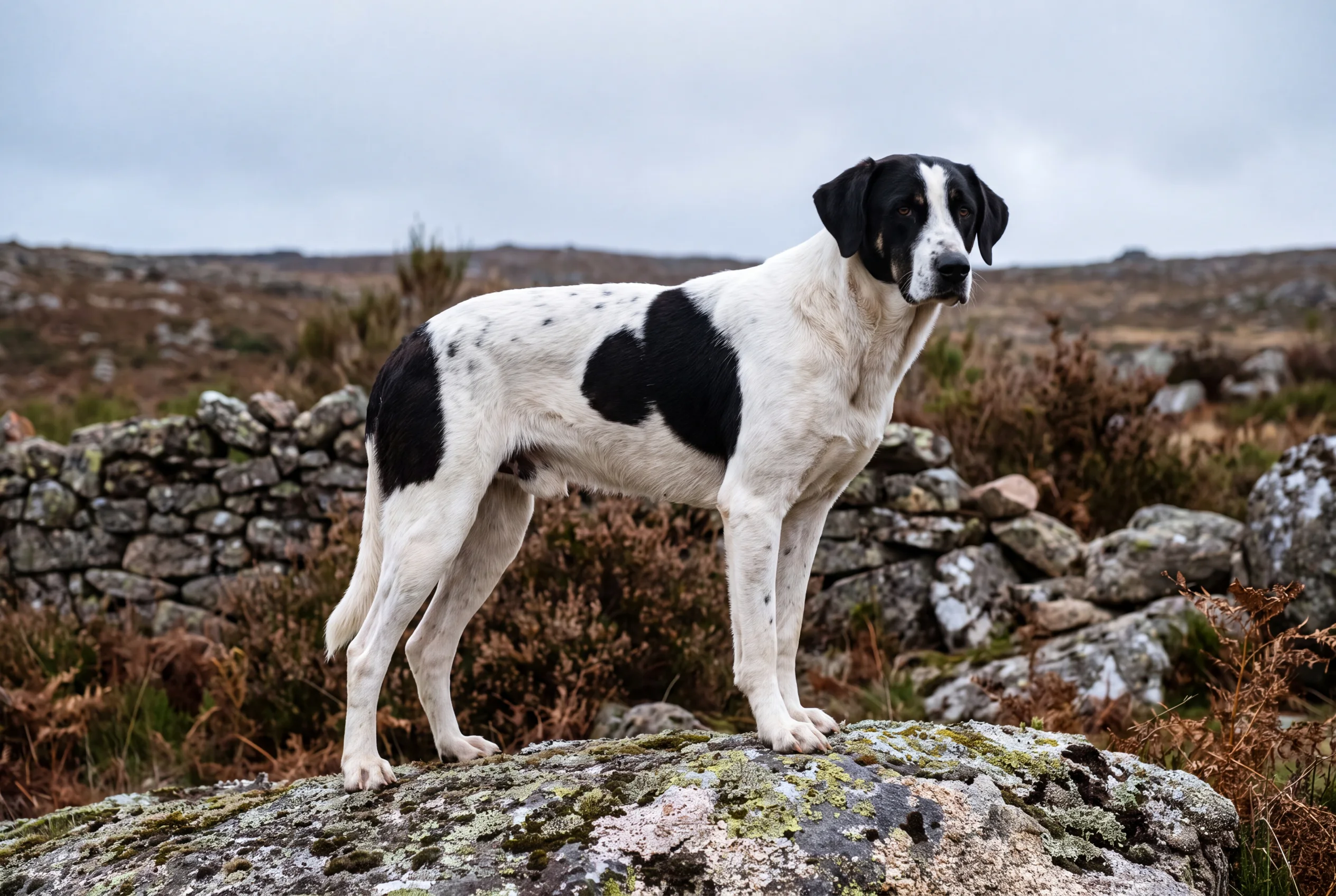
Cão de Gado Transmontano
Portugal's biggest dog, and it never guards the mountain alone.
Vital stats
| Size | Giant · 68–85 cm · males 75–85, females 68–78 |
| Weight | 50–75 kg · males 60–75, females 50–60 |
| Life expectancy | 10–12 years |
| Energy | Moderate — still most of the day, then covers ground |
| Shedding | Heavy — thick coat over a dense undercoat |
| Coat | Thick, medium length · usually white with black, yellow, fawn or wolf grey markings |
| Group | Working · Mountain Dog (FCI №368, Group 2) |
| Origin | Trás-os-Montes, Portugal |
| FCI group | 2 — Pinscher and Schnauzer, Molossoid and Swiss Mountain Dogs · FCI 368 |
Breed traits
Friendliness
Care
Mind
The Cão de Gado Transmontano by the numbers
The Cão de Gado Transmontano facts owners search for most — price, lifespan, weight, shedding and colours, in one place.
Less common, so expect a waitlist and some travel to a reputable breeder — which pushes the price up. Ongoing costs run high — more food, bigger doses at the vet, and pricier insurance.
We don't quote a single figure: the real price swings with breeder, region, bloodline and health testing — and a rescue costs a fraction of a breeder's litter. Adopting is almost always the cheapest route.
Temperament
The standard gets the size out of the way in its first line: despite its size it is a docile but reserved dog, cautious without being aggressive, always calm and with a serene expression. Then it says something the Estrela and Castro Laboreiro standards do not. In contact with strangers, after an initial reserve, it allows handling without problems, being very sensitive to gentle treatment and attention. That describes a guardian meant to tell a wolf from a walker rather than to treat both as intrusions, which is what shepherds wanted from a dog living out on open common grazing that other people cross. The same paragraph notes that it lives and socialises with other males without conflict. Indoors it is undemonstrative and slow-moving, attached to its own household and content to do nothing for hours, and it asks for very little until something around it changes.
Habits & quirks
Never one dog
Flock guarding here is never done by a single animal. The standard says so outright, and adds that the males live and socialise together without conflict and normally outnumber the females on a flock. A Trás-os-Montes shepherd with several hundred sheep runs several dogs, and the breed was shaped around that rather than around holding a yard by itself.
A hook in the tail counts against it
The tail is entire and thick, well covered with hair, hanging sabre shaped, and it may curve at the tip; in motion it lifts sickle-shaped and can even curl. A hook at the end is listed among the faults. Worth knowing if you have come to this breed from the Serra da Estrela, where a missing hook is the fault. Two Portuguese mountain breeds, opposite rules on the same piece of anatomy.
Still working against wolves
Conservation groups place pups of the native guardian breeds with shepherds in wolf country soon after weaning, cover food and veterinary care until the dog is grown, and send someone back every few weeks to see how it is settling with the flock. The reasoning is blunt. A shepherd who stops losing sheep has less reason to lay poison, and the Iberian wolf's biggest problem in Portugal is being killed in return for the ones it takes.
Moves lighter than the weight suggests
Height at the withers about equals body length, and the elbow sits noticeably higher than half the height at the withers, so the dog stands squarer and longer in the leg than 70 kg leads you to expect. The standard calls the gait light, energetic, rhythmical and with great extension, despite the size and corpulence. It will walk open grazing all day and still cross it quickly when it has to.
Health
Treat the Transmontano as the giant breed it is. There is very little published health data — the registered population is small and the studbook only goes back to around 2004 — so the pedigree does a lot of the work: ask for hip and elbow scores on both parents, read the pedigree yourself for how closely the litter is bred, and grow a puppy slowly rather than fast. One detail from the breed standard is worth carrying to the vet: this dog is not meant to be deep-chested — the chest should reach the elbow but not drop below it — so don't assume the classic barrel-chested giant outline is correct here.
Nutrition
| Exercise | An hour or two of unhurried walking a day, ideally on ground with some slope and some give in it, plus room to move around at home. This is not a running partner. It spends most of the day still and then covers distance when there is a reason to. Keep a growing puppy off stairs, jumps and long forced walks, because at this adult weight the joints take the better part of two years to finish. |
| Grooming | Thick hair of medium length over a dense undercoat, shorter and thinner on the head, ears, muzzle and limbs. A thorough brush once or twice a week covers it, daily when the undercoat lifts. The standard marks a coat that is not dense enough, too short in the body, or missing its undercoat as a severe fault, so a correct one sheds in proportion. |
| Training and visitors | Reward-based, patient, and started the week the puppy comes home. The standard describes a dog very sensitive to gentle treatment and attention, and heavy handling on an animal heading for 70 kg is both useless and unsafe. Teach a settle, a reliable recall and a routine for the front door long before the dog is big enough to make its own arrangements. Socialise into towns, traffic and other dogs, and keep going past the first year. |
| Health | There is very little published health data, because the registered population is small and the studbook is young; Portuguese records for the breed only start around 2004. Treat it as a giant breed. Ask for hip and elbow scores on both parents, read the pedigree yourself for how closely bred the litter is, and grow a puppy slowly rather than fast. One point from the standard is worth carrying to the vet: the chest should reach the elbow without passing it, and a chest below the elbow is a severe fault, so the classic deep-chested outline is not what this dog is supposed to have. |
A dog heading for 75 kg is easy to overfeed and expensive to get wrong, so feed the Transmontano for lean condition and let the frame set the pace. Grow a puppy slowly on a large- or giant-breed food — at this adult weight the joints take the better part of two years to finish, and pushing growth is how you damage them. Keep an adult lean, since every extra kilo tells on the joints of a giant, and split the day's food into more than one meal rather than a single large bowl.
Puppy guide
A Transmontano puppy becomes one of the largest dogs there is, so the first two years are about growing it slowly and safely. Keep it off stairs, jumps and long forced walks while the joints are still forming — at this eventual size they take nearly two years to finish. Start training and socialising the week it comes home, gently: take it into towns, traffic and the company of other dogs, and keep going well past the first birthday. Get the manners and the front-door routine in place early, long before the dog is big enough to make its own arrangements.
Training
Train with rewards and patience, and start the week the puppy arrives. The standard describes a dog very sensitive to gentle treatment and attention, and heavy handling on an animal heading toward 70 kg is both useless and unsafe. Teach a settle, a reliable recall and a calm routine for the front door long before the dog is big enough to arrange things for itself. This is a more sociable guardian than the Estrela or the Castro Laboreiro — its standard expects it to accept a stranger's hands once the first moment has passed — but that only pays off with early, steady socialising into towns, traffic and other dogs, kept up past the first year.
Life expectancy
Cães de Gado Transmontano live 10–12 years. That is a fair span for a dog this size, though little formal health data sits behind it. You protect it the way you protect any giant: grow the puppy slowly, keep the adult lean so the joints aren't carrying extra weight, screen the parents' hips and elbows, and choose a litter that isn't too closely bred from a young, small studbook.
Similar breeds
Breeds with a similar build and background — worth a look if this one isn't quite the fit.
Breeds that look like this
Common questions
Does this dog belong in a home with no livestock?
Usually not, and the size is only half the reason. A male can stand 85 cm and weigh 75 kg, which settles the question of most houses, most cars and a good many fences before temperament is even discussed. The other half is the job. This breed was selected to work open mountain grazing in company with other dogs and a shepherd nearby all day, and without a flock it will guard your household and your boundary instead, on its own, which is not the arrangement it was built for. The people who make it work have land, a fence that means something, time for a long daily walk and no expectation of an off-lead park dog. One thing genuinely helps: the standard's line about accepting handling after an initial reserve makes this a more sociable guardian than the Estrela or the Castro Laboreiro, so visitors tend to be a smaller problem than the logistics. If you wanted a large easygoing family dog, the logistics are still the problem.
Do guardian dogs actually help save wolves?
The chain is reasonable and partly measured, and it is worth being precise about which part is which. The Iberian wolf has been protected in Portugal since 1988, is listed there as Endangered, and its main threat is illegal killing in retaliation for livestock losses; dogs on a flock cut the losses, so there is less reason to shoot or poison. On the numbers, mind the source. Grupo Lobo's own reporting in Carnivore Damage Prevention News, a practitioner newsletter rather than a peer-reviewed journal, followed 97 dogs placed into 63 flocks from 1997 and found that losses fell in 75% of cases, by anywhere from 13% to 100%, with 90% of the adult dogs rated excellent or good by the shepherds keeping them. Those dogs were Castro Laboreiros, Estrelas and Rafeiros do Alentejo. The Transmontano joined the programme later and has not been reported separately at that level of detail. What nobody has published is a clean count of wolves not killed, which is a far harder thing to measure than sheep not lost.
How does it differ from the other Portuguese guardians, and can you buy one?
Size sorts it out first. The Transmontano is the largest of the four national guardian breeds, well clear of the Serra da Estrela and much heavier than the Castro Laboreiro. Colour sorts it second: white with black, yellow, fawn or wolf grey markings, against the Estrela's masked fawn or wolf grey and the Castro Laboreiro's brindled cor do monte. Temperament sorts it third, since this is the one whose standard expects it to accept a stranger's hands once the first moment has passed. Buying one is the hard part. The FCI has recognised the breed only provisionally, since February 2020, Portuguese records go back around twenty years, and most of these dogs are out working flocks in Trás-os-Montes rather than sitting in a studbook. Outside Portugal there is almost nothing, and a serious search means a Portuguese waiting list and a conversation in Portuguese.
Does the Cão de Gado Transmontano shed a lot?
Yes — the Cão de Gado Transmontano is a heavy shedder, dropping hair year-round or in big seasonal moults. Brush it several times a week and expect regular vacuuming; it isn't the coat for you if loose fur is a dealbreaker.
Is the Cão de Gado Transmontano hypoallergenic?
Not really. No dog is truly hypoallergenic, and the Cão de Gado Transmontano's shedding coat releases plenty of the dander that sets off allergies. If someone at home is allergic, this isn't the easiest breed to live with — spend time around one first.
Is the Cão de Gado Transmontano good with children?
They can be. The Cão de Gado Transmontano is reasonably sociable and can be good with children in the right home, especially when socialised early. Supervise around young kids and teach dog and child to respect each other.
Is the Cão de Gado Transmontano easy to train?
They can be a challenge. The Cão de Gado Transmontano is intelligent but independent, and would rather make its own decisions than take orders. Reward-based training and patience work best; expect recall in particular to take time.