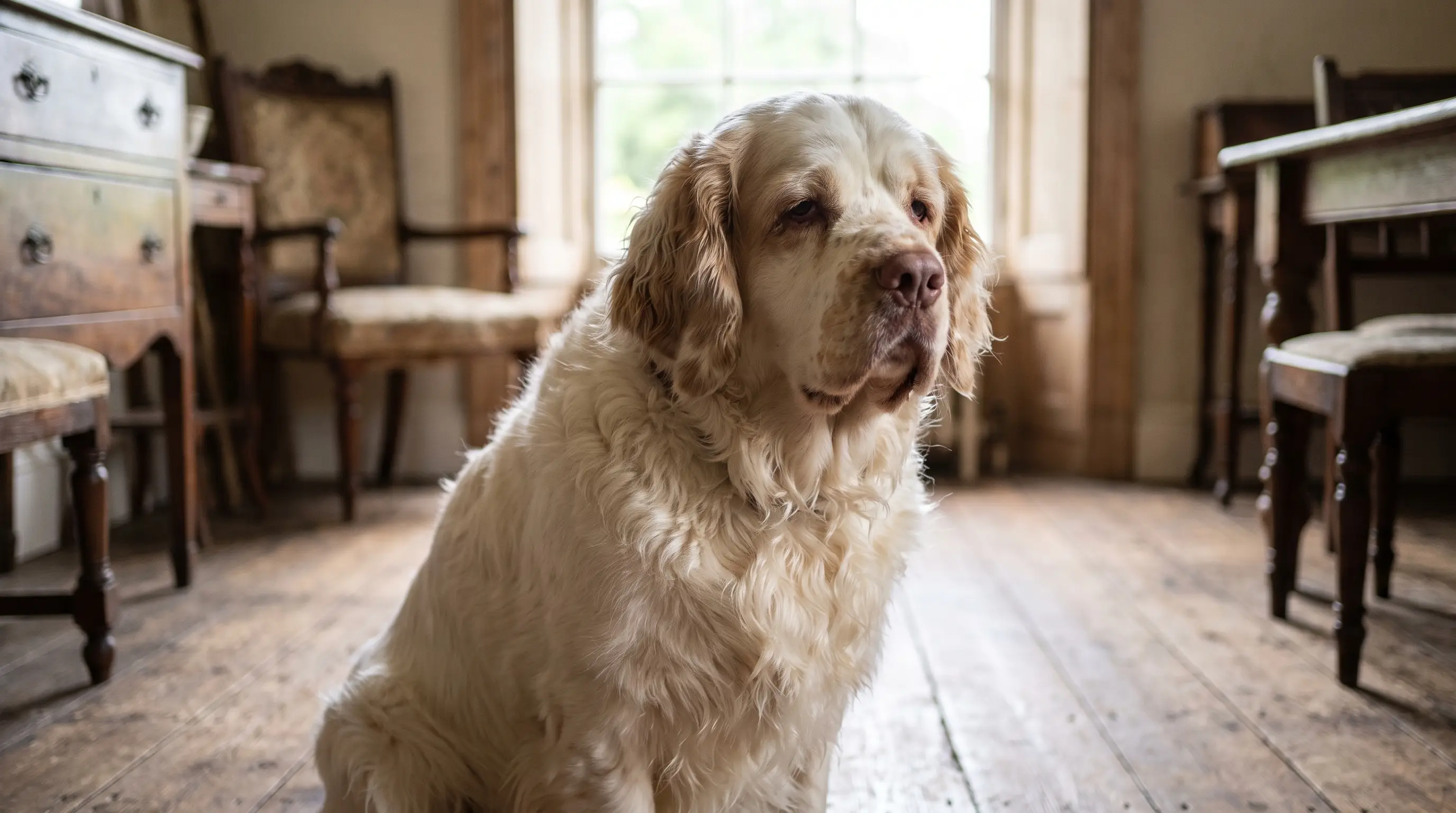
Clumber Spaniel
The gentleman's spaniel — slow, certain, and heavier than it looks.
Vital stats
| Size | Medium, long and heavy · 43–51 cm |
| Weight | 25–39 kg |
| Life expectancy | 10–12 years |
| Energy | Moderate — 45–60 min/day |
| Shedding | Heavy for a spaniel |
| Coat | Dense, straight white coat · lemon or orange markings |
| Group | Sporting · FCI №109 / AKC |
| Origin | Nottinghamshire, England |
| FCI group | 8 — Retrievers, Flushing Dogs and Water Dogs · FCI 109 |
Breed traits
Friendliness
Care
Mind
The Clumber Spaniel by the numbers
The Clumber Spaniel facts owners search for most — price, lifespan, weight, shedding and colours, in one place.
Less common, so expect a waitlist and some travel to a reputable breeder — which pushes the price up. Ongoing costs run high — more food, bigger doses at the vet, and pricier insurance.
We don't quote a single figure: the real price swings with breeder, region, bloodline and health testing — and a rescue costs a fraction of a breeder's litter. Adopting is almost always the cheapest route.
Temperament
Developed on the Duke of Newcastle's Clumber Park estate to push methodically through heavy cover, the Clumber works at a trot where other spaniels sprint. The same wiring at home gives you a thoughtful, even-tempered companion — playful in bursts, devoted without being needy, and stubborn in the mild, immovable way of a dog that knows its own pace.
Habits & quirks
The trophy bearer
A true spaniel mouth: it greets you carrying a shoe, a cushion, whatever conveys the occasion.
Freight-train snoring
That broad head comes with a soundtrack — Clumber snoring is audible through walls and oddly beloved.
The slow follow
It shadows you room to room at its own unhurried pace, arriving shortly after you've settled.
Selective hearing
It heard you perfectly; it's simply finishing what it was sniffing first.
Health
The Clumber is a lot of dog on a low, long frame, and that build sets the health priorities. Keep it genuinely lean — extra kilos punish the long back and the joints, and a food-loving breed will happily carry them. Ask a breeder about hips, and about the eyelids, since entropion runs in the breed and turns a lash inward against the eye. Those heavy, low-hung ears trap moisture, so keep them clean and dry to head off infections. Choose a breeder who screens for the above and shows you the results, not one who waves the question away.
Nutrition
| Exercise | A steady 45–60 minutes daily suits it — think long rambles and swimming, not road-running. |
| Grooming | Brush the dense white coat weekly and keep those long ears clean and dry to prevent infections. |
| Weight | Food-loving and low-slung — extra kilos punish the long back and joints, so measure meals. |
| Health | Watch hips, eyelids (entropion runs in the breed) and ears; choose breeders who screen. |
A Clumber loves its food and is built close to the ground, a combination that puts weight on fast and lands it exactly where the dog can least afford it — the long back and the joints. Measure the meals, keep ribs easy to feel under that dense coat, and be honest about treats, including the shoe-fetching bribes this breed invites. A lean Clumber moves better, ages better and snores no worse. Feed the dog in front of you rather than the label's guess for its weight bracket.
Puppy guide
A Clumber grows into a heavy, long-backed adult, so the puppy's job is to get there without overloading joints that are still forming. Keep exercise gentle and unforced in the first year — rambles and play, not road-running or stairs — and keep the pup lean from the start. Build the grooming and ear-cleaning routine into these early weeks so a big adult already accepts being handled, and start calm, food-led training while everything is small. Socialise widely, and let this slow, deliberate breed take things at the pace it was built for.
Training
A Clumber is mellow, not lazy: it was bred to work a full day through heavy cover at a deliberate trot, and it brings that same steady, self-possessed pace to training. It is stubborn in the mild, immovable way of a dog that knows its own mind, so nagging gets you nowhere and food gets you everywhere. Keep sessions short and rewarding, lean on the breed's love of scent games and retrieving, and forgive the selective hearing — it heard you, it is simply finishing its sniff first. Patient, consistent work suits it far better than drilling.
Life expectancy
Clumber Spaniels live 10–12 years. A Clumber earns the top of its range the same way it stays comfortable day to day: a lean weight that spares the long back and joints, clean dry ears, and parents screened for hips and eyes. This is a heavy dog on a low frame, and the kindest thing you can do for its years is to keep the scales honest.
Similar breeds
Breeds with a similar build and background — worth a look if this one isn't quite the fit.
Breeds that look like this
Common questions
Are Clumber Spaniels lazy?
Mellow, not lazy — they were bred to work all day at a deliberate trot rather than a sprint. They still need proper daily exercise and enjoy scent games and retrieving.
Do Clumber Spaniels drool?
Yes — those loose flews mean more slobber than any other spaniel, especially after drinking. Keep a towel by the water bowl and make peace with it.
Why are Clumber Spaniels so rare?
They were always an aristocrat's estate dog rather than a popular pet, and numbers stayed small after the world wars. Today they're a vulnerable native breed in the UK with few litters a year.
Does the Clumber Spaniel shed a lot?
Yes — the Clumber Spaniel is a heavy shedder, dropping hair year-round or in big seasonal moults. Brush it several times a week and expect regular vacuuming; it isn't the coat for you if loose fur is a dealbreaker.
Is the Clumber Spaniel hypoallergenic?
Not really. No dog is truly hypoallergenic, and the Clumber Spaniel's shedding coat releases plenty of the dander that sets off allergies. If someone at home is allergic, this isn't the easiest breed to live with — spend time around one first.
Is the Clumber Spaniel good with children?
Generally yes. The Clumber Spaniel is a friendly, people-loving breed that usually does well with children when raised and socialised well. As with any dog, teach children to be gentle and supervise around toddlers.
Is the Clumber Spaniel easy to train?
Reasonably. The Clumber Spaniel is trainable with consistency and rewards, though it isn't the quickest study. Keep sessions short and positive, and be patient with the basics like recall.