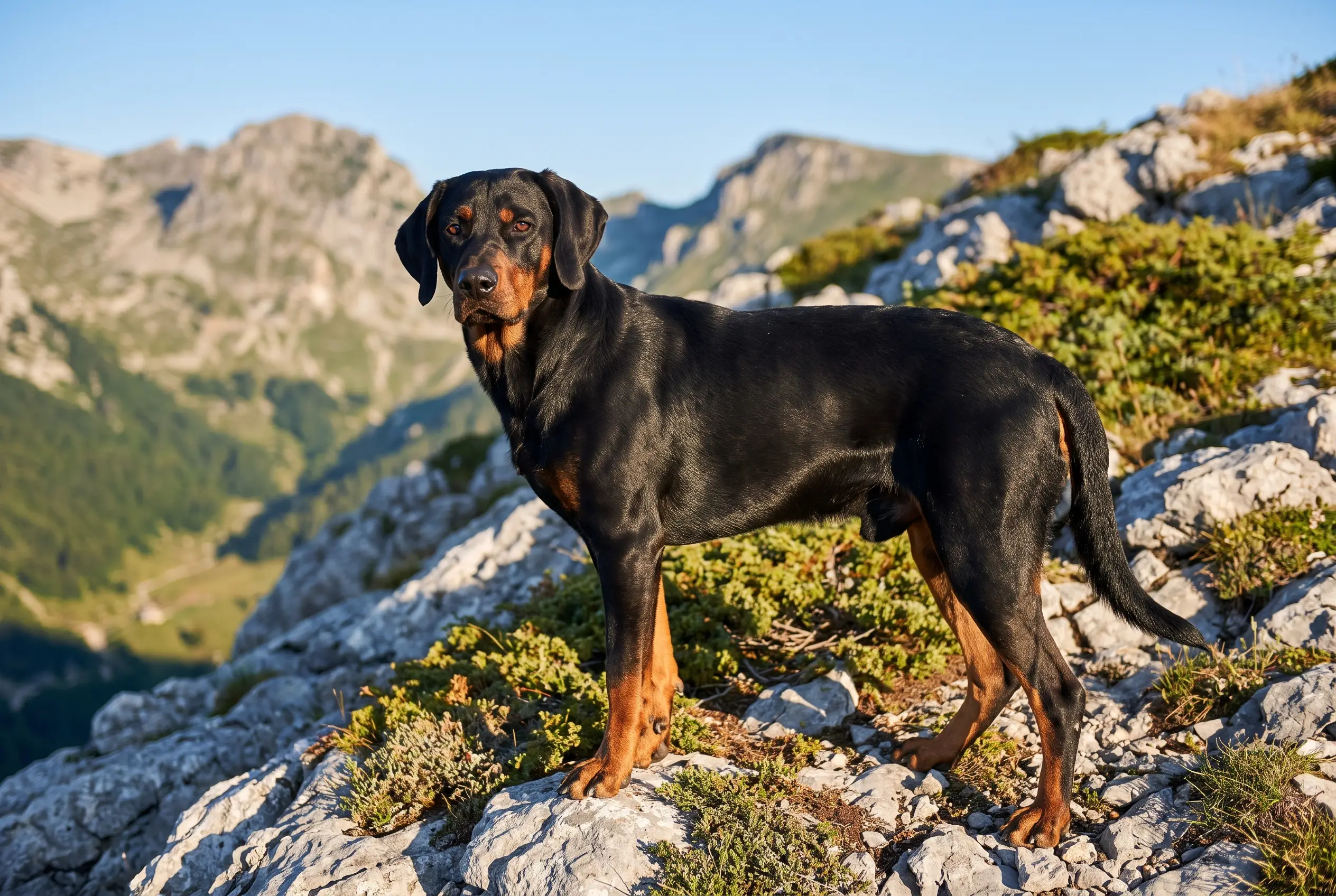
Crnogorski Planinski Gonič
The only solid black-and-tan hound in the Balkans, built to run a mountain trail all day.
Vital stats
| Size | Medium · 44–54 cm |
| Weight | 20–25 kg — breed literature; the standard sets none |
| Life expectancy | 11–14 years — breed literature, not survey data |
| Energy | High — built to hunt all day on steep, rocky ground |
| Shedding | Low — short coat, a weekly brush is enough |
| Coat | Short, dense, rough-textured, glossy · black with tan markings |
| Group | Scenthound · Medium-sized Hound (FCI №279, Group 6) |
| Origin | Republic of Montenegro |
| FCI group | 6 — Scent hounds and related breeds · FCI 279 |
Breed traits
Friendliness
Care
Mind
The Crnogorski Planinski Gonič by the numbers
The Crnogorski Planinski Gonič facts owners search for most — price, lifespan, weight, shedding and colours, in one place.
Less common, so expect a waitlist and some travel to a reputable breeder — which pushes the price up. Plan for steady ongoing costs — mid-range food, routine vet care and insurance.
We don't quote a single figure: the real price swings with breeder, region, bloodline and health testing — and a rescue costs a fraction of a breeder's litter. Adopting is almost always the cheapest route.
Temperament
The standard's behaviour clause runs four words: well balanced, attached to his master, docile, trustworthy. That's a working hound's temperament, not a lapdog's — it describes a dog that trusts its handler and does the job it's given rather than one bred to sit quietly in a flat. On the trail it's a scenthound through and through, following ground scent for hours at a steady pace across difficult terrain. At home the standard's own words hold: docile and trustworthy, without the wariness or edge that shows up in some regional guard breeds. It isn't a breed built to be ignored — a scenthound left without exercise or scent work tends to find its own trail, usually the neighbour's bin.
Habits & quirks
Exactly one coat, drawn precisely
The colour clause is oddly specific: black over the body, with tan the size of a hazelnut above each eye, tan on the sides of the muzzle that must not run past the corner of the lips, and tan grading from light red to a bright, warm red on the legs. A white patch on the chest up to 3 cm across is tolerated — the standard is blunt that it isn't wanted.
Cat feet for karst
The forefeet are true cat feet: tight, well-arched toes on black, elastic pads. It's a foot built to grip loose limestone rather than soft turf, which matches the ground it was bred to cover — Montenegro's Balkan uplands run steep and rocky, not flat.
The name is the job description
Planinski is Serbo-Croatian and Montenegrin for mountain. Paired with gonič — hound, literally chaser — the name states the job plainly: a hound that runs scent trails through highland terrain.
One dog, two names on the record
The FCI recognised this breed on 8 May 1969 in Warsaw as the Yugoslav Mountain Hound. Standard number 279 never changed; only the name did, on 15 July 1997, when the FCI renamed it Crnogorski Planinski Gonič after Montenegro took over patronage of the breed.
Health
There is little on the health record for this hound, which is good news read carefully rather than a guarantee: breed literature reports no widely recognised breed-specific problems, but there is no breed-wide survey behind that, and the 11–14 years usually quoted for lifespan come from breeders, not data. The population outside the Balkans is small, and a small gene pool is the thing to ask about. Talk to the breeder about hip screening and how deep the pedigree goes — sound practice for any working hound with limited numbers, rather than a box the breed clubs make you tick. Beyond that, this is a hardy mountain worker: keep it fit, keep it lean, and let it use its nose.
Nutrition
| Exercise | This is a working scenthound built to cover mountain ground for hours at a steady trot. Long daily walks or runs on varied, uneven terrain suit it far better than flat laps of a park, and real scent work — a trailing game, or hunting where that's the household's thing — gives it the job its nose expects. |
| Grooming | The short, dense, rough-textured coat needs little beyond a weekly brush to clear loose hair; there's no heavy undercoat blowout to plan around. Check the low-set, close-lying ears after time outdoors, especially in cover. |
| Training | The standard's own description — well balanced, docile, trustworthy — is a dog that wants to work with a handler, not against one. The real challenge is the nose: once it locks onto a scent trail, recall has to be trained early and kept sharp, the same as with any serious scenthound. |
| Health | Breed literature reports no widely recognised breed-specific health problems, and there's no breed-wide health survey behind the 11–14 years usually quoted for life expectancy. The population outside the Balkans is small, so ask breeders directly about hip screening and pedigree depth — sound practice for any working hound with limited numbers, not a documented programme requirement here. |
Feed a working scenthound to the work it actually does: a hound running mountain trails all day and a hound pottering round a garden do not need the same bowl. Weigh the meals, count the training treats in the day's total, and check by hand for ribs under that short, dense coat. Keep it lean — extra weight is a straight tax on the joints and the stamina this breed is built around. There is nothing exotic to manage here; a good complete food, matched to age and workload, is the whole of it.
Puppy guide
A young Montenegrin Mountain Hound is a scenthound in the making, so the nose leads and the recall has to be built before it does. Start recall early and make coming back the best thing that happens all day, because once an adult locks onto a trail a half-taught recall won't hold it. Let the body grow into the work rather than racing it — long, steady walks on varied ground do more than hard runs while the joints are still forming. Socialise widely so a confident, level-headed hound is what you end up with, the docile, trustworthy dog its own standard describes.
Training
The good news is in the standard: this is a hound bred to work with a handler, not against one, well balanced and biddable by nature. The catch is the nose. Once it picks up a trail it stops hearing you, so recall is the one lesson you cannot let slide — teach it early, reward it hard, and keep it sharp for the life of the dog. Keep sessions short and interesting, work on a long line near livestock or roads until the recall is genuinely proof, and give the nose a proper job so it doesn't invent one.
Life expectancy
Montenegrin Mountain Hounds live 11–14 years — breed literature, not survey data. This is a hardy breed with little on its health record, and you keep a hound at the top of that range the ordinary way: lean weight, real daily exercise for body and nose, and a breeder who can talk openly about hips and pedigree. The number itself comes from breeders rather than a survey, so treat it as a guide and let the dog's condition, not the calendar, tell you how it's ageing.
Similar breeds
Breeds with a similar build and background — worth a look if this one isn't quite the fit.
Breeds that look like this
Common questions
Is the Crnogorski Planinski Gonič the same dog as the Yugoslav Mountain Hound?
Same dog, same FCI standard number, different name on file. The FCI recognised the breed in Warsaw on 8 May 1969 as the Yugoslav Mountain Hound. After Yugoslavia broke apart and Montenegro took over patronage of the breed, the FCI renamed it Crnogorski Planinski Gonič — Montenegrin Mountain Hound in English — on 15 July 1997. Standard No. 279 never changed; only the cover did.
How do you tell it apart from the other Balkan scenthounds?
By colour, mostly. The Crnogorski Planinski Gonič is the only regional FCI hound that comes solid black with tan points — hazelnut-sized tan over the eyes, tan on the muzzle and lower legs. Its neighbours run different: the Srpski Gonič (FCI №150) is fox red with a black saddle, the Srpski Trobojni Gonič (FCI №229) is tricolour on the same red-and-black base, the Posavski Gonič (FCI №154) is red-wheaten with white markings, the Istrian hounds (FCI №151 shorthaired, №152 wirehaired) are white with orange patches, and the Bosanski Oštrodlaki Gonič-Barak (FCI №155) runs wheaten to grey with white markings. A solid black-and-tan hound, in this company, is this one.
Does it need an experienced owner?
Not a beginner's dog, but not a difficult one either. It's a scenthound bred to hunt steep ground for hours, so it needs real daily exercise and something for its nose to do — an under-exercised hound invents its own entertainment, usually somewhere inconvenient. In return, the standard promises a dog that's genuinely docile and attached to its family, and owners report the same.
Does the Crnogorski Planinski Gonič shed a lot?
Not much. The Crnogorski Planinski Gonič is a low-shedding breed, so loose hair around the home stays minimal. It still needs regular grooming, but you won't be fighting drifts of fur.
Is the Crnogorski Planinski Gonič hypoallergenic?
No dog is truly hypoallergenic, but the Crnogorski Planinski Gonič comes closer than most: its low-shedding coat releases less of the dander that triggers allergies. Many allergy sufferers manage well with this breed, but spend time around one before committing.
Is the Crnogorski Planinski Gonič good with children?
They can be. The Crnogorski Planinski Gonič is reasonably sociable and can be good with children in the right home, especially when socialised early. Supervise around young kids and teach dog and child to respect each other.
Is the Crnogorski Planinski Gonič easy to train?
Reasonably. The Crnogorski Planinski Gonič is trainable with consistency and rewards, though it isn't the quickest study. Keep sessions short and positive, and be patient with the basics like recall.