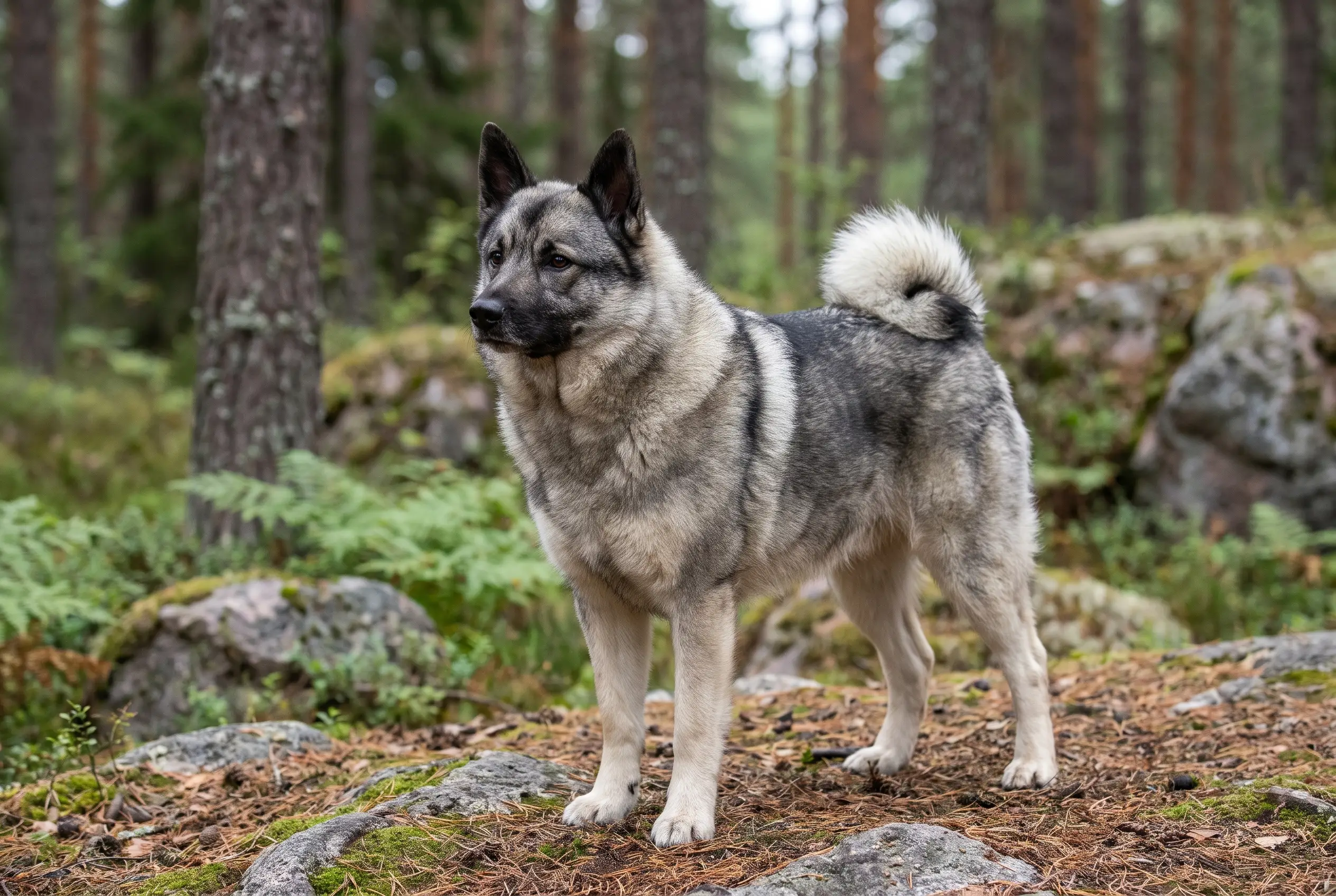
Norwegian Elkhound
Norway's grey hunter — moose ahead, millennia behind.
Vital stats
| Size | Medium · 49–52 cm |
| Weight | 20–25 kg |
| Life expectancy | 12–15 years |
| Energy | High — 60–90 min/day |
| Shedding | Very heavy, seasonal blows |
| Coat | Dense grey double coat · black-tipped guard hairs |
| Group | Hound · FCI №242 / AKC |
| Origin | Norway |
| FCI group | 5 — Spitz and primitive types · FCI 242 |
Breed traits
Friendliness
Care
Mind
The Norwegian Elkhound by the numbers
The Norwegian Elkhound facts owners search for most — price, lifespan, weight, shedding and colours, in one place.
Widely bred, so you can usually find a litter from a registered breeder without a long wait. Plan for steady ongoing costs — mid-range food, routine vet care and insurance. Its coat also needs a professional groom every few weeks — a real line in the budget.
We don't quote a single figure: the real price swings with breeder, region, bloodline and health testing — and a rescue costs a fraction of a breeder's litter. Adopting is almost always the cheapest route.
Temperament
For centuries the Elkhound ranged ahead of Norwegian hunters, trailing moose alone and pinning them in place with relentless barking — work that bred a dog who thinks for itself and reports at volume. At home it is loyal, dignified, and affectionate on its own terms, with a hunter's nose that never clocks off.
Habits & quirks
The bark bulletin
News, weather, and visitor alerts are delivered at hunting volume.
Snow-drift napping
Offered a warm bed and a snowbank, it will often choose the snowbank.
The nose veto
An interesting scent trail outranks most instructions.
Dinner diplomacy
Few breeds negotiate for food with such patient, dignified persistence.
Care
| Exercise | An hour or more of vigorous daily activity — hiking, jogging, long rambles; this breed has trailed moose all day. |
| Grooming | Rake the dense coat weekly, and daily through the spectacular spring and autumn moults. |
| Feeding | A famously easy keeper: measure meals and ration treats or the waistline vanishes. |
| Training | Start recall early and keep sessions short — an independent hunter obeys when convinced, not commanded. |
Life expectancy
This breed has a typical life expectancy of 12–15 years.
Similar breeds
Breeds with a similar build and background — worth a look if this one isn't quite the fit.
Breeds that look like this
Common questions
Do Norwegian Elkhounds bark a lot?
Yes — barking is literally the breed's hunting technique, and the voice carries. Training moderates it, but a quiet Elkhound was never the design.
Can Norwegian Elkhounds live with cats?
Raised together from puppyhood, often yes — but the prey drive is real, and strange cats or small pets outdoors will be chased. Manage introductions carefully.
Are Elkhounds good apartment dogs?
Only for dedicated owners: the barking and exercise needs work against flat life. A house, a garden and long daily outings suit this forest breed far better.
Does the Norwegian Elkhound shed a lot?
Yes — the Norwegian Elkhound is a heavy shedder, dropping hair year-round or in big seasonal moults. Brush it several times a week and expect regular vacuuming; it isn't the coat for you if loose fur is a dealbreaker.
Is the Norwegian Elkhound hypoallergenic?
Not really. No dog is truly hypoallergenic, and the Norwegian Elkhound's shedding coat releases plenty of the dander that sets off allergies. If someone at home is allergic, this isn't the easiest breed to live with — spend time around one first.
Is the Norwegian Elkhound good with children?
They can be. The Norwegian Elkhound is reasonably sociable and can be good with children in the right home, especially when socialised early. Supervise around young kids and teach dog and child to respect each other.
Is the Norwegian Elkhound easy to train?
Reasonably. The Norwegian Elkhound is trainable with consistency and rewards, though it isn't the quickest study. Keep sessions short and positive, and be patient with the basics like recall.