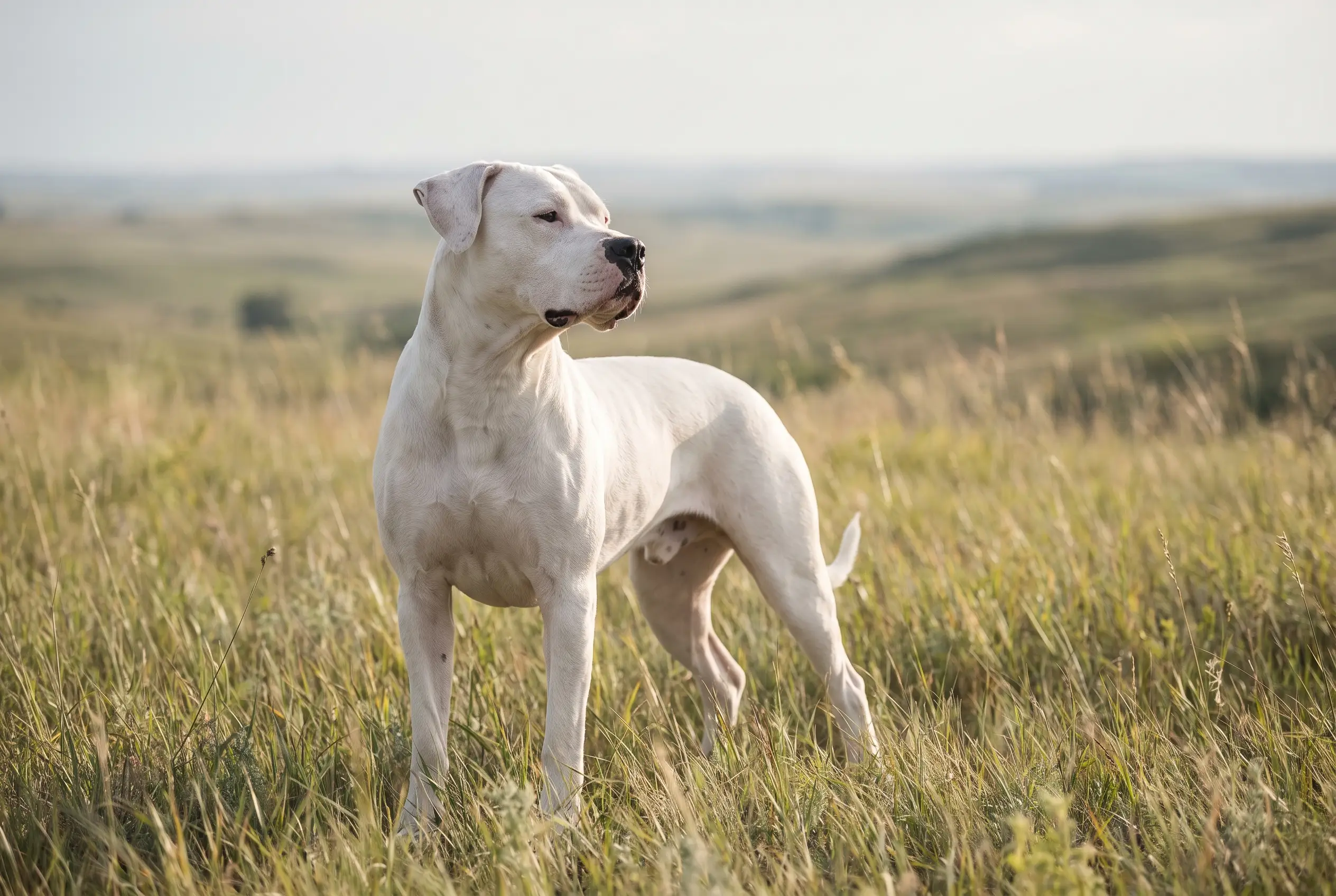
Dogo Argentino
A white knight of the Pampas — big-game courage wrapped around family devotion.
Vital stats
| Size | Large · 60–68 cm |
| Weight | 35–45 kg |
| Life expectancy | 9–15 years |
| Energy | High — 60–90 min/day |
| Shedding | Low–moderate |
| Coat | Short and smooth · pure white |
| Group | Working · FCI №292 / AKC |
| Origin | Córdoba, Argentina |
| FCI group | 2 — Pinscher and Schnauzer, Molossoid and Swiss Mountain Dogs · FCI 292 |
Breed traits
Friendliness
Care
Mind
The Dogo Argentino by the numbers
The Dogo Argentino facts owners search for most — price, lifespan, weight, shedding and colours, in one place.
Widely bred, so you can usually find a litter from a registered breeder without a long wait. Ongoing costs run high — more food, bigger doses at the vet, and pricier insurance.
We don't quote a single figure: the real price swings with breeder, region, bloodline and health testing — and a rescue costs a fraction of a breeder's litter. Adopting is almost always the cheapest route.
Temperament
Built from a fighting-breed base into a pack hunter of boar and puma, the Dogo was deliberately bred to be fierce in the field yet stable and affectionate at home. That contract holds — with experienced owners who socialise early and lead consistently. Its courage is bottomless; your judgement must match it.
Habits & quirks
The gentle switch
Ferocious focus on the trail, soft clowning with its family — the founder designed exactly that.
Sun seeker
White coat notwithstanding, the Dogo drapes itself in every sunbeam — mind the sunburn.
Power play
Tug, wrestle, sprint — it plays like the athlete it is, so teach manners early.
The velvet guardian
Quietly positions itself between its people and anything new.
Health
The health headline for the Dogo Argentino is its ears. A pure-white coat comes with a pigment-linked risk of congenital deafness, which shows up in a minority of puppies in one ear or both, and there is a straightforward answer to it: buy only from a breeder who BAER-tests every litter and will show you the results, including the parents'. Ask about hips as well, and screen your own dog. One more thing the white coat brings is sunburn — this is a dog that will lie in every sunbeam it can find, so thin-coated pink skin needs watching in strong sun. Test the hearing, check the hips, mind the sun.
Nutrition
| Socialisation | Wide, early and ongoing exposure to people and dogs is non-negotiable for this powerful hunter. |
| Exercise | Daily vigorous outlets — running, tug, scent games — keep the athlete content. |
| Health | The white coat carries a pigment-linked deafness risk — buy from BAER-tested litters; screen hips too. |
| Legality | Banned or restricted in several countries and cities — always check local law first. |
The Dogo Argentino is a big, powerful athlete — 35 to 45 kg of working muscle — and how you feed it is really about protecting that frame. Feed to keep the dog genuinely lean, where you can feel the ribs without pressing, because every extra kilo lands on the joints of a heavy, fast, hard-playing dog. Match the food to real daily exercise rather than to the dog's size, count training treats in the total, and take particular care through the long puppy growth of a large breed, when steady condition matters more than fast size. With a dog built like this, lean is the whole game.
Puppy guide
With a Dogo Argentino puppy, socialisation is not an enrichment activity — it is the whole job. Wide, early and continuing exposure to people and other dogs is non-negotiable for a powerful guardian breed that will, left to itself, quietly appoint itself protector of the household. Start young: reward calm greetings, teach manners before the puppy is strong enough to make its own rules, and build the off switch into the play, because a Dogo tugs, wrestles and sprints like the athlete it becomes. If the litter was BAER-tested you already know your puppy hears; the rest is the patient, consistent leadership this breed needs from an experienced owner, every week, for the first couple of years.
Training
Training a Dogo Argentino is a commitment to consistency, not a six-week course. This is a breed for experienced, active owners: it was built to be fierce in the field and stable at home, and that contract only holds when the person at the other end of the lead socialises early and leads the same way every day. The courage is bottomless, so your judgement has to match it — set clear rules, keep them, and make good manners a habit long before the dog has the size and power to negotiate. Reward, patience and calm beat a heavy hand every time; a Dogo works with a leader it trusts, not one it fears. And before any of it, check your local law — the breed is banned or restricted in several countries and cities.
Life expectancy
Dogo Argentinos live 9–15 years. The Dogo Argentino's lifespan spans a wide band, as it does for many large breeds, and lean weight is the single biggest thing in your control: a slim Dogo asks far less of its heart and joints across a long life than a heavy one. Beyond that, the longevity work is done up front — a BAER-tested, hip-screened puppy from a careful breeder, early socialisation that makes the adult easy to live with, and daily exercise that keeps a working athlete fit rather than frustrated. Look after the joints, keep the weight off, and give this dog the active life it was built for.
Similar breeds
Breeds with a similar build and background — worth a look if this one isn't quite the fit.
Breeds that look like this
Common questions
Is the Dogo Argentino a good family dog?
In experienced hands, yes — the breed was deliberately created to be gentle and devoted with its family. It still needs serious socialisation, training and exercise, and it is not a first dog.
Is the Dogo Argentino banned anywhere?
Yes — several countries, including the UK, restrict or ban the breed, and some cities and insurers add their own rules. Always check local law before committing.
Are Dogo Argentinos deaf?
The all-white coat is linked to pigment-associated deafness, which affects a minority of puppies in one or both ears. Buy from breeders who BAER-test their litters.
Does the Dogo Argentino shed a lot?
Moderately. The Dogo Argentino sheds a fair amount, steadily through the year with heavier seasonal patches. A weekly brush keeps most of the loose hair off your floors and clothes.
Is the Dogo Argentino hypoallergenic?
Not really. No dog is truly hypoallergenic, and the Dogo Argentino's shedding coat releases plenty of the dander that sets off allergies. If someone at home is allergic, this isn't the easiest breed to live with — spend time around one first.
Is the Dogo Argentino easy to train?
Reasonably. The Dogo Argentino is trainable with consistency and rewards, though it isn't the quickest study. Keep sessions short and positive, and be patient with the basics like recall.