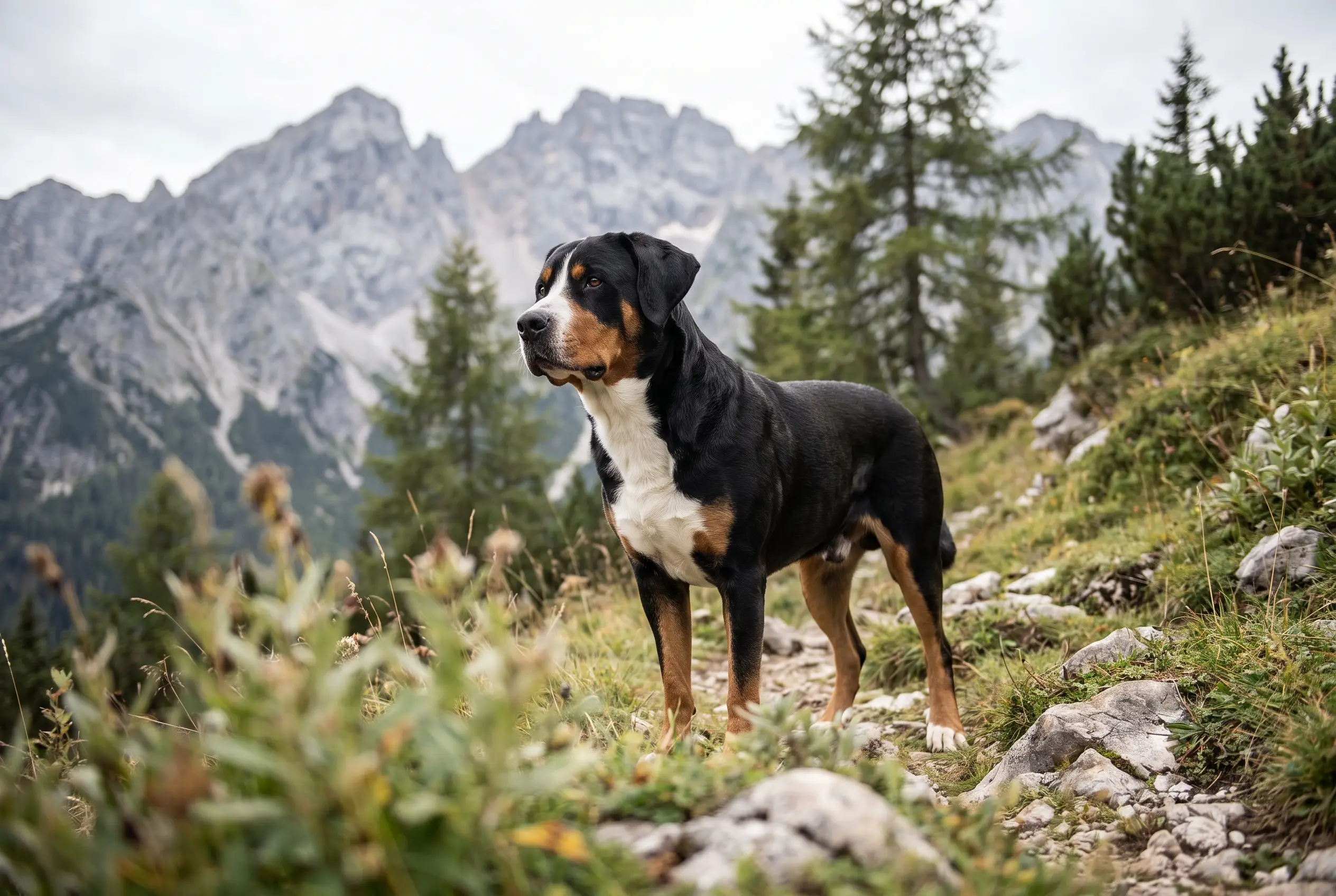
Greater Swiss Mountain Dog
The farmer's draught horse in dog form — an Alpine giant with a valley-filling bark.
Vital stats
| Size | Large · 60–72 cm |
| Weight | 30–50 kg |
| Life expectancy | 8–11 years |
| Energy | Moderate — 45–60 min/day |
| Shedding | Moderate, heavier in spring and autumn |
| Coat | Short dense double coat · black, rust & white |
| Group | Working · FCI №58 / AKC |
| Origin | Swiss Alps, Switzerland |
| FCI group | 2 — Pinscher and Schnauzer, Molossoid and Swiss Mountain Dogs · FCI 58 |
Breed traits
Friendliness
Care
Mind
The Greater Swiss Mountain Dog by the numbers
The Greater Swiss Mountain Dog facts owners search for most — price, lifespan, weight, shedding and colours, in one place.
Widely bred, so you can usually find a litter from a registered breeder without a long wait. Ongoing costs run high — more food, bigger doses at the vet, and pricier insurance.
We don't quote a single figure: the real price swings with breeder, region, bloodline and health testing — and a rescue costs a fraction of a breeder's litter. Adopting is almost always the cheapest route.
Temperament
Bred to pull carts of milk and cheese and drive cattle to Alpine markets, the Swissy is confident, steady, and deeply attached to its people. That working past shows up as vigilance — one deep bark tells you someone's at the gate — and a cheerful readiness to lean 50 kilos of love against your legs.
Habits & quirks
The lean
A Swissy shows affection by pressing its full weight against your legs — brace accordingly.
The announcement bark
One resonant boom for every arrival; it was the farm's doorbell for centuries.
Cart-dog heart
Give it something to pull or carry and watch it glow — draught work is in the blood.
Puppy for years
The body grows fast, the mind takes its time — expect a giant adolescent until age three.
Health
The big health topics with a Greater Swiss Mountain Dog come with the size. Learn the signs of bloat and act fast if you see them — deep-chested giants carry real risk — and consider splitting the day's food into two meals. The joints matter too: raise the dog to spare the hips and elbows, and buy from a breeder who screens. This is a giant breed, so the lifespan is shorter than a smaller dog's, which is simply the trade for all that dog.
Nutrition
| Exercise | Steady daily walks and hikes rather than repetitive impact — protect those growing joints until fully mature. |
| Health | Learn the signs of bloat and consider splitting meals; deep-chested giants carry real risk. |
| Training | Start leash manners early — a full-grown Swissy pulls harder than most owners can hold. |
| Feeding | Grow puppies slowly on large-breed food; rapid weight gain stresses hips and elbows. |
Grow a Swissy slowly — feed a large-breed diet and resist the urge to pile on weight, because rapid gain stresses hips and elbows while the frame is still forming. In an adult, keep it lean: easy ribs, a visible waist, no spare load on those joints. Given the deep chest, split the daily ration into two meals and let things settle around exercise rather than feeding one big bowl.
Puppy guide
A Swissy grows fast in the body and slowly in the head — expect a giant adolescent until around three. Let the frame build at its own pace: steady walks and gentle play rather than repetitive impact, and no forced running while the joints are open. Start leash manners on day one, because the cute puppy that leans on your shin becomes fifty kilos that pulls, and socialize the watchful side early so confidence, not suspicion, is the default.
Training
Start leash manners early and mean it — a full-grown Greater Swiss pulls harder than most owners can hold, and a dog that hauls you down the path is no fun for either of you. Happily, it's a steady, biddable working breed that wants to work with you, so calm, consistent, reward-based sessions land well. Set the manners while it's small enough to guide.
Life expectancy
Greater Swiss Mountain Dogs live 8–11 years. A giant breed's years are fewer than a small dog's, and that's the honest trade for a dog this size. You make the most of them the sensible way: grow the puppy slowly, keep the adult lean to protect hips and elbows, know the signs of bloat, and start with parents from a breeder who health-screens.
Similar breeds
Breeds with a similar build and background — worth a look if this one isn't quite the fit.
Breeds that look like this
Common questions
Is the Greater Swiss Mountain Dog the same as the Bernese?
No — they're cousins among Switzerland's four Sennenhund breeds. The Swissy is bigger, short-coated, and generally a touch more vigilant.
How much exercise does a Swissy need?
Less than its size suggests — 45–60 minutes of steady walking or hiking daily suits most. They're draught dogs, not endurance runners.
Are Greater Swiss Mountain Dogs good family dogs?
Excellent ones — patient, devoted and gentle with children they know. Just supervise around toddlers; an affectionate lean can flatten a small person.
Does the Greater Swiss Mountain Dog shed a lot?
Moderately. The Greater Swiss Mountain Dog sheds a fair amount, steadily through the year with heavier seasonal patches. A weekly brush keeps most of the loose hair off your floors and clothes.
Is the Greater Swiss Mountain Dog hypoallergenic?
Not really. No dog is truly hypoallergenic, and the Greater Swiss Mountain Dog's shedding coat releases plenty of the dander that sets off allergies. If someone at home is allergic, this isn't the easiest breed to live with — spend time around one first.
Is the Greater Swiss Mountain Dog easy to train?
Reasonably. The Greater Swiss Mountain Dog is trainable with consistency and rewards, though it isn't the quickest study. Keep sessions short and positive, and be patient with the basics like recall.