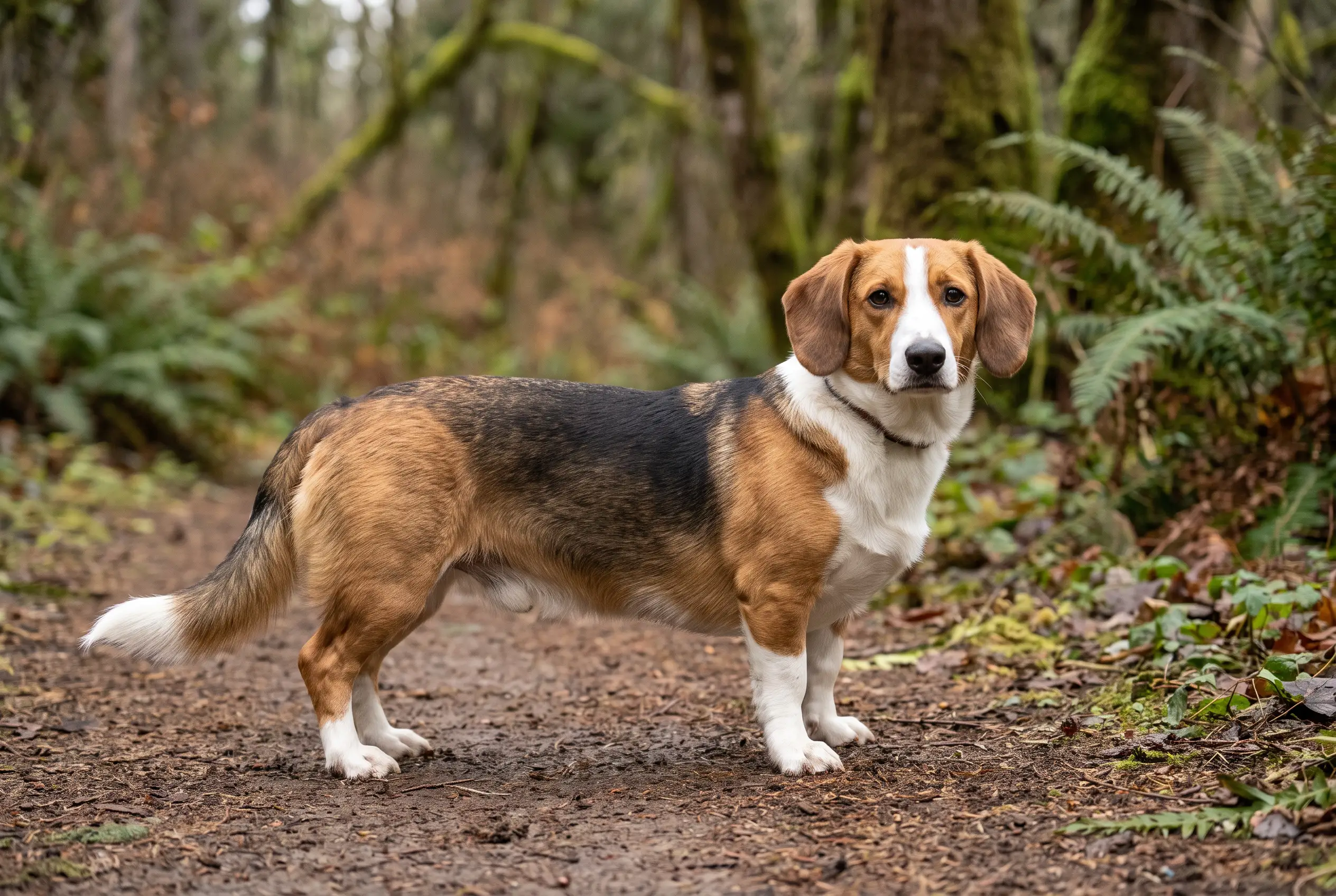
Drever
Bred down from a German import to track deer over rough Swedish ground, and renamed by public vote in 1947.
Vital stats
| Size | Small · 32–38 cm (dogs), 30–36 cm (bitches) |
| Weight | 14–18 kg — breed-club figure; the standard's own "Size and weight" heading gives no number |
| Life expectancy | 12–15 years — breed literature, not survey data |
| Energy | High — built to track deer and hare over rough ground all day |
| Shedding | Low to moderate — short, harsh, close-lying coat |
| Coat | Short, harsh, straight and close-lying · any colour with clearly defined white markings |
| Group | Scenthound · Small-sized Hounds (FCI №130, Group 6) |
| Origin | Sweden |
| FCI group | 6 — Scent hounds and related breeds · FCI 130 |
Breed traits
Friendliness
Care
Mind
The Drever by the numbers
The Drever facts owners search for most — price, lifespan, weight, shedding and colours, in one place.
Widely bred, so you can usually find a litter from a registered breeder without a long wait. Plan for steady ongoing costs — mid-range food, routine vet care and insurance.
We don't quote a single figure: the real price swings with breeder, region, bloodline and health testing — and a rescue costs a fraction of a breeder's litter. Adopting is almost always the cheapest route.
Temperament
The standard's own behaviour clause is short: "Keen and even-tempered hound. Never aggressive, nervous or shy." That keenness is a hunting drive, not household energy — the standard's history section notes the breed is strictly kept as a hunting dog and is hardly ever heard of as "just" a companion dog, and its general-appearance section calls for a dog built to work efficiently in Swedish terrain and climate. In practice, a Drever with a job is stable, biddable and unbothered by gunfire or strange dogs at a hunt; a Drever with nothing to track can turn restless, and its nose will start making decisions if a person doesn't get there first.
Habits & quirks
A German import, renamed by vote
The Drever descends from the Westphalian Dachsbracke (FCI №100), imported to Sweden around 1910 and first registered in 1913. In 1947 the larger of two size types then in use was given the name Drever, from the Swedish drev, a hunt style where hounds drive game toward waiting guns; breed histories describe the name as the winner of a newspaper competition, a detail the standard itself doesn't repeat. Sweden's kennel club recognised the breed nationally in 1953, and the FCI followed in 1955.
Built to a ratio
The standard's proportions section is unusually precise: the distance from ground to sternum should equal 40% of the height at the withers, and the muzzle should equal the skull in length. The result reads exactly as intended — a robust, fairly long body on short legs, built for a full day's work rather than speed.
White markings, within limits
The colour section allows any base colour as long as white markings are present and clearly defined, preferably as a blaze, a full neck collar, and white on the legs, feet and tail tip, with symmetrical markings preferred. Three things disqualify outright: a predominantly white coat, merle, and liver brown.
Sweden's most popular hunting hound
Alongside the rare Nordic and Baltic scenthounds it shares a family tree with, the Drever stands out for sheer numbers: Sweden's own kennel club describes it as one of the country's great favourites among hunters, with no other scenthound matching its popularity there. Outside Scandinavia it stays a working specialist — the UKC recognised it only in 1996, and the AKC still keeps it in its Foundation Stock Service rather than full recognition.
Health
The Drever's own breed literature reports no widely flagged hereditary problem specific to the breed — the standard's fault list is almost entirely structural — so this is a genuinely hardy little hound. Two sensible cautions apply anyway. It is a long-bodied dog on short legs, so keep it lean and go easy on repeated jumping on and off furniture to spare the back, and as with any hunting breed kept in a small international population, ask a breeder about hip screening and the depth of the pedigree.
Nutrition
| Exercise | Built for a full day tracking deer, hare and fox over rough Swedish ground, the Drever needs real daily work, not just a walk — tracking games, long off-lead hikes with scent work, or actual hunting. A Drever without a nose-led outlet will find its own trail to follow, on or off the property. |
| Grooming | The coat is short, harsh, straight and close-lying, longer on the neck, back and back of the thighs, and it needs only a weekly brush. Check the broad, medium-long ears, which hang close to the cheeks without folds and can trap moisture after a day in wet cover. |
| Training | The standard's temperament clause is short and direct — keen and even-tempered, never aggressive, nervous or shy — which makes the Drever biddable by hound standards. The catch is the nose: recall needs early, consistent work, because a hunting-bred scenthound mid-track isn't reliably listening. |
| Health | The standard's fault list is almost entirely structural — bite, eye colour, coat pattern — rather than a list of hereditary disease, and breed literature reports no widely flagged health problem specific to the Drever. As with any hunting breed kept in a small international population, it's worth asking a breeder about hip screening and pedigree depth. |
Built low and long to track deer over rough ground all day, the Drever is an easy keeper with a real appetite, which is a combination that puts weight on fast. Weigh the food, fold the scent-work treats into the daily total, and keep the dog lean — extra weight on that long back is exactly what it doesn't need. Feed to the day's actual work: a full day's tracking and a quiet day at home are not the same meal.
Puppy guide
A Drever puppy is a nose with legs, switched on to scent from early on, so the first year is about building recall before the nose takes over completely. Keep the growing body's work sensible — this is a long-backed dog, so limit repeated stair-climbing and big jumps while the frame sets — and pour your energy into scent games and a rock-solid recall instead. Socialise widely so the even, biddable temperament the standard describes has every chance to settle in.
Training
The standard's temperament clause is short and direct — keen and even-tempered, never aggressive, nervous or shy — which makes the Drever biddable by hound standards. The one catch is the nose: a hunting-bred scenthound mid-track is not reliably listening, so recall needs early, consistent, high-value work and a long line well into the first year. Keep sessions short and rewarding, and give that keen nose a legal outlet before it finds its own.
Life expectancy
Drevers live 12–15 years — breed literature, not survey data. The Drever is a hardy, long-lived hound with no breed-specific disease widely flagged against it, and you hold it at the top of that range with the basics: a lean weight that spares the long back, real daily work for the nose, and a breeder who screens hips and breeds from a deep enough pedigree. The years quoted come from breed literature rather than a survey, so read them as a guide.
Similar breeds
Breeds with a similar build and background — worth a look if this one isn't quite the fit.
Breeds that look like this
Common questions
Is the Drever the same dog as a Dachshund?
No, different breeds, despite the short legs and a shared German root. The Dachshund's classification runs by chest circumference and it was bred to go underground after badger and fox; the Drever comes from the Westphalian Dachsbracke (FCI №100), a Group 6 scenthound whose own standard sets a height (32–38 cm) and calls for a dog that tracks deer, hare and fox on the surface, in a hunting party, not below it alone.
Are Drevers good pets outside Sweden?
They can be, but go in with clear eyes: the breed's own FCI standard notes it is strictly kept as a hunting dog and is hardly ever heard of as "just" a companion dog. A Drever needs a real outlet for its nose and stamina — scent work, tracking, or actual hunting — and does best with people ready to give it a job, not just a sofa.
What's the difference between a Drever and Sweden's other stövare hounds, like the Hamiltonstövare or Smålandsstövare?
Leg length, mostly. The Hamiltonstövare (FCI №132) and Smålandsstövare (FCI №129) are taller, longer-legged hounds built for a faster gallop; the Drever is deliberately short on leg — the standard's own phrase — so a hunter on foot can keep pace with it while it tracks. All three come out of the same Swedish scenthound tradition and share an even, biddable temperament, but the Drever is built to be followed on foot, not to outrun its handler.
Does the Drever shed a lot?
Moderately. The Drever sheds a fair amount, steadily through the year with heavier seasonal patches. A weekly brush keeps most of the loose hair off your floors and clothes.
Is the Drever hypoallergenic?
Not really. No dog is truly hypoallergenic, and the Drever's shedding coat releases plenty of the dander that sets off allergies. If someone at home is allergic, this isn't the easiest breed to live with — spend time around one first.
Is the Drever good with children?
They can be. The Drever is reasonably sociable and can be good with children in the right home, especially when socialised early. Supervise around young kids and teach dog and child to respect each other.
Is the Drever easy to train?
Reasonably. The Drever is trainable with consistency and rewards, though it isn't the quickest study. Keep sessions short and positive, and be patient with the basics like recall.