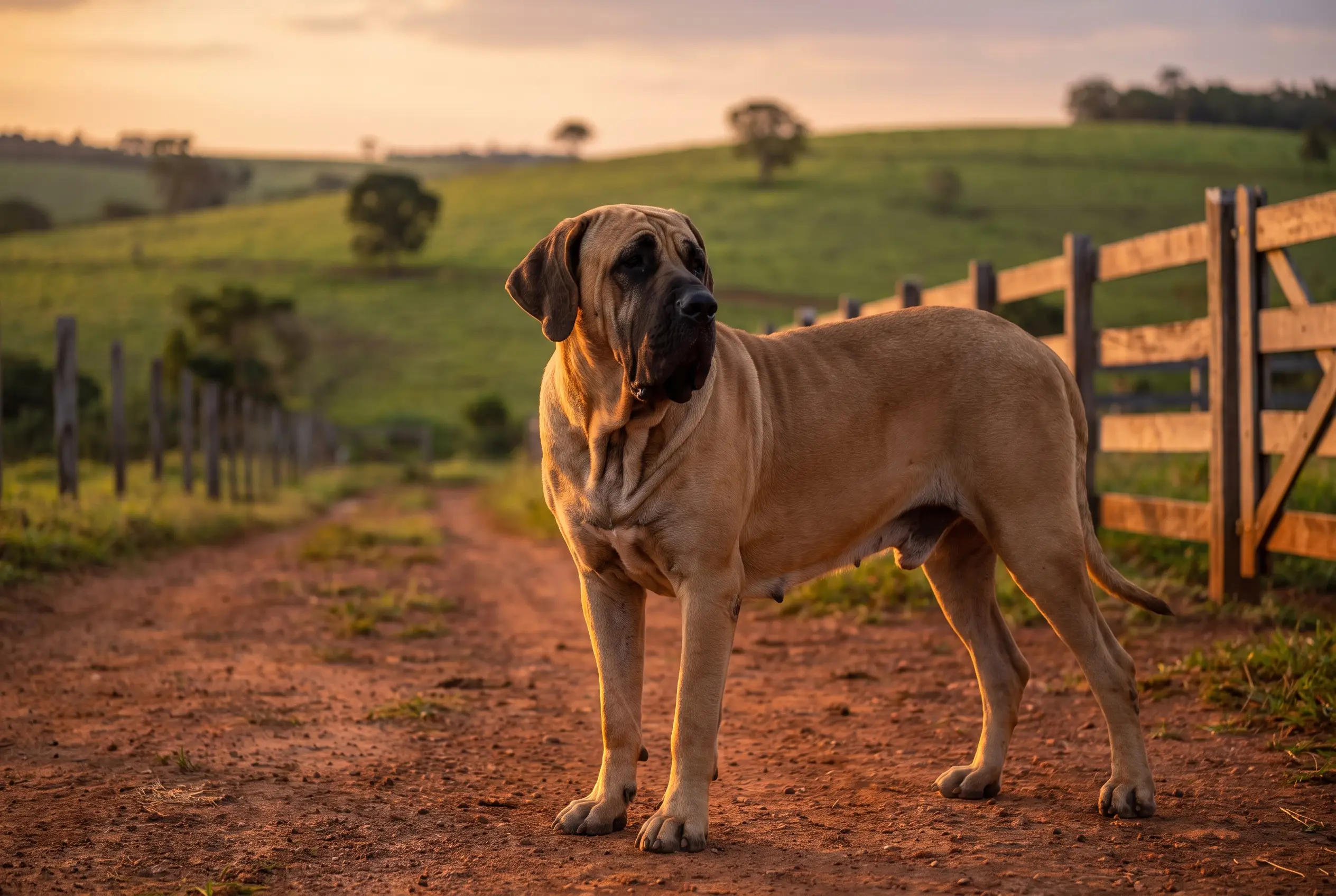
Fila Brasileiro
“Faithful as a Fila,” the Brazilian saying goes. Strangers get the other half of the deal.
Vital stats
| Size | Giant · 60–75 cm |
| Weight | From 40 kg (females) · from 50 kg (males) |
| Life expectancy | 9–11 years |
| Energy | Moderate — long daily patrols, not sprints |
| Shedding | Low to moderate — a weekly brush covers it |
| Coat | Short and smooth · fawn, brindle or black, often with a black mask |
| Group | Working · Molossoid (FCI №225, Group 2) |
| Origin | Brazil |
| FCI group | 2 — Pinscher and Schnauzer, Molossoid and Swiss Mountain Dogs · FCI 225 |
Breed traits
Friendliness
Care
Mind
The Fila Brasileiro by the numbers
The Fila Brasileiro facts owners search for most — price, lifespan, weight, shedding and colours, in one place.
Less common, so expect a waitlist and some travel to a reputable breeder — which pushes the price up. Ongoing costs run high — more food, bigger doses at the vet, and pricier insurance.
We don't quote a single figure: the real price swings with breeder, region, bloodline and health testing — and a rescue costs a fraction of a breeder's litter. Adopting is almost always the cheapest route.
Temperament
Two dogs live in one skin. With its family the Fila is calm, patient and physically affectionate, gentle with household children and happiest spending the day within sight of its people — Brazilians say “faithful as a Fila” for a reason. With strangers it shows ojeriza, a pronounced distrust the FCI standard describes as typical of the breed; it deepens as the dog matures, and no amount of training removes it. Early, lifelong socialisation teaches a Fila to carry that suspicion quietly instead of acting on it — that is the realistic goal, and it takes an owner who has raised large guardian breeds before and never needs this dog to be friendly at the gate.
Habits & quirks
Ojeriza at the gate
From adolescence on it draws a firm line between its people and everyone else. The standard itself describes the aversion to strangers; visitors get watched, not welcomed.
The camel walk
Its signature gait moves both legs on one side together, a rolling amble the standard calls the camel's pace. It looks unhurried and covers farm distances all day.
Butter with its own
Inside the family circle it is patient and physically gentle, children included, and will lean its 50-plus kilos on whoever sits still long enough.
Nose to the ground
The Bloodhound share still works. Bred to trail jaguar and stray cattle, it drops its head to a scent and follows — another reason the fence has to be real.
Health
The Fila Brasileiro is a giant guardian breed, and its health needs are the ones that go with that size and shape. Screen breeding lines for hip and elbow dysplasia, and watch for entropion, where the eyelid rolls inward against the eye. Like other deep-chested giants it is at risk of bloat (gastric torsion), so feed two or three smaller meals a day rather than one large one and keep hard exercise well away from mealtimes. Let a Fila grow slowly rather than pushing size and weight on a young frame — the joints of a giant are years in the making — and keep the adult lean to spare them.
Nutrition
| Exercise | An hour or more of walking a day, plus ground of its own to patrol. It was bred for steady farm rounds, not fetch or dog-park play — which it should skip anyway. |
| Training | Socialise early and keep at it for life, with calm, reward-based handling from an experienced owner. Harsh methods backfire badly on a guardian this suspicious. |
| Space & fencing | A securely fenced property is the entry ticket, with managed introductions for every visitor, courier and meter reader. A city flat cannot hold this breed. |
| Health | Screen breeding lines for hip and elbow dysplasia and watch for entropion (eyelids rolling inward). Deep-chested giants bloat: feed two or three smaller meals and keep exercise away from mealtimes. |
Feed a Fila as the deep-chested giant it is. The single most important rule is bloat prevention: split the daily ration into two or three smaller meals instead of one big one, and leave a clear gap between eating and any hard exercise. Grow puppies slowly and steadily rather than forcing size, and keep the adult lean — extra weight on a dog this large is a direct tax on the hips, elbows and joints you're trying to protect. Match the food to a life of long, steady patrols rather than sprints.
Puppy guide
A Fila puppy is where the whole project succeeds or fails, and it is not a project for a first-time owner. The breed's distrust of strangers — ojeriza — is bred in and arrives with maturity no matter what, so early and genuinely lifelong socialisation is not optional: it teaches the dog to carry that suspicion quietly instead of acting on it. Handle everything calmly and with rewards, introduce every visitor on your terms, and start before you even bring the puppy home by confirming the breed is legal where you live and that you have securely fenced ground. Raise the body slowly too, keeping hard exercise light while a giant's joints form.
Training
Training a Fila is a decade-long commitment to management, not a puppy course you finish. Socialise early and keep at it for life, always with calm, reward-based handling — harsh methods backfire badly on a guardian this suspicious and this powerful. The realistic goal is never a dog that greets strangers warmly; it is a dog that watches quietly and takes its cue from you at every gate, door and introduction. This takes an owner who has raised large guardian breeds before, has the fencing and the routine to control who the dog meets, and has checked that the breed is legal where they live.
Life expectancy
Fila Brasileiros live 9–11 years. The Fila Brasileiro is a giant breed, and giants are shorter-lived than smaller dogs — you keep one sound for its span rather than stretching it far beyond. Screen the parents for hip and elbow dysplasia, watch for entropion, guard against bloat with split meals and calm timing around exercise, and above all keep the adult lean, because every extra kilo on a frame this size wears the joints faster. Slow growth in puppyhood and a steady, unhurried life of patrols do more for a Fila's years than anything in a bowl.
Similar breeds
Breeds with a similar build and background — worth a look if this one isn't quite the fit.
Breeds that look like this
Common questions
Is the Fila Brasileiro legal to own?
Not everywhere. The UK bans the breed by name under the Dangerous Dogs Act, Norway and Denmark ban it too, and a further list of countries and territories restrict or prohibit it. Check your national and municipal law before you ever contact a breeder — and if you live where the Fila is banned, that is the answer, not an obstacle to work around.
Is a Fila a good first dog?
No. Its distrust of strangers is bred in, arrives with maturity whether you invite it or not, and has to be managed for ten years or more by someone who can read a giant guardian and control every introduction. First-time owners, flat dwellers and busy households with a constant flow of visitors should choose another breed — for the dog's sake as much as their own.
What does “ojeriza” actually mean?
It is Portuguese for a deep, instinctive aversion, and in this breed it names the distrust of strangers written into the FCI standard — judges are even told not to penalise a Fila for refusing a stranger's touch. It is not bad training and not a defect; it is the breed. The same standard describes the other side: docile, obedient and gentle with its own people.
Does the Fila Brasileiro shed a lot?
Moderately. The Fila Brasileiro sheds a fair amount, steadily through the year with heavier seasonal patches. A weekly brush keeps most of the loose hair off your floors and clothes.
Is the Fila Brasileiro hypoallergenic?
Not really. No dog is truly hypoallergenic, and the Fila Brasileiro's shedding coat releases plenty of the dander that sets off allergies. If someone at home is allergic, this isn't the easiest breed to live with — spend time around one first.
Is the Fila Brasileiro good with children?
It depends. The Fila Brasileiro tends to be more reserved, so it suits older, calmer children better than boisterous toddlers. Early socialisation and careful, supervised introductions matter more with this breed.
Is the Fila Brasileiro easy to train?
Reasonably. The Fila Brasileiro is trainable with consistency and rewards, though it isn't the quickest study. Keep sessions short and positive, and be patient with the basics like recall.