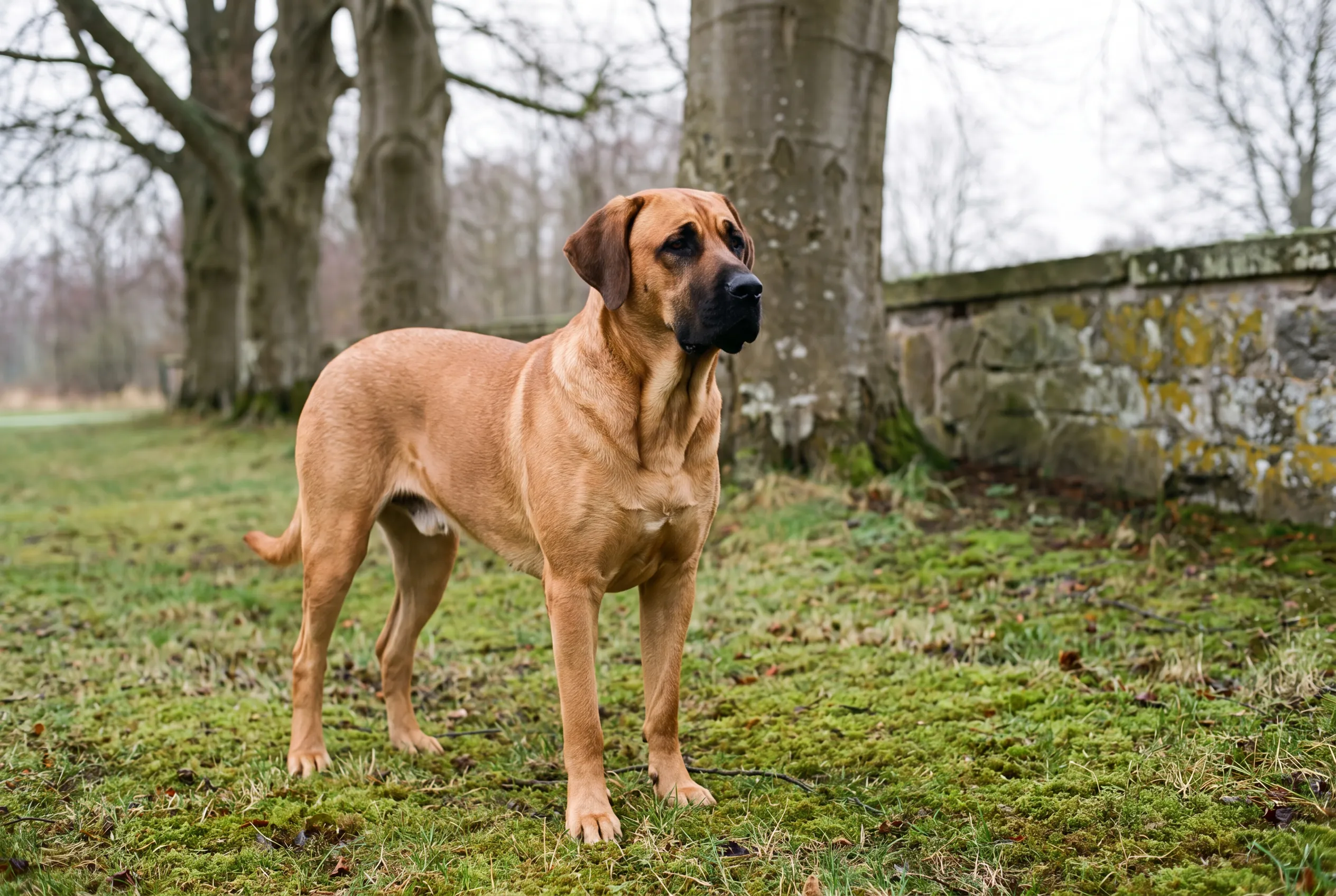
Broholmer
Denmark's estate mastiff, rebuilt from a magazine appeal and the dogs that answered it.
Vital stats
| Size | Giant · 70–75 cm |
| Weight | 40–70 kg |
| Life expectancy | 7–12 years |
| Energy | Low to moderate — a walker, not a runner |
| Shedding | Moderate — short coat over a dense undercoat |
| Coat | Short and close-lying · yellow or red, with or without a black mask, or black |
| Group | Working · Mastiff (FCI №315, Group 2) |
| Origin | Funen, Denmark |
| FCI group | 2 — Pinscher and Schnauzer, Molossoid and Swiss Mountain Dogs · FCI 315 |
Breed traits
Friendliness
Care
Mind
The Broholmer by the numbers
The Broholmer facts owners search for most — price, lifespan, weight, shedding and colours, in one place.
Less common, so expect a waitlist and some travel to a reputable breeder — which pushes the price up. Ongoing costs run high — more food, bigger doses at the vet, and pricier insurance.
We don't quote a single figure: the real price swings with breeder, region, bloodline and health testing — and a rescue costs a fraction of a breeder's litter. Adopting is almost always the cheapest route.
Temperament
The FCI standard asks for calm, good tempered, friendly and watchful, with great self-confidence, and a well-bred Broholmer reads exactly like that. It lies down in the middle of the room and stays there. It gets up when the door goes, has a look, and settles again. It barks at what earns it. The old job was holding a farmyard rather than patrolling one, and the guarding instinct still works that way: presence, not pursuit. With its own people it is openly affectionate, which at 60 kg means a head in your lap and a shoulder leaning on your shins. Strangers get an unhurried once-over. That self-confidence shows up day to day as a dog that does not startle and does not escalate. What owners raise instead is the other side of the same coin — when a Broholmer does decide something is wrong, there is very little of the resulting decision a person can physically overrule.
Habits & quirks
Settles, and stays settled
Indoors this is one of the quietest big dogs going. It picks a spot with a view of the door, drops, and does not get up for much. The flip side is that a bored Broholmer does not fidget or chew, it simply gets heavier.
Leans on people
Affection here is delivered by body weight. A Broholmer greets you by putting its head across your knees and its shoulder against your leg, and it does not adjust the force for children or for anyone unsteady on their feet.
Takes two years to finish
Giant breeds grow long and grow late, and the Broholmer is still filling out through its second year. Breeders keep puppies off stairs, off jumps and off forced road-work until the joints have closed, and they keep them lean while they do it.
Answers the door rather than the fence
It is watchful without being reactive, and most of the alerting happens at the threshold. Fence-line patrolling and boundary barking are not typical, which is one of the few things about owning a dog this size that is easier than expected.
Health
Plan for a giant breed built from a narrow founder base. Hip and elbow dysplasia are the standing orthopaedic concerns, the SOD1 mutation behind degenerative myelopathy is documented in the breed and clears with a DNA test, and heart screening is routine in the big molossers. Danish breeding approval runs through the breed society and requires hip and elbow scores, a temperament assessment and DNA testing, with a cap on how many puppies one sire may produce — ask to see those results. Ask about pedigree depth too, because with this few founders the inbreeding coefficient matters more than usual.
Nutrition
| Exercise | An hour or two of steady walking a day, split into two outings, suits it. This is not an endurance dog and not a running partner: it works at a walk and a trot, and heavy exercise on an unfinished skeleton does real damage. Sniffing routes and slow ground beat distance. |
| Grooming | The easiest part of the breed. A rubber mitt or bristle brush once a week lifts the dead undercoat, more often during the seasonal drop. Keep an eye on the ear leathers and the loose skin at the throat, and expect some drool after drinking, though less than the pendulous-lipped mastiffs. |
| Training | Start early, while you can still pick the dog up. It is biddable, food-motivated and slower to fire than most guarding breeds, but lead manners, an off switch at the door and calm handling by strangers all have to be routine before the dog outweighs the handler. Reward-based work throughout; force on a 60 kg dog is a bad plan and a worse habit. |
| Health | Plan around a giant breed with a narrow founder base. Hip and elbow dysplasia are the standing orthopaedic concerns, the SOD1 mutation behind degenerative myelopathy is documented in the breed, and cardiac screening is normal practice in the large molossers. Danish breeding approval runs through the breed society and requires hip and elbow scores, a temperament assessment and DNA testing, with limits on how many puppies one sire may produce. Ask for those results and ask about pedigree depth, because with this few founders the coefficient of inbreeding matters more than usual. |
With a giant breed, keeping it lean is the single biggest thing you control, and it matters most while the dog is still growing — extra weight on an unfinished skeleton does lasting damage to hips and elbows. Feed a large-breed puppy diet on a breeder's or vet's guidance through that long growth, weigh the meals, and go easy on treats. A grown Broholmer is a calm dog that walks rather than runs, so it needs less fuel than its size suggests; judge by the waistline, not the scoop.
Puppy guide
A Broholmer grows long and grows late, still filling out through its second year, so the first job is protecting the joints while they close: keep a puppy off stairs, off jumps and off forced road-work, and keep it lean the whole time. The second job is training, started early — while you can still lift the dog — because lead manners, a calm greeting and settling at the door all need to be routine before a puppy outweighs the person holding the lead. Socialise it gently and widely; a confident giant is a manageable one.
Training
Start early, while you can still pick the dog up. A Broholmer is biddable, food-motivated and slower to fire than most guarding breeds, but lead manners, an off switch at the door and calm handling by strangers all have to be habit before the dog outweighs you. Keep everything reward-based from the start — force on a sixty-kilo dog is a bad plan and a worse habit — and remember that with a breed this size, the training you skip is a physical problem later, not just a behavioural one.
Life expectancy
Broholmers live 7–12 years. Breed sources put the Broholmer at {life} — a wide range, and an honest one for a giant breed rebuilt from a small founder group; the FCI standard gives no figure at all. Big dogs age faster and carry more joint load, and this gene pool hasn't had many generations to shed its problems, so the low end is a realistic outcome rather than a failure of care. Screened parents, a lean puppy through growth, and a lean adult afterwards are the levers actually in your hands.
Similar breeds
Breeds with a similar build and background — worth a look if this one isn't quite the fit.
Breeds that look like this
Common questions
Can a first-time owner handle a Broholmer?
Temperament is not the obstacle here. This is one of the calmer large guarding breeds, it is not a bolter, and it wants to be near you rather than working a boundary. The obstacle is arithmetic. An adult male is 75 cm at the shoulder and up to 70 kg, so a dog that leans on a toddler, pulls on ice, or refuses to get into the car at the vet is a physical problem you have to solve with training done in advance, because you will not solve it with strength. Add the costs that scale with body mass: food, anaesthetic, medication, insurance, and a car that fits the crate. First-time owners who train early and consistently do well with the breed. First-time owners who intend to start when the puppy is six months old are already too late.
How hard is it to find one outside Denmark?
Hard. Nothing left Denmark until 1998, and the breed sits under an estimated 800 dogs worldwide with most of them still Danish. Elsewhere in Europe you are looking at a handful of breeders per country, litters planned years ahead, and the Danish society's approval rules shaping which matings happen at all. In North America it remains an AKC Foundation Stock Service breed rather than a fully recognised one, and the population is smaller again. Waiting is normal. A Broholmer puppy available immediately, cheaply, and without health results is worth walking away from.
How long do they actually live?
Breed sources put it at roughly seven to twelve years, which is a wide range and an honest one for a giant breed rebuilt from a small founder group. The FCI standard gives no figure. Big dogs age faster and carry more joint load, and the Broholmer's gene pool has not had many generations to shed problems, so the low end of that range is a realistic outcome and not a failure of care. Screened parents, a lean body condition through growth, and staying lean afterwards are the levers you actually control.
Does the Broholmer shed a lot?
Moderately. The Broholmer sheds a fair amount, steadily through the year with heavier seasonal patches. A weekly brush keeps most of the loose hair off your floors and clothes.
Is the Broholmer hypoallergenic?
Not really. No dog is truly hypoallergenic, and the Broholmer's shedding coat releases plenty of the dander that sets off allergies. If someone at home is allergic, this isn't the easiest breed to live with — spend time around one first.
Is the Broholmer good with children?
Generally yes. The Broholmer is a friendly, people-loving breed that usually does well with children when raised and socialised well. As with any dog, teach children to be gentle and supervise around toddlers.
Is the Broholmer easy to train?
Reasonably. The Broholmer is trainable with consistency and rewards, though it isn't the quickest study. Keep sessions short and positive, and be patient with the basics like recall.