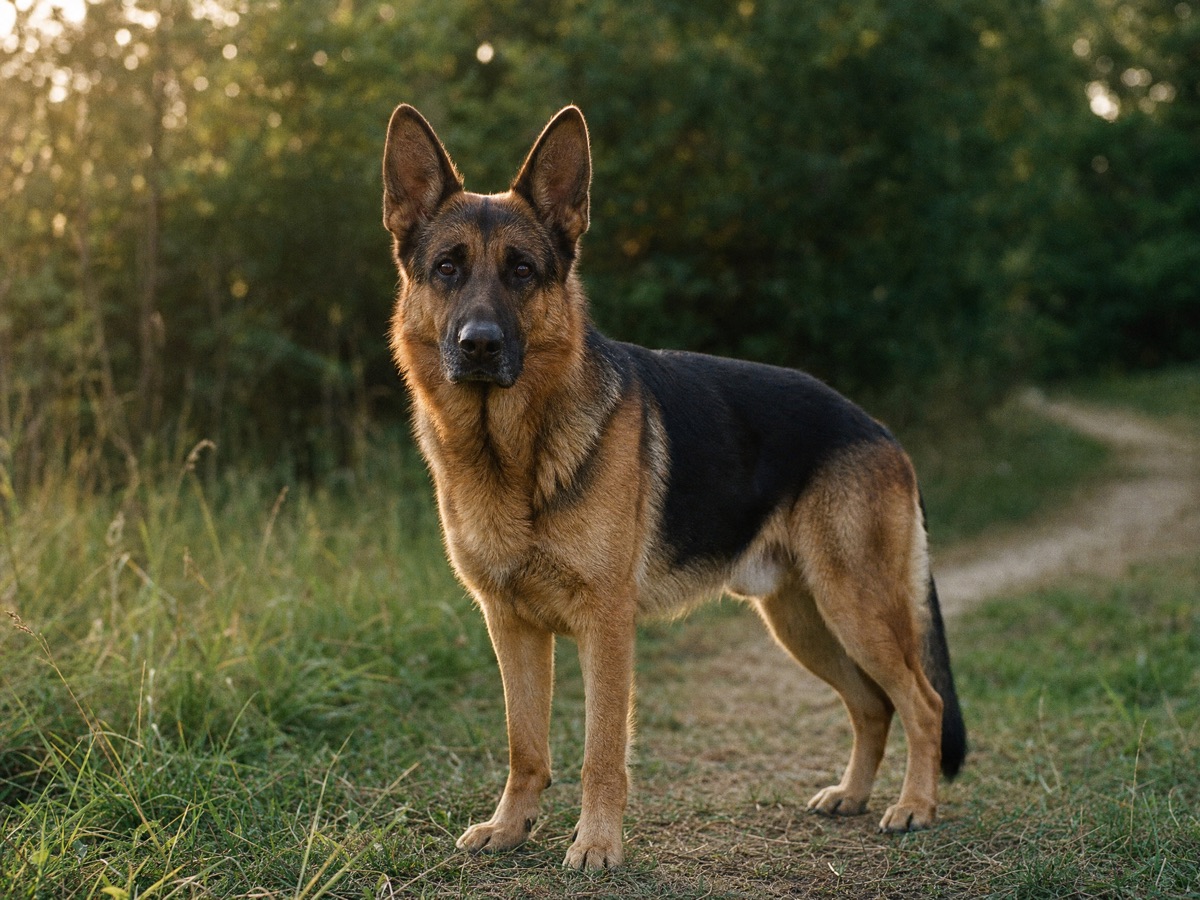
German Shepherd
Loyal, brave and endlessly capable — the world's premier working partner.
On these lists: Guard dogs · Protection dogs · Service dogs
Vital stats
| Size | Large · 55–65 cm |
| Weight | 22–40 kg |
| Life expectancy | 9–13 years |
| Energy | High — 90+ min/day |
| Shedding | Heavy, year-round |
| Coat | Dense double coat · black & tan, sable, black |
| Group | Herding · FCI №166 / AKC |
| Origin | Germany |
| FCI group | 1 — Sheepdogs and Cattledogs · FCI 166 |
Breed traits
Friendliness
Care
Mind
The German Shepherd by the numbers
The German Shepherd facts owners search for most — price, lifespan, weight, shedding and colours, in one place.
Widely bred, so you can usually find a litter from a registered breeder without a long wait. Ongoing costs run high — more food, bigger doses at the vet, and pricier insurance.
We don't quote a single figure: the real price swings with breeder, region, bloodline and health testing — and a rescue costs a fraction of a breeder's litter. Adopting is almost always the cheapest route.
Temperament
Captain Max von Stephanitz set out in 1899 to build the perfect working dog, and the result still patrols, guides, searches and serves worldwide. At home that heritage reads as intense loyalty, quick learning and a watchful reserve with strangers. Give it work and leadership and you get a superb partner; leave it idle and it will invent a job you won't like.
Habits & quirks
Perimeter patrol
Expect regular self-assigned rounds of the garden fence — the property is being managed, whether you asked or not.
One-person radar
Shepherds famously pick their person and track them around the house with quiet, constant attention.
The alert bark
Every doorbell, delivery and distant car door will be announced. Thoroughly.
Head on paws, eyes on you
Even at rest, a Shepherd is never quite off duty — it watches the room like a lifeguard.
Health
The German Shepherd's big health question is the joints. Hip and elbow dysplasia genuinely run in the breed, so this is one place you do not compromise: buy only from a breeder who scores hips and elbows and will show you the numbers on both parents. Beyond the joints, learn the signs of bloat — a deep-chested dog can twist its stomach, and gastric torsion is a race to the vet — and ask about the heart, because dilated cardiomyopathy (DCM) turns up in some lines. Keep him lean, keep him moving, and most Shepherds stay sound working dogs well into old age.
Nutrition
| Exercise | At least 90 minutes daily, and the mind matters as much as the legs — scent work, obedience or agility beat laps of the park. |
| Training | Highly biddable but powerful and protective: early socialisation and consistent training are non-negotiable. |
| Grooming | That double coat sheds year-round with two heavy seasonal blows — brush several times a week and befriend your vacuum. |
| Health | Hip and elbow dysplasia run in the breed; insist on scored parents and keep the dog lean and well-muscled. |
Feed a German Shepherd for the working body it has, not the chart on the food bag. This is a big, active dog that needs at least 90 minutes of real exercise a day, and the mind wants working as hard as the legs — so count the training treats into the day's food and weigh the meals rather than guessing. Keep him lean above all: every extra kilo lands on hips and elbows that already carry the breed's weak spot, and a light frame is the simplest protection those joints will ever get.
Puppy guide
A German Shepherd puppy grows into a big, powerful, protective dog, and the work you put in during the first year decides which version of that you get. Socialise him early and widely — new people, places, dogs and sounds — so the natural guarding instinct settles into confidence rather than suspicion. Keep exercise sensible while the joints are still forming and skip the repetitive jumping and long runs, start reward-based training the day he arrives, and give that quick mind something to chew on every day. A well-raised Shepherd puppy is astonishingly easy to live with; a bored, under-socialised one is a lot of dog.
Training
Few dogs are as rewarding to train as a German Shepherd — this is one of the most biddable breeds there is, quick to learn and genuinely happy to work with you. That willingness cuts both ways, though: a dog this powerful and this switched-on needs consistent, reward-based training and clear rules from the start, or it will make its own decisions. Keep sessions varied and fair, give the brain a real job rather than just a walk, and channel the guarding instinct into obedience and control. Train the mind well and you get the loyal, level-headed working partner the breed is famous for.
Known health issues
No breed is problem-free. These are the conditions most worth knowing about for this breed — with what a good breeder screens for and what an owner watches. General guidance, not a substitute for your vet.
Hip dysplasia
A poorly fitting hip joint that wears early and can cause pain and arthritis, most common in larger breeds. Good breeders screen: Hip-scored parents (BVA/OFA/FCI). Watch for: Stiffness, a bunny-hop run, or reluctance on stairs.
Elbow dysplasia
A developmental fault in the elbow that leads to lameness and arthritis, seen in fast-growing large breeds. Good breeders screen: Elbow-scored parents. Watch for: Front-leg limping that worsens after exercise.
Bloat (GDV)
A sudden, life-threatening twisting of the stomach, mostly in deep-chested breeds — a true emergency. Good breeders screen: Ask about family history; discuss preventive gastropexy for high-risk lines. Watch for: A swollen belly, unproductive retching, restlessness — go to a vet at once.
Heart muscle disease (DCM)
A weakening of the heart muscle that enlarges the heart, seen in several large and giant breeds. Good breeders screen: Heart-screened parents (echo/Holter where advised). Watch for: Tiring, coughing, fainting, or a swollen belly.
Life expectancy
German Shepherds live 9–13 years. German Shepherds are a large breed, and you keep one at the top of its range the same way you keep it sound: lean weight off those hips and elbows, real daily exercise for body and mind, and parents scored for hips and elbows before you ever bring the puppy home. Watch for bloat and keep half an eye on the heart, and a well-bred Shepherd stays a working dog for a long time.
Popular German mixes
Shepadoodle
The Shepherd's brains and loyalty in a lower-shedding coat; a clever, driven cross that needs a job and firm early training.
Golden Shepherd
The Golden's warmth softens the Shepherd's edge: friendly, trainable and devoted, but still a big, active dog.
Sheprador
Two working favourites combined: energetic, smart and eager to please, and happiest in a busy, active home.
Gerberian Shepsky
A striking, high-energy cross with the Shepherd's drive and the Husky's stamina; needs plenty of exercise and early rules.
Shepweiler
A large, powerful, protective guardian that bonds hard to its family; needs experienced handling and thorough socialisation.
Similar breeds
Breeds with a similar build and background — worth a look if this one isn't quite the fit.
Compare this breed
Breeds that look like this
Common questions
Are German Shepherds good family dogs?
Yes, with early socialisation and training — they're devoted and protective, and thrive as an involved part of family life.
Do German Shepherds shed a lot?
Heavily and year-round — they're nicknamed 'German shedders'. Brush several times a week to keep it manageable.
How much exercise does a German Shepherd need?
Plan on 90 minutes or more a day, split between physical exercise and mental work like training games or scent tasks. An under-worked Shepherd becomes vocal, destructive and anxious.
Is the German Shepherd hypoallergenic?
Not really. No dog is truly hypoallergenic, and the German Shepherd's shedding coat releases plenty of the dander that sets off allergies. If someone at home is allergic, this isn't the easiest breed to live with — spend time around one first.
Is the German Shepherd easy to train?
Yes. The German Shepherd is one of the more trainable breeds — quick to learn and keen to work with you, which makes reward-based training straightforward. Start early, keep it positive, and it picks things up fast.
Stories featuring this breed
All stories →
PAW Patrol breeds: every pup's real dog, from Chase to Tracker
Chase is a German Shepherd, Zuma is a Chocolate Labrador, and Skye's Cockapoo isn't a registered breed at all. The honest, canon breed behind every PAW Patrol pup.
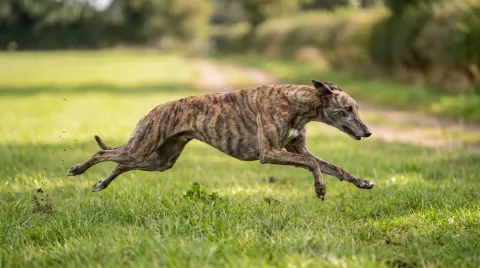
The fastest dog breeds, and how fast they really go
The Greyhound hits about 72 km/h — second only to the cheetah, and the winner over any real distance. Honest top speeds for the sighthounds and the surprises, plus how fast a Dobermann actually is.

Disney dog breeds: the real dog behind every one
Lady is a Cocker Spaniel and Dug is a Golden Retriever, but Pluto and Bolt were never given an official breed. The honest list.