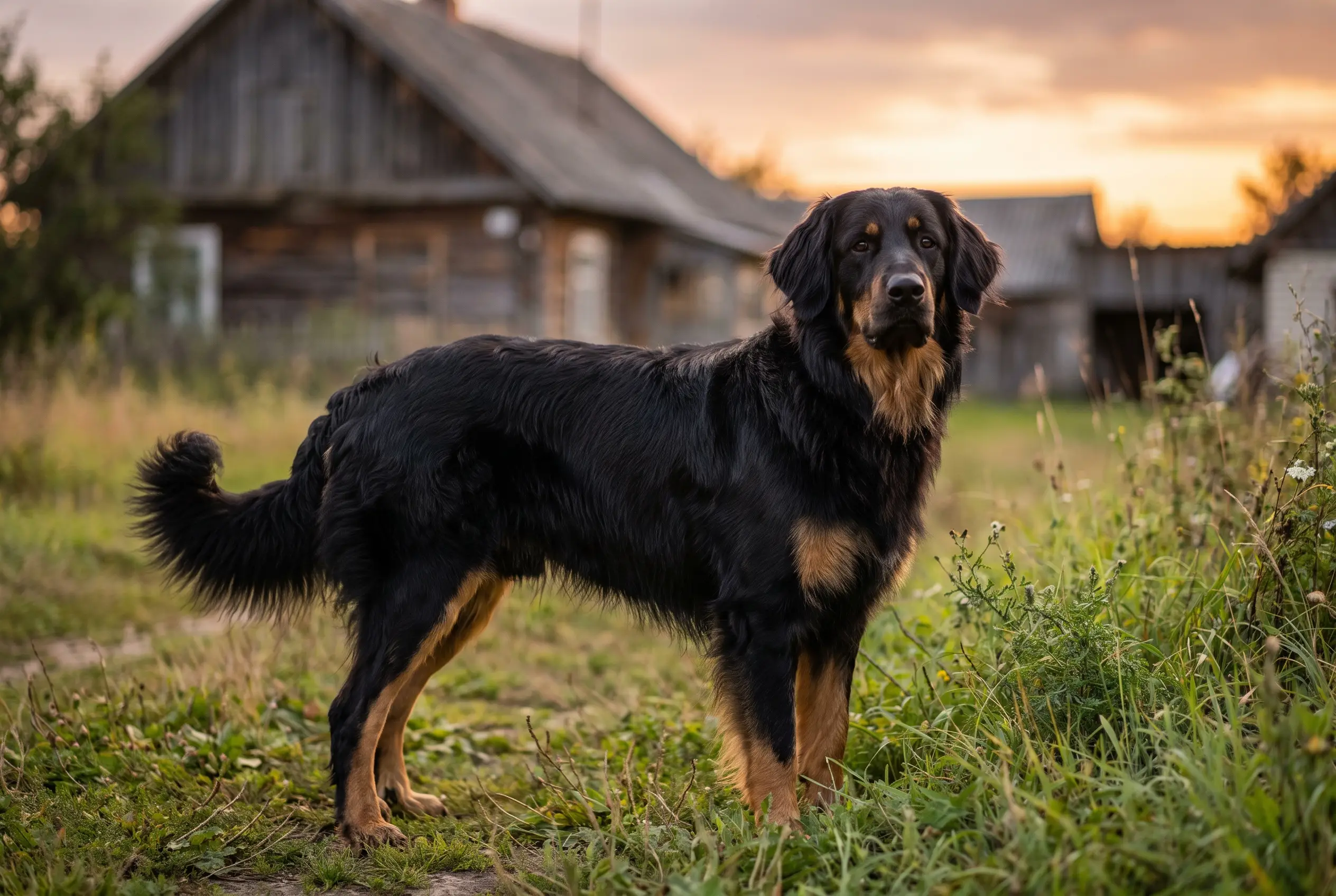
Hovawart
The old German farm watchman, rebuilt and still on duty.
Vital stats
| Size | Large · 58–70 cm |
| Weight | 25–45 kg |
| Life expectancy | 12–14 years |
| Energy | Moderate to high — daily exercise plus a job to do |
| Shedding | Moderate — heavier during the seasonal moults |
| Coat | Long, slightly wavy, light undercoat · black, black and gold, or blond |
| Group | Working · Molossoid (FCI №190, Group 2) |
| Origin | Germany |
| FCI group | 2 — Pinscher and Schnauzer, Molossoid and Swiss Mountain Dogs · FCI 190 |
Breed traits
Friendliness
Care
Mind
The Hovawart by the numbers
The Hovawart facts owners search for most — price, lifespan, weight, shedding and colours, in one place.
Widely bred, so you can usually find a litter from a registered breeder without a long wait. Ongoing costs run high — more food, bigger doses at the vet, and pricier insurance.
We don't quote a single figure: the real price swings with breeder, region, bloodline and health testing — and a rescue costs a fraction of a breeder's litter. Adopting is almost always the cheapest route.
Temperament
The Hovawart is even-tempered, self-assured and deeply loyal to its family, with a guarding instinct that needs no encouragement. It watches its territory as a matter of course, decides for itself what deserves attention, and takes a cool, polite line with strangers. It also matures late — expect a large, strong adolescent until two or three years old — so training has to stay consistent, fair and patient through that whole stretch. Push it around and it digs in; give it clear rules and real work, and it becomes a steady partner that does well in tracking, rescue and protection sport.
Habits & quirks
Self-appointed sentry
It picks the spot with the best view of the gate and the door, and settles there. Guarding the household is not a trick you taught it — it came installed.
A long adolescence
The body is finished around one; the head takes until two or three. Expect a 40-kilo teenager for a while, and keep the training going all the way through.
Its own risk assessor
It sizes up a visitor itself before taking your word for it. In a well-raised dog that lands on polite indifference, not suspicion.
A voice built for a farmyard
Anything crossing its boundary gets announced in a bark sized for open country. The neighbours will know when the post arrives.
Health
Sturdy is the honest word for a Hovawart: it's one of the sounder large working breeds, largely because the German clubs made hip screening mandatory decades ago and drove dysplasia rates down to among the lowest in the group. Buy from a breeder who X-rays hips and can show you the scores, and you've dealt with the main thing. Beyond that, keep an eye on the thyroid: if the coat dulls or the energy quietly drains away, have it checked, because low thyroid is the one that likes to hide behind 'he's just slowing down.'
Nutrition
| Exercise | An hour or more a day, with work for the nose and brain folded in — tracking, obedience, rescue training. A garden alone does not count; to this dog, a garden is just a post to guard. |
| Grooming | Brush the long coat weekly, more often during the two moults. There is little undercoat and nothing to trim — an easy coat for a dog this size. |
| Training | Start early, keep it fair, and stay consistent for years — the breed answers force with stubbornness. Socialise widely as a puppy, because the guarding instinct arrives on its own. |
| Health | Sturdy for a large breed. Buy from lines with hip scores — German club screening has kept dysplasia rates low — and have the thyroid checked if coat or energy fades. |
Feed a Hovawart as the big, slow-growing dog it is. A guardian this size does best kept lean rather than heavy, since extra weight is a tax the joints pay for years, so measure the food to the actual day's work and let the ribs stay easy to feel. Through the long puppy and adolescent stretch, a large-breed diet fed for steady growth rather than fast bulk is kinder to a frame that isn't finished until well past its first birthday.
Puppy guide
Raising a Hovawart is a long project, not a first-year one. The guarding instinct comes installed and needs no encouragement, so the job is the opposite: socialise the puppy as widely as you can, people, dogs, traffic, the vet, so its self-appointed watch settles on polite indifference rather than suspicion. Start fair, consistent training early and plan to keep it going for years, because the body finishes around a year old while the judgement takes until two or three. And feed for slow, steady growth on that big frame.
Training
The Hovawart is clever and willing, but it answers force with a flat refusal: push it around and it digs in, so heavy-handed methods backfire on exactly the dog you'd least want to lose an argument with. Keep the rules clear and consistent, make the sessions fair and worth its while, and give it a real job for the nose and brain: tracking, obedience, rescue or protection sport. Stay patient through the whole long adolescence and you get a steady, reliable partner at the end of it.
Life expectancy
Hovawarts live 12–14 years. For a dog this size, that's a good long run, and the breed's mandatory hip screening is a big part of why. You keep a Hovawart at the top of the range the ordinary way: a lean weight that spares the joints, hips and thyroid you've actually had checked, daily exercise with real work folded in, and the patience to let a late-maturing dog grow up on its own clock rather than pushing the body faster than the head.
Similar breeds
Breeds with a similar build and background — worth a look if this one isn't quite the fit.
Breeds that look like this
Common questions
What does "Hovawart" mean?
"Farm watchman", from the Middle High German hova (farm, estate) and wart (watchman). Dogs of that name guarded German estates from the Middle Ages on; the modern breed was rebuilt in the 1920s and 30s by Kurt Friedrich König's circle, who crossed the last Black Forest farm dogs with Newfoundlands, Leonbergers and German Shepherds. The FCI recognised the result in 1964 as standard No. 190.
Is a Hovawart a good family dog?
Yes — for a family it can guard. It is affectionate and patient with its own household, children included, and treats the home as its responsibility. Strangers get watched rather than welcomed, so early socialisation matters, and its size and self-confidence make it a hard first dog.
When does a Hovawart calm down?
Around two to three years old. The breed matures late, so a full-grown body carries a puppy's judgement for longer than most owners expect. Keep training and structure in place through the whole adolescence — the adult that comes out the other side is steady and reliable.
Does the Hovawart shed a lot?
Moderately. The Hovawart sheds a fair amount, steadily through the year with heavier seasonal patches. A weekly brush keeps most of the loose hair off your floors and clothes.
Is the Hovawart hypoallergenic?
Not really. No dog is truly hypoallergenic, and the Hovawart's shedding coat releases plenty of the dander that sets off allergies. If someone at home is allergic, this isn't the easiest breed to live with — spend time around one first.
Is the Hovawart easy to train?
Reasonably. The Hovawart is trainable with consistency and rewards, though it isn't the quickest study. Keep sessions short and positive, and be patient with the basics like recall.