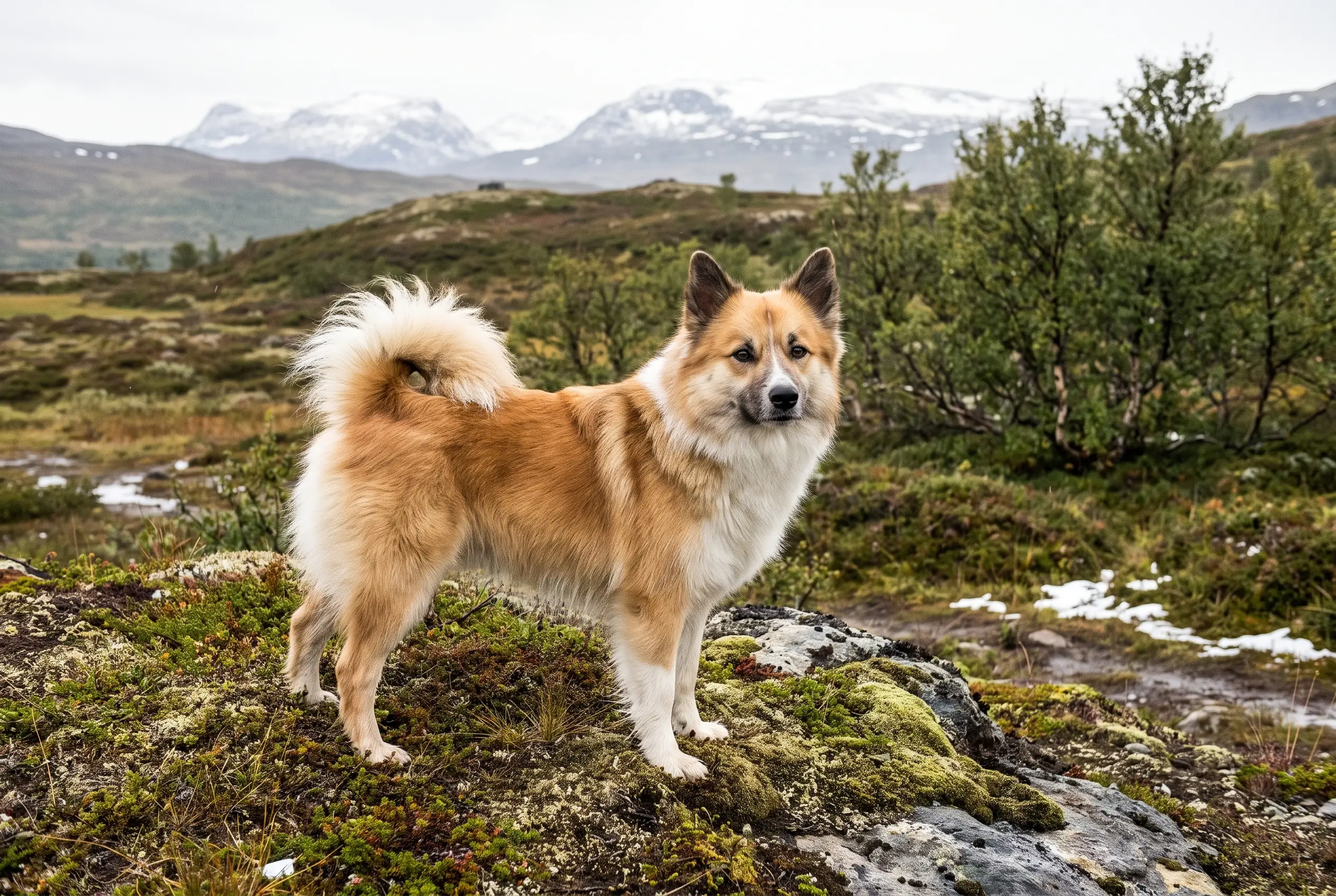
Icelandic Sheepdog
The Viking settlers' herding companion — a smile with a curled tail, still doing its rounds.
Vital stats
| Size | Small-medium · 42–46 cm |
| Weight | 9–14 kg |
| Life expectancy | 12–14 years |
| Energy | High — 60 min/day plus brain work |
| Shedding | Heavy, twice-yearly moults |
| Coat | Thick double coat · tan, red, grey or black with white |
| Group | Herding · FCI №289 / AKC |
| Origin | Iceland |
| FCI group | 5 — Spitz and primitive types · FCI 289 |
Breed traits
Friendliness
Care
Mind
The Icelandic Sheepdog by the numbers
The Icelandic Sheepdog facts owners search for most — price, lifespan, weight, shedding and colours, in one place.
Less common, so expect a waitlist and some travel to a reputable breeder — which pushes the price up. Ongoing costs stay modest — it eats little and routine vet care sits at the lower end.
We don't quote a single figure: the real price swings with breeder, region, bloodline and health testing — and a rescue costs a fraction of a breeder's litter. Adopting is almost always the cheapest route.
Temperament
Bred to gather sheep across Iceland's open lava fields — often working by voice across long distances — the Icelandic Sheepdog is happy, busy, and vocal by design. At home that translates into a merry shadow that announces every arrival, herds stray family members towards the kitchen, and greets guests as long-lost friends.
Habits & quirks
The full-body greeting
Wagging starts at the tail and takes over the entire dog — strangers included.
Herding the household
Family members drifting apart on a walk will be politely rounded back up.
Weather-proof joy
A coat built for Icelandic winters means rain and snow are features, not bugs.
The town crier
Every arrival, bird, and interesting cloud gets a bulletin — it worked by voice for centuries.
Health
The Icelandic Sheepdog is a hardy, functional little spitz, which is no surprise in a breed that spent a thousand years working Iceland's weather with nobody to fuss over it. There's no headline disease defining the breed here. The honest caveat is history: it came close to dying out in the twentieth century and was rebuilt from a small number of dogs, so the gene pool is narrow, and a careful breeder who tracks it and health-tests to the national club's guidance is worth seeking out. Buy from one of those and you're getting about as sound a dog as its size offers.
Nutrition
| Exercise | An hour of daily activity plus training games or herding-style play — an idle Icelandic invents loud hobbies. |
| Grooming | Weekly brushing most of the year, daily during the two dramatic seasonal coat-blows. |
| Training | Channel the bark early with a quiet cue; the instinct to announce is strong and sincere. |
| Company | Bred to work beside people all day — this is not a breed for long solitary hours. |
A working spitz this size doesn't need much food to run all day, so it's easy to overfeed an Icelandic Sheepdog into carrying weight the thick coat then hides. Feed a measured amount of a good complete food, fold the training treats into the total rather than adding them on top, and judge condition with your hands under the fur rather than by the fluffy outline. Keep it lean and keep it busy: this is a dog that would rather earn its dinner than be handed it.
Puppy guide
An Icelandic Sheepdog puppy is cheerful, busy and already opinionated about noise: the bark was part of the job for centuries, so teach a quiet cue early and reward the off switch before the habit sets. It's a friendly, people-focused breed that hates being left alone, so build up short absences gently and don't expect it to spend long days by itself. Get it used to gentle brushing while young, since the double coat will one day blow out twice a year, and give the herding brain proper games so it doesn't invent its own.
Training
This is a bright, biddable dog that genuinely enjoys working with you, so training an Icelandic Sheepdog is mostly a pleasure: the one job that needs deliberate effort is the voice. The instinct to announce every arrival is strong and sincere, so put barking on cue and teach a reliable 'quiet' early rather than trying to stamp it out later. Channel the herding drive into games and tricks, keep it in your company where it wants to be, and you'll rarely fight it on anything else.
Life expectancy
Icelandic Sheepdogs live 12–14 years. That's a healthy span for the breed, and it comes down to ordinary care rather than managing any one condition: a lean weight, a double coat kept clean and brushed out through its moults, daily exercise for the body and real work for the busy brain, and a breeder minding the narrow gene pool. An Icelandic Sheepdog kept fit, occupied and in company tends to make the most of those years.
Similar breeds
Breeds with a similar build and background — worth a look if this one isn't quite the fit.
Breeds that look like this
Common questions
Do Icelandic Sheepdogs bark a lot?
Yes — barking was literally part of the job, used to move sheep across distances. Training can moderate it, but a quiet dog this is not.
Are Icelandic Sheepdogs rare?
Outside Iceland, quite — the breed nearly vanished in the 20th century before a dedicated rescue effort. Expect breeder waiting lists.
Are they good with children?
Among the best — gentle, playful and patient, with a herding style that's about presence rather than nipping. Supervise as always.
Does the Icelandic Sheepdog shed a lot?
Yes — the Icelandic Sheepdog is a heavy shedder, dropping hair year-round or in big seasonal moults. Brush it several times a week and expect regular vacuuming; it isn't the coat for you if loose fur is a dealbreaker.
Is the Icelandic Sheepdog hypoallergenic?
Not really. No dog is truly hypoallergenic, and the Icelandic Sheepdog's shedding coat releases plenty of the dander that sets off allergies. If someone at home is allergic, this isn't the easiest breed to live with — spend time around one first.
Is the Icelandic Sheepdog easy to train?
Reasonably. The Icelandic Sheepdog is trainable with consistency and rewards, though it isn't the quickest study. Keep sessions short and positive, and be patient with the basics like recall.