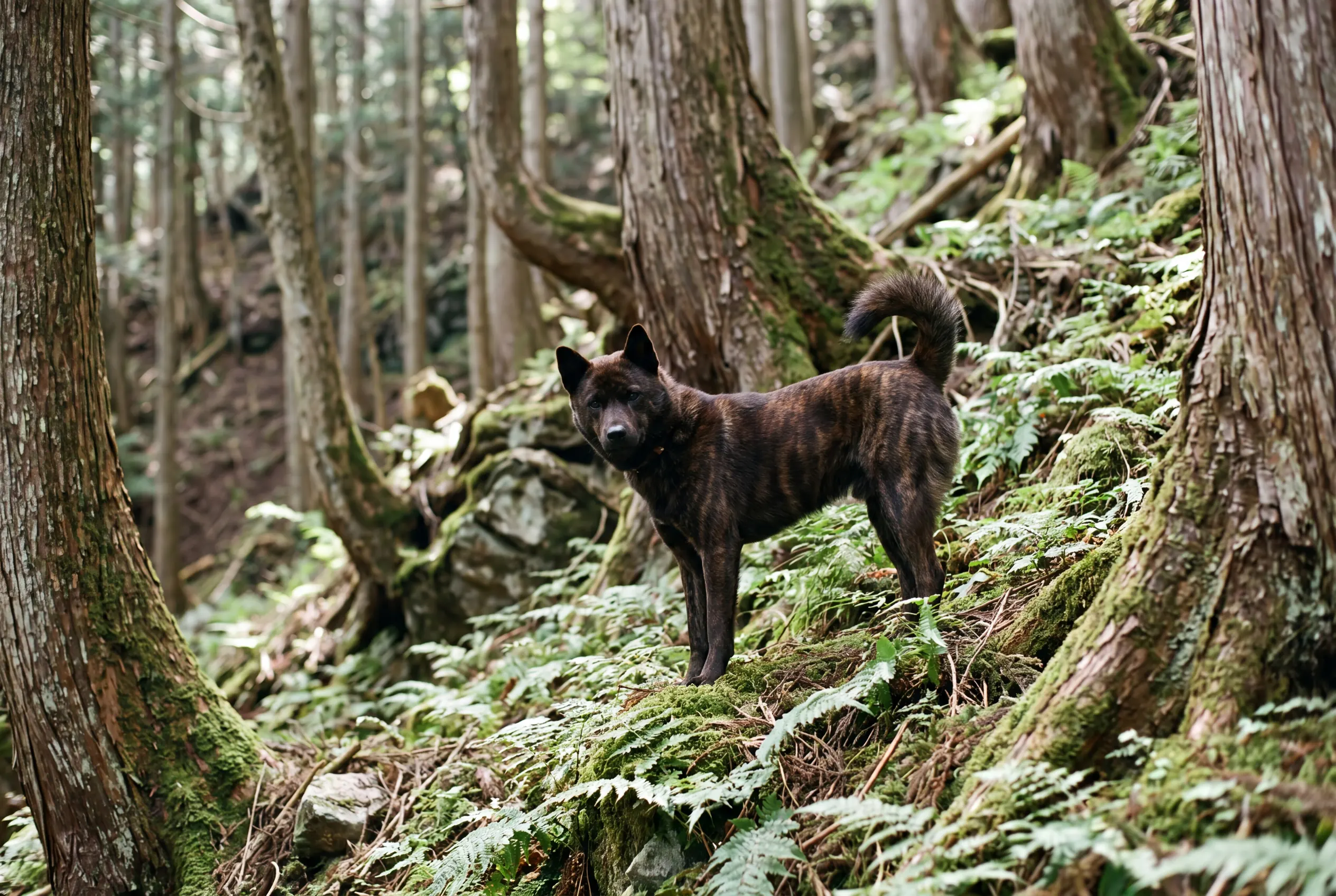
Kai Ken
Japan's tiger dog, born plain and striped by degrees.
Vital stats
| Size | Medium · 45–53 cm |
| Weight | 11–25 kg |
| Life expectancy | 12–15 years |
| Energy | High — built for long days on steep ground |
| Shedding | High in season — two heavy moults a year |
| Coat | Harsh double coat · black brindle, middle brindle or red brindle |
| Group | Non-Sporting · Asian Spitz (FCI №317, Group 5) |
| Origin | Kai province (Yamanashi Prefecture), Japan |
| FCI group | 5 — Spitz and primitive types · FCI 317 |
Breed traits
Friendliness
Care
Mind
The Kai Ken by the numbers
The Kai Ken facts owners search for most — price, lifespan, weight, shedding and colours, in one place.
Less common, so expect a waitlist and some travel to a reputable breeder — which pushes the price up. Plan for steady ongoing costs — mid-range food, routine vet care and insurance.
We don't quote a single figure: the real price swings with breeder, region, bloodline and health testing — and a rescue costs a fraction of a breeder's litter. Adopting is almost always the cheapest route.
Temperament
The FCI standard sums the Kai up in four words: keen and very alert. Day to day that reads as a dog switched on to everything within earshot, attached hard to one or two people, and reserved rather than rude with visitors. It is quieter than most of its size and slow to pick fights. The old boar-hunting job was done in company, and the standard credits that pack instinct with keeping the breed pure, so many Kai handle other dogs better than the Shiba or the Kishu do. What stays intact is the hunting. Anything small and quick gets locked onto, and a Kai that decides a route exists will take it, over a fence or up a slope you assumed was a wall. It cooperates readily with someone it trusts and goes deaf to anyone it does not.
Habits & quirks
Goes over, not around
Rock faces, leaning trunks, garden fences. The Kai's hocks are built for climbing and it will use them on anything with a foothold, which is why breeders talk about height and dig-proofing before they talk about anything else.
Takes to water
Plenty of Kai swim by choice and will cross a river mid-hunt rather than lose a line. Expect a dog that treats a lake as part of the walk.
Sticks to its person
It picks a small circle and follows it around the house, keeping half an eye on the door. Affection is undemonstrative and constant rather than showy.
Reads the other dog first
Kai were worked in groups and most of them size up a strange dog before reacting. Calm introductions usually go somewhere, which is not true of every Japanese native.
Care
| Exercise | Ninety minutes of real terrain a day suits it best: hills, long lines, scent games, water. Flat pavement loops leave a Kai bored and inventive. |
| Grooming | Weekly brushing keeps the harsh outer coat and dense undercoat in order, daily during the two big moults when the undercoat lifts out in sheets. It stays close to odourless and rarely needs a bath. |
| Training | Reward-based, short, and varied. The Kai learns quickly and will work for a person it rates, but it stops dead at drilling and at anything heavy-handed. Socialise early and widely, and never trust a recall near deer. |
| Health | One of the sounder Japanese breeds. Ask breeders for hip and patella screening and eye certification; the gene pool is small enough that pedigree depth is worth checking too. |
Life expectancy
This breed has a typical life expectancy of 12–15 years.
Similar breeds
Breeds with a similar build and background — worth a look if this one isn't quite the fit.
Breeds that look like this
Common questions
Is a Kai a realistic first dog?
For most people, no. It is easier to live with than several of its cousins and genuinely bonded to its family, but it needs daily hard exercise, secure fencing well above head height, patient reward-based training from a handler who will not out-stubborn it, and an owner comfortable with a dog that is polite to strangers rather than pleased to see them. The prey drive rules out reliable off-lead work in most of Europe. First-time owners who have the time, the ground and a good trainer manage; first-time owners who wanted an easygoing family dog do not.
Will my Kai puppy's brindle change?
Almost certainly. Kai are born close to solid, usually dark, and the striping fills in as the coat matures, which the FCI standard states as a feature of the breed. Breeders commonly see it take three to five years to settle, and the coat tends to deepen along the way, so an aka-tora puppy can end up reading as chu-tora. Judge the adult, not the eight-week-old.
How hard is a Kai to find outside Japan?
Hard. The Kai Ken Aigokai registers around 800–900 puppies a year, nearly all of them in Japan, and export is a slow business handled by a handful of people. Europe and North America run on small numbers of breeders and waiting lists measured in years. Anyone offering a Kai puppy quickly and cheaply is selling something else.
Does the Kai Ken shed a lot?
Yes — the Kai Ken is a heavy shedder, dropping hair year-round or in big seasonal moults. Brush it several times a week and expect regular vacuuming; it isn't the coat for you if loose fur is a dealbreaker.
Is the Kai Ken hypoallergenic?
Not really. No dog is truly hypoallergenic, and the Kai Ken's shedding coat releases plenty of the dander that sets off allergies. If someone at home is allergic, this isn't the easiest breed to live with — spend time around one first.
Is the Kai Ken good with children?
They can be. The Kai Ken is reasonably sociable and can be good with children in the right home, especially when socialised early. Supervise around young kids and teach dog and child to respect each other.
Is the Kai Ken easy to train?
Reasonably. The Kai Ken is trainable with consistency and rewards, though it isn't the quickest study. Keep sessions short and positive, and be patient with the basics like recall.