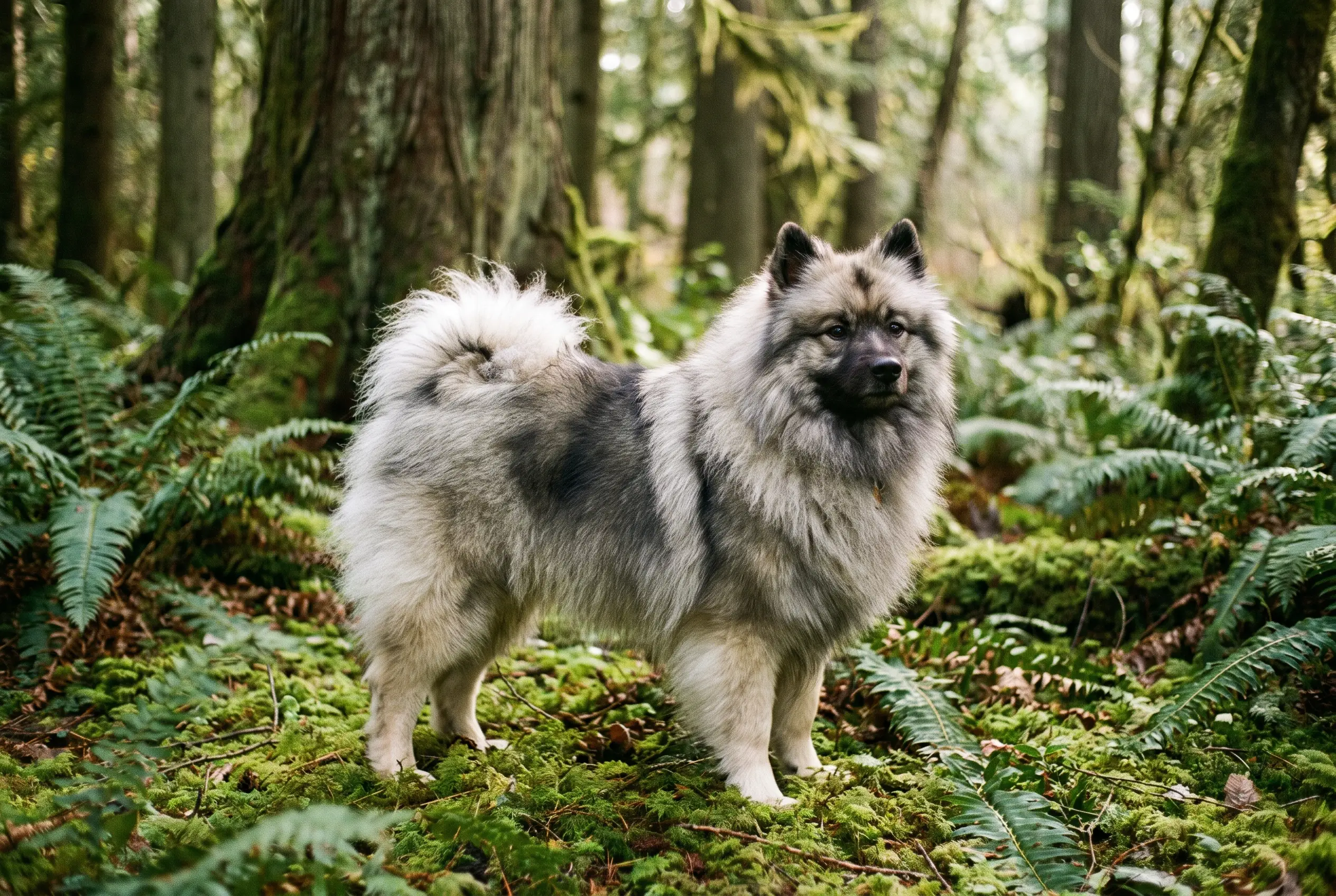
Keeshond
The smiling barge dog of the Dutch canals, wearing spectacles it never takes off.
On these lists: Family dogs · Dogs for anxiety
Vital stats
| Size | Medium · 43–46 cm |
| Weight | 16–20 kg |
| Life expectancy | 12–15 years |
| Energy | Moderate — 60 min/day |
| Shedding | Heavy, with big seasonal blows |
| Coat | Thick stand-off double coat · silver-grey, black-tipped |
| Group | Non-sporting (AKC) · Spitz, Wolfsspitz type (FCI) |
| Origin | Netherlands |
| FCI group | 5 — Spitz and primitive types · FCI 97 |
Breed traits
Friendliness
Care
Mind
The Keeshond by the numbers
The Keeshond facts owners search for most — price, lifespan, weight, shedding and colours, in one place.
Widely bred, so you can usually find a litter from a registered breeder without a long wait. Plan for steady ongoing costs — mid-range food, routine vet care and insurance. Its coat also needs a professional groom every few weeks — a real line in the budget.
We don't quote a single figure: the real price swings with breeder, region, bloodline and health testing — and a rescue costs a fraction of a breeder's litter. Adopting is almost always the cheapest route.
Temperament
Bred as a companion and watchdog on Dutch river barges, the Keeshond kept close quarters with its family and liked it that way — this is a dog that considers your presence the whole point of the day. Expect a merry, gently mischievous shadow that announces visitors with enthusiasm and then greets them like old friends.
Habits & quirks
The Keeshond smile
Many genuinely grin — lips pulled back, eyes crinkled — when greeting their people.
Spin cycle
Excitement is expressed in tight, happy circles, usually at dinner time or your return.
Doorbell duty
Centuries of barge-watching left a keen announcer; nothing crosses the threshold unreported.
Fur weather
Twice a year the coat lets go all at once, redecorating the house in silver.
Care
| Grooming | A thorough line-brush once or twice a week reaches the dense undercoat; never shave — the coat insulates against heat as well as cold. |
| Company | This breed is miserable alone for long days; separation issues are its most common behaviour problem. |
| Exercise | An hour of walks and play keeps it content — it's a companion first, athlete second. |
| Barking | Teach a 'thank you, enough' cue early, or the watchdog instinct will run the neighbourhood news. |
Life expectancy
This breed has a typical life expectancy of 12–15 years.
Similar breeds
Breeds with a similar build and background — worth a look if this one isn't quite the fit.
Breeds that look like this
Common questions
Do Keeshonds shed a lot?
Yes — the dense double coat sheds steadily and blows out spectacularly once or twice a year. Regular brushing keeps it in the brush rather than on the carpet.
Are Keeshonds good family dogs?
Among the best of the spitz breeds — patient with children, sociable with other dogs and devoted to the household. Their main demand is simply to be included.
Why is the Keeshond called the Dutch barge dog?
It travelled and guarded the barges working Holland's canals and rivers in the 17th and 18th centuries. The close-quarters life shaped its compact size and people-loving nature.
Is the Keeshond hypoallergenic?
Not really. No dog is truly hypoallergenic, and the Keeshond's shedding coat releases plenty of the dander that sets off allergies. If someone at home is allergic, this isn't the easiest breed to live with — spend time around one first.
Is the Keeshond easy to train?
Reasonably. The Keeshond is trainable with consistency and rewards, though it isn't the quickest study. Keep sessions short and positive, and be patient with the basics like recall.