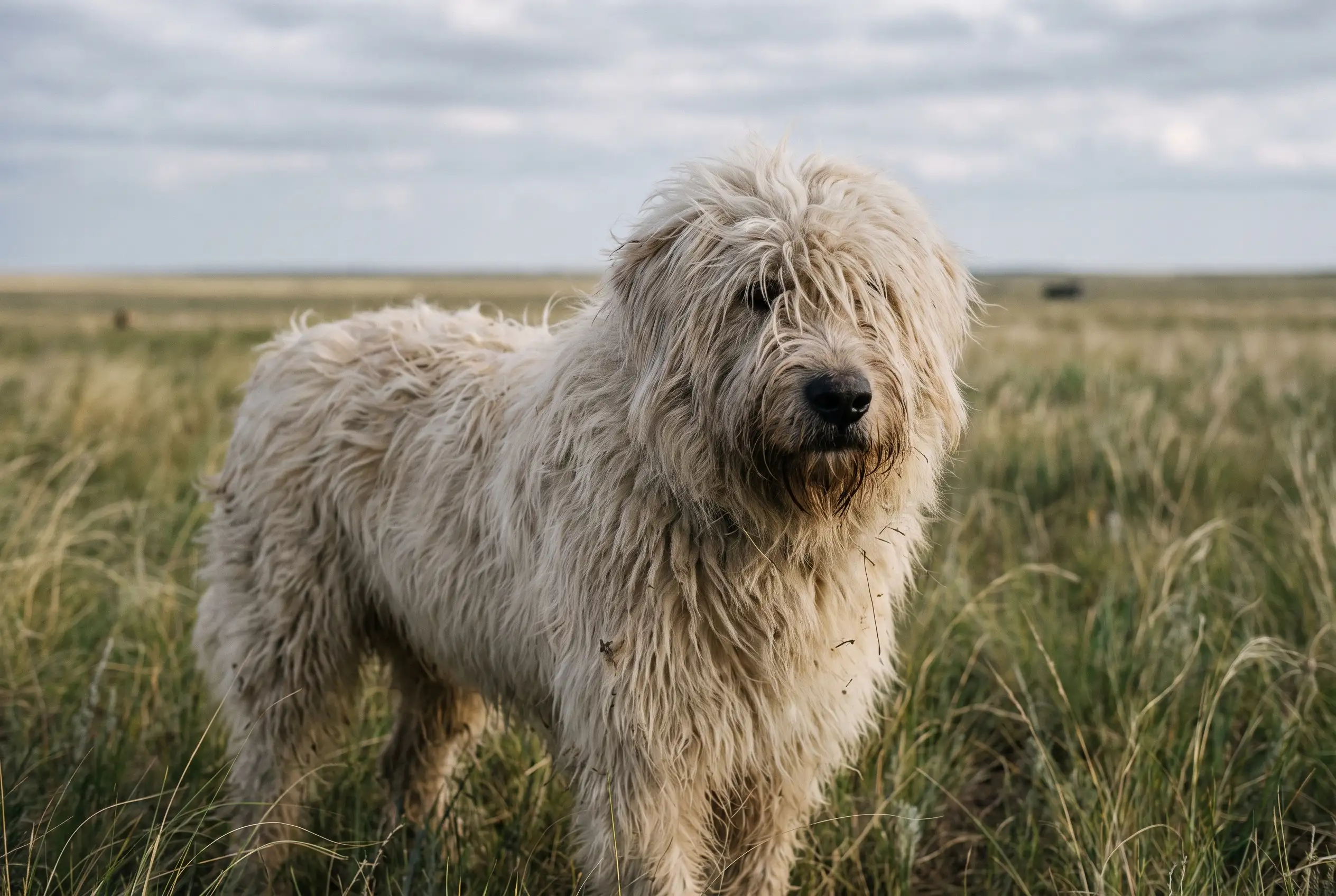
South Russian Shepherd Dog
Shaggy, white, and hard to pick out of the flock until it moves.
Vital stats
| Size | Large · from 66 cm (dogs), from 62 cm (bitches) — the standard gives no upper limit |
| Weight | From 35 kg (dogs), from 30 kg (bitches); large individuals are reported well past 60 kg |
| Life expectancy | 10–12 years — breed literature, not survey data |
| Energy | Moderate — it patrols rather than runs, but there is sighthound in the pedigree |
| Shedding | Heavy · a soft, thick, long undercoat under a coarse shaggy topcoat |
| Coat | At least 10 cm, harsh and shaggy, slightly wavy · white, or white with grey, wheaten or ivory patches, or solid grey or pale ivory |
| Group | Herding · Sheepdogs, without working trial (FCI №326, Group 1) |
| Origin | Southern steppe, Russia |
| FCI group | 1 — Sheepdogs and Cattledogs · FCI 326 |
Breed traits
Friendliness
Care
Mind
The South Russian Shepherd Dog by the numbers
The South Russian Shepherd Dog facts owners search for most — price, lifespan, weight, shedding and colours, in one place.
Less common, so expect a waitlist and some travel to a reputable breeder — which pushes the price up. Ongoing costs run high — more food, bigger doses at the vet, and pricier insurance. Its coat also needs a professional groom every few weeks — a real line in the budget.
We don't quote a single figure: the real price swings with breeder, region, bloodline and health testing — and a rescue costs a fraction of a breeder's litter. Adopting is almost always the cheapest route.
Temperament
Well-balanced, self-confident and independent is how the standard opens, and it goes on to say the dog is devoted to its owner but mistrustful and aloof towards strangers. Independent is the operative word. This is a guardian bred to be left with stock on open steppe and to settle matters without a person present, and it carries that into a garden without adjusting the settings. It is affectionate and physically close with the people it counts as its own, and it treats everybody else as a question it has already answered. It does not warm up over the course of a visit. It matures late, it is territorial with strange dogs, and it is unusually quick off the mark for something that size — the sighthound crosses in its history left it faster than it looks. None of this is aggression in the standard's sense, which disqualifies both aggressive and overly shy dogs. It is a dog that was never asked for permission and does not think to ask for it.
Habits & quirks
The standard sets a floor and no ceiling
Not less than 66 cm and 35 kg for males, not less than 62 cm and 30 kg for females, followed by the line that a larger size is preferable if the dog is well proportioned. Almost every other FCI standard brackets a breed between two numbers. This one points in one direction and lets breeders keep going.
Highest point over the loin
The topline rises to a slight arch over the loin, and the croup sits level with the withers or one to two centimetres above. It is listed as a characteristic feature of the breed rather than a tolerance, and it is the quickest way to identify one under all that hair.
There is a sighthound in it
The standard's history says so outright: repeated crossing with local sighthounds raised the height, pushed the colour towards white, flattened the ribs, tucked up the belly and opened the rear angulation. That is why a dog shaped like a haystack can cover ground the way it does.
The colour is not finished until two
Puppies and young dogs carry a more intense colour than they will keep, and the standard says the final coat colour appears at 18 to 24 months. An incompletely matured colour after two years is a severe fault, so the dog you judge is not the puppy you bought.
Care
| Exercise | Ground rather than mileage. It wants a large, securely fenced area to walk the edges of, plus a couple of unhurried outings where it can look at things and make up its mind about them. It is not a jogging or cycling dog and it is not a dog park dog — strange dogs on shared ground are the situation it handles worst. |
| Grooming | A serious weekly job and a daily one twice a year. Ten centimetres and more of coarse hair over a soft, long, thick undercoat mats close to the skin where you cannot see it: behind the ears, under the elbows, in the trousers, in the beard. Work it out with a rake and a comb rather than a brush skimmed over the top. The standard specifically calls a coat with the undercoat entirely combed out undesirable, so this is maintenance, not stripping. |
| Training | Everything depends on what happens before six months. Meet people, dogs, traffic and livestock early and often, then keep topping it up, because the adult defaults to suspicion. Teach handling, grooming and gates while the dog can still be moved by hand. Obedience competition is not the goal and pushing hard for it backfires; a dog this independent responds to a consistent household rather than to drilling, and it needs an owner who has done a big guarding breed before. |
| Health | No breed health survey exists. Manage it as a giant breed: hip and elbow scores on the parents, controlled growth, bloat awareness with a deep chest. Two practical things follow from the coat — check the skin under it regularly, since hot spots and parasites hide well in 10 cm of undercoat, and take heat seriously, because this coat was built for a continental winter. |
Life expectancy
This breed has a typical life expectancy of 10–12 years — breed literature, not survey data.
Similar breeds
Breeds with a similar build and background — worth a look if this one isn't quite the fit.
Breeds that look like this
Common questions
Is it the same as a Caucasian or Central Asian Ovcharka?
No. Ovcharka is simply the Russian word for a shepherd's dog, so it appears in several breed names that have nothing else in common. The Caucasian and Central Asian Shepherd Dogs are heavy molossoid mountain dogs, and the FCI files them in Group 2. This one is in Group 1 with the sheepdogs: lighter, longer in the body, faster, and white rather than the fawns, greys and brindles of the other two.
Is the breed legal where I live?
Not everywhere. Denmark has banned it since 1 July 2010, as one of thirteen breeds on the prohibition list, which means it cannot be owned, bred or imported there, and dogs owned before March 2010 travel through under leash and muzzle rules. Other countries and some insurers treat large guarding breeds separately. Check your national and municipal rules before you commit, not after.
Is it a good family dog?
For most families, no, and that is worth saying plainly. It is devoted to its own people and can be gentle indoors, but it is a large, independent guardian that decides about visitors by itself, is difficult with strange dogs, needs land with a real fence, and carries a coat that takes hours every month. It suits an experienced owner with property to guard and no illusions about training it out of what it is. It is a poor first dog and a poor city dog.
Does the South Russian Shepherd Dog shed a lot?
Yes — the South Russian Shepherd Dog is a heavy shedder, dropping hair year-round or in big seasonal moults. Brush it several times a week and expect regular vacuuming; it isn't the coat for you if loose fur is a dealbreaker.
Is the South Russian Shepherd Dog hypoallergenic?
Not really. No dog is truly hypoallergenic, and the South Russian Shepherd Dog's shedding coat releases plenty of the dander that sets off allergies. If someone at home is allergic, this isn't the easiest breed to live with — spend time around one first.
Is the South Russian Shepherd Dog easy to train?
They can be a challenge. The South Russian Shepherd Dog is intelligent but independent, and would rather make its own decisions than take orders. Reward-based training and patience work best; expect recall in particular to take time.