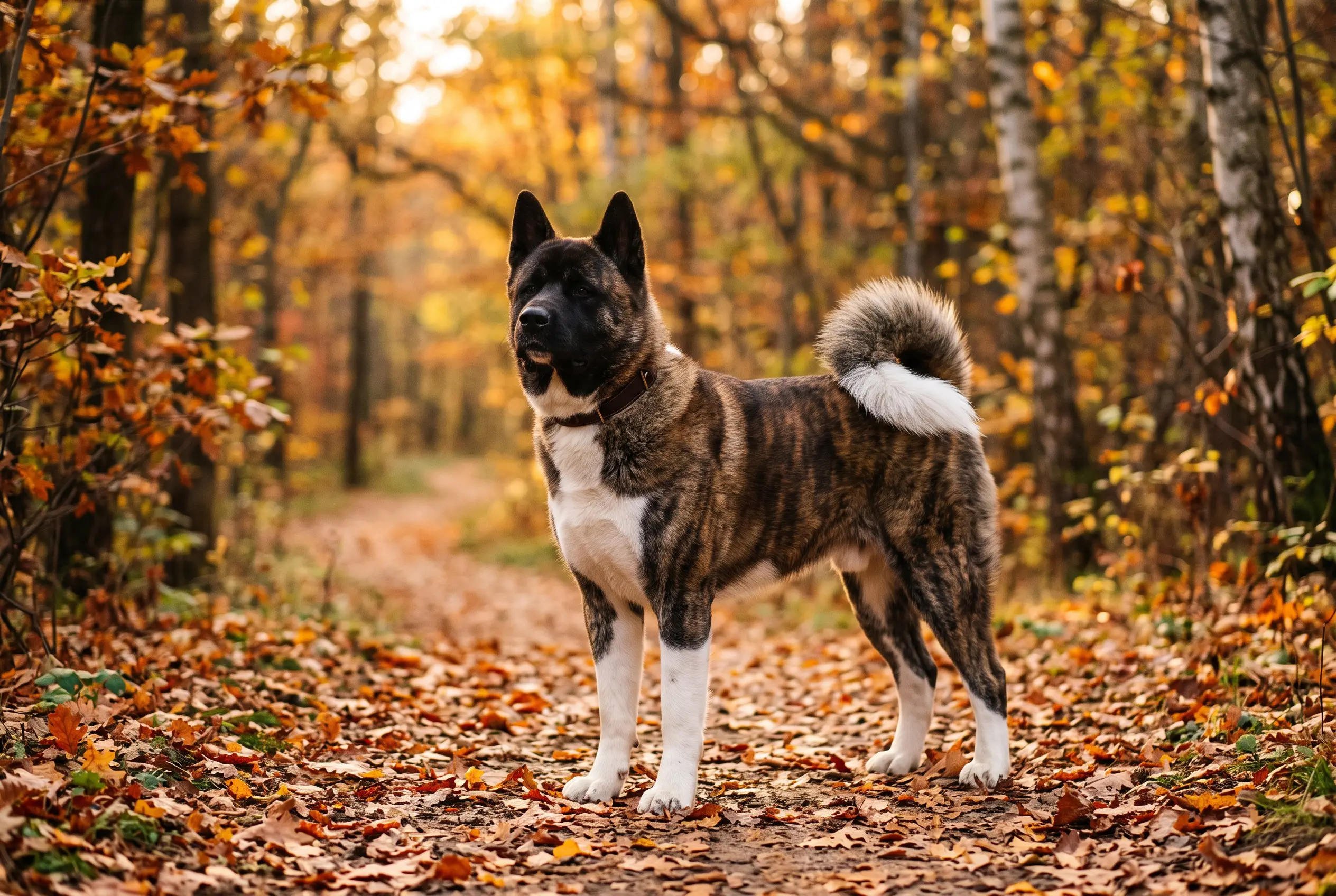
American Akita
The Akita that left Japan and came back twice the dog.
Vital stats
| Size | Large · 61–71 cm |
| Weight | 32–59 kg |
| Life expectancy | 10–13 years |
| Energy | Moderate — daily walks, not marathons |
| Shedding | Heavy in bursts — two undercoat blows a year |
| Coat | Thick double coat · all colours, usually with a black mask |
| Group | Working · Asian Spitz (FCI №344, Group 5) |
| Origin | United States, from Japanese lines |
| FCI group | 5 — Spitz and primitive types · FCI 344 |
Breed traits
Friendliness
Care
Mind
The American Akita by the numbers
The American Akita facts owners search for most — price, lifespan, weight, shedding and colours, in one place.
Widely bred, so you can usually find a litter from a registered breeder without a long wait. Ongoing costs run high — more food, bigger doses at the vet, and pricier insurance.
We don't quote a single figure: the real price swings with breeder, region, bloodline and health testing — and a rescue costs a fraction of a breeder's litter. Adopting is almost always the cheapest route.
Temperament
The American Akita is calm, self-possessed and territorial — a guardian by temperament, not by training. With its family it is loyal and surprisingly playful; with strangers it is reserved and watchful, and it rarely barks without a reason. It thinks for itself, which reads as stubbornness in obedience class, and it has little patience for other dogs of the same sex. Firm, fair handling and broad socialisation from puppyhood are what keep all that power good-natured.
Habits & quirks
The silent type
It watches the street from its spot by the window and says nothing — until something actually needs saying.
One family, whole heart
Affection is for the inner circle. Guests get polite tolerance, delivery drivers get a stare.
Cat rules
It grooms itself, keeps clean, and takes offence at undignified handling — owners compare it to a very large cat.
Chooses its friends
Same-sex dogs are rivals until proven otherwise; early, well-managed introductions decide how wide its circle gets.
Health
The American Akita is a big, powerful dog, and there are real things to screen for. Ask to see hip and eye clearances in the parents, and know that the breed also carries a known risk of autoimmune skin conditions and of bloat, the sudden and dangerous twisting of the stomach. A responsible breeder will talk openly about all three. Keep it lean, learn the early signs of bloat, and you have a robust, steady guardian.
Nutrition
| Socialisation | Start in puppyhood and keep going: people, dogs, places. A guardian this strong must learn early what normal looks like. |
| Exercise | A long daily walk or two and something to think about. It would rather patrol the garden than chase a ball for an hour. |
| Grooming | Weekly brushing most of the year, daily when the undercoat blows. The coat needs no trimming. |
| Health | Screen lines for hip dysplasia and eye disease; the breed also carries a known risk of autoimmune skin conditions and bloat. |
This is a heavy dog on a moderate engine — daily walks, not marathons — so it is easy to overfeed. Weigh the meals, keep the ribs findable under that thick coat, and don't let the bulk turn to fat on joints already carrying a lot of dog. Because the breed carries a bloat risk, split the day's food into two measured meals rather than one big bowl, and give it time to settle around hard exercise rather than feeding right before or after.
Puppy guide
An American Akita puppy grows into a strong-willed guardian, so the first year is about teaching it what normal looks like: people, dogs and places, early, often and well-managed. It is naturally reserved and slow to trust strangers, and broad early socialisation is what keeps all that power good-natured. Bring on a heavy-boned pup gently — steady exercise while the joints form — and start early on the same-sex dog manners this breed will need for life.
Training
The Akita thinks for itself, which reads as stubbornness in an obedience class, so train with firm, fair, consistent handling rather than repetition or force. It rarely barks without reason and takes offence at being pushed around, so earn cooperation instead of demanding it, and keep sessions respectful and short. Socialise broadly from puppyhood, especially around other dogs, because its low tolerance for same-sex dogs is the thing most likely to catch an owner out.
Life expectancy
American Akitas live 10–13 years. The American Akita is a large guardian breed, and large dogs do not get the longest lives — but you hold it near the top of its range the usual way: a lean weight off those joints, parents screened for hips and eyes, an eye out for the breed's skin and bloat risks, and the steady daily walks and company a settled guardian needs.
Similar breeds
Breeds with a similar build and background — worth a look if this one isn't quite the fit.
Breeds that look like this
Common questions
What is the difference between an American Akita and an Akita?
One ancestor, two breeds since the FCI split them in 1999. The Japanese Akita is lighter and fox-like, restricted to red, sesame, brindle and white with urajiro markings; the American Akita is heavier, broader in the head, usually wears a black mask, and comes in every colour including pinto. Temperament differs less than looks — both are independent guardians.
Are American Akitas dangerous?
They are powerful, territorial dogs with strong guarding instincts and little tolerance for same-sex dogs — in the wrong hands that is a real risk. Well bred, well socialised and well managed, they are steady, quiet companions. They need an experienced owner, and some countries regulate ownership, so check local rules.
Are they good with children?
With the children of their own family, generally patient and protective, especially when raised together. They are big, strong and intolerant of rough handling, so small-child households need supervision and dog-savvy kids. Visiting children's play can be misread as a threat — manage introductions.
Does the American Akita shed a lot?
Yes — the American Akita is a heavy shedder, dropping hair year-round or in big seasonal moults. Brush it several times a week and expect regular vacuuming; it isn't the coat for you if loose fur is a dealbreaker.
Is the American Akita hypoallergenic?
Not really. No dog is truly hypoallergenic, and the American Akita's shedding coat releases plenty of the dander that sets off allergies. If someone at home is allergic, this isn't the easiest breed to live with — spend time around one first.
Is the American Akita easy to train?
Reasonably. The American Akita is trainable with consistency and rewards, though it isn't the quickest study. Keep sessions short and positive, and be patient with the basics like recall.