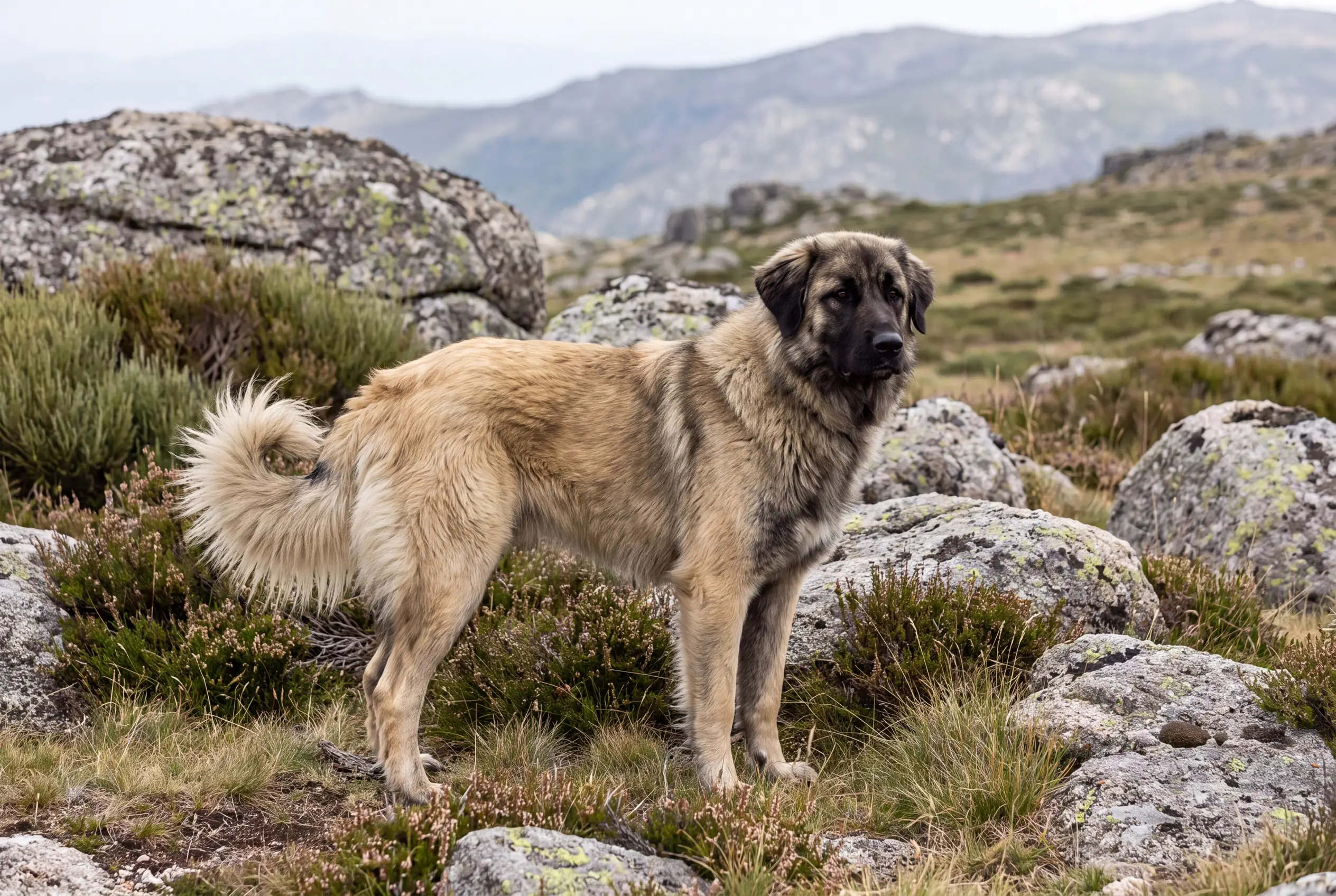
Cão da Serra da Estrela
Portugal's mountain guard: docile to its shepherd, unconvinced by everyone else.
Vital stats
| Size | Large · 62–73 cm |
| Weight | 35–60 kg · males 45–60, females 35–45 |
| Life expectancy | 10–12 years |
| Energy | Moderate — long slow patrols, not sprints |
| Shedding | Heavy — dense undercoat, big seasonal moults |
| Coat | Long or short · yellow, fawn, wolf grey or brindle, usually masked |
| Group | Working · Mountain Dog (FCI №173, Group 2) |
| Origin | Serra da Estrela, Portugal |
| FCI group | 2 — Pinscher and Schnauzer, Molossoid and Swiss Mountain Dogs · FCI 173 |
Breed traits
Friendliness
Care
Mind
The Cão da Serra da Estrela by the numbers
The Cão da Serra da Estrela facts owners search for most — price, lifespan, weight, shedding and colours, in one place.
Less common, so expect a waitlist and some travel to a reputable breeder — which pushes the price up. Ongoing costs run high — more food, bigger doses at the vet, and pricier insurance. Its coat also needs a professional groom every few weeks — a real line in the budget.
We don't quote a single figure: the real price swings with breeder, region, bloodline and health testing — and a rescue costs a fraction of a breeder's litter. Adopting is almost always the cheapest route.
Temperament
The FCI standard says it in one line: inseparable companion of the shepherd and faithful flock guardian, distrustful towards strangers, typically docile to its master. Both halves hold up. An Estrela that counts you as its own is steady, physically affectionate and unusually patient with children and with slow-moving elderly people, and it spends most of the day doing very little. An Estrela that has not placed you will put itself between you and the house and stay there. It guards on judgement more than on noise, watching an arrival for a while before it commits to an opinion, and once it has one it is slow to revise. Portuguese breeders talk about a dog that learns quickly and still sees no reason to repeat anything for you.
Habits & quirks
The hook gives it away
The tail hangs to at least the hock, curved like a sabre, and finishes in a hook. In motion it lifts above the horizontal and swings up, forward and sideways, without ever going flat over the croup. Judges mark a missing hook as a fault, so breeders watch for it in the nest.
Holds the gate
Territory is the job. The dog picks the boundary, works out where the entrances are, and puts itself where it can see them. Visitors are handled far better if you bring the dog to them outside the gate first rather than letting them walk in.
Patrols at walking pace
Its chest is shallower than half the height at the withers and the croup sits level with or just above the shoulder, which is a build for covering broken ground all day rather than for standing still. Expect a dog that would rather walk for three hours than run for twenty minutes.
Hauled loads as well
Draught work is written into the standard's list of uses alongside guarding. In the villages below the range these dogs pulled small carts, and the breed kept the frame and the shoulder for it.
Health
With the Estrela, hips come first and it is not a formality: a Portuguese radiographic survey found hip dysplasia in roughly two-thirds of the dogs it screened, so hip scoring before breeding carries real weight here. Ask for FCI or OFA hip grades on both parents, plus elbows, patellas and a cardiac check, and expect a breeder who offers them without being asked. The deep chest brings the other risk, gastric torsion, so split the day's food into more than one meal and learn the signs.
Nutrition
| Exercise | An hour or more of steady walking a day, ideally on ground with some slope in it. This is stamina rather than speed, and young dogs should be kept off long forced walks and stairs while the joints are still closing. |
| Grooming | The long variety needs brushing two or three times a week, with the feathering behind the forearms, around the neck and on the tail checked for mats. The short variety takes a weekly going-over. Both carry the same dense undercoat and both drop it in sheets twice a year. |
| Training and visitors | Socialise hard and early, and keep doing it past the first year. Reward-based work suits the breed and force does not; a dog this size that has learned to argue is not a problem you can win by hand. Teach a place command and a reliable greeting routine before you need them. |
| Health | Hips first. Ask for FCI or OFA hip grades on both parents, plus elbows, patellas and a cardiac check, and expect a breeder who volunteers them. Gastric torsion is the other risk that comes with the deep chest, so split meals and know the signs. |
An Estrela is a big, slow dog that spends most of the day resting, so it is easy to overfeed one into trouble. Feed for lean condition — you want to feel the ribs — because extra weight lands straight on the hips and joints of a breed already prone to dysplasia. Split the daily ration into two or more meals rather than one big bowl: the deep chest makes gastric torsion a real risk, and a single large meal is one of the things that brings it on. Grow a puppy slowly on a large-breed food and let the frame finish before the weight does.
Puppy guide
An Estrela puppy grows into a big, territorial guardian, and the two jobs of the first year are the joints and the socialising. Keep it off long forced walks, jumps and stairs while the joints are still closing, and build fitness slowly. At the same time, introduce it to as many people, dogs and places as you can and keep it up well past the first birthday — the guarding drive is coming whether you shape it or not, and early, calm exposure is what decides whether the adult reads a visitor or simply distrusts one. Teach a place command and a greeting routine before you need them.
Training
Reward-based work suits the Estrela and force does not — a dog this size that has learned to argue with you is not a fight you can win by hand. It learns quickly but sees little reason to repeat things to please you, so keep sessions short and make cooperation worth its while. The real curriculum is social: distrust of strangers is written into the breed, so the earlier and wider you socialise, and the longer you keep it up, the more manageable the adult guardian becomes. Teach a solid place command and a calm way to meet visitors, and have both in place before the day you need them.
Life expectancy
Cães da Serra da Estrela live 10–12 years. The way you protect the far end of an Estrela's life is mostly the way you protect its hips: keep the dog lean, don't push a growing puppy, feed in split meals to guard against bloat, and start from parents with good hip scores. A big, unhurried dog that isn't carrying extra weight is the one that ages well.
Similar breeds
Breeds with a similar build and background — worth a look if this one isn't quite the fit.
Breeds that look like this
Common questions
Does an Estrela work in a home with no livestock and no land?
Sometimes, and it depends more on the household than on the acreage. The guarding drive does not need sheep to switch on; without a flock the dog simply appoints your family and your boundary instead, which is why an apartment with a shared stairwell and a stream of unfamiliar people is the hardest possible setting for one. What it actually needs is a securely fenced area it can treat as its own, an hour or more of walking, an owner who will manage introductions for the life of the dog, and neighbours far enough away to live with a deep bark at night. Owners with a normal house and garden who commit to the socialising do fine. A first-time owner who wanted an easygoing large family dog should look at another breed.
What is the difference between the long-haired and short-haired varieties?
Coat only. The FCI recognises both under the same standard, with the same build, temperament and colours. The long-haired dog carries a straight or slightly wavy topcoat with feathering on the tail, neck, buttocks and the back of the forearms; the short-haired one has short hair spread evenly over the body and no feathering at all. Both have the coarse goat-hair texture and the fine undercoat, so both shed heavily. The long coat is the one most people picture and the one that has done best in the show ring, while Portuguese shepherds have gone on preferring the short coat for the obvious reason that it needs almost no upkeep on a mountain.
How is an Estrela with visitors and other dogs?
Reserved with visitors by design, and the standard lists distrust of strangers as a breed characteristic rather than a flaw. Most will accept people the family clearly accepts, particularly if they meet them outside the property first, but few will ever be pleased to see a stranger and a nervous or pushy guest gets a cool reception. With other dogs it is harder work: same-sex adults can be touchy and an unfamiliar dog arriving on home ground is read as an intrusion. Early, wide socialisation makes a real difference, and lead work in public stays sensible for life.
Does the Cão da Serra da Estrela shed a lot?
Yes — the Cão da Serra da Estrela is a heavy shedder, dropping hair year-round or in big seasonal moults. Brush it several times a week and expect regular vacuuming; it isn't the coat for you if loose fur is a dealbreaker.
Is the Cão da Serra da Estrela hypoallergenic?
Not really. No dog is truly hypoallergenic, and the Cão da Serra da Estrela's shedding coat releases plenty of the dander that sets off allergies. If someone at home is allergic, this isn't the easiest breed to live with — spend time around one first.
Is the Cão da Serra da Estrela good with children?
They can be. The Cão da Serra da Estrela is reasonably sociable and can be good with children in the right home, especially when socialised early. Supervise around young kids and teach dog and child to respect each other.
Is the Cão da Serra da Estrela easy to train?
They can be a challenge. The Cão da Serra da Estrela is intelligent but independent, and would rather make its own decisions than take orders. Reward-based training and patience work best; expect recall in particular to take time.