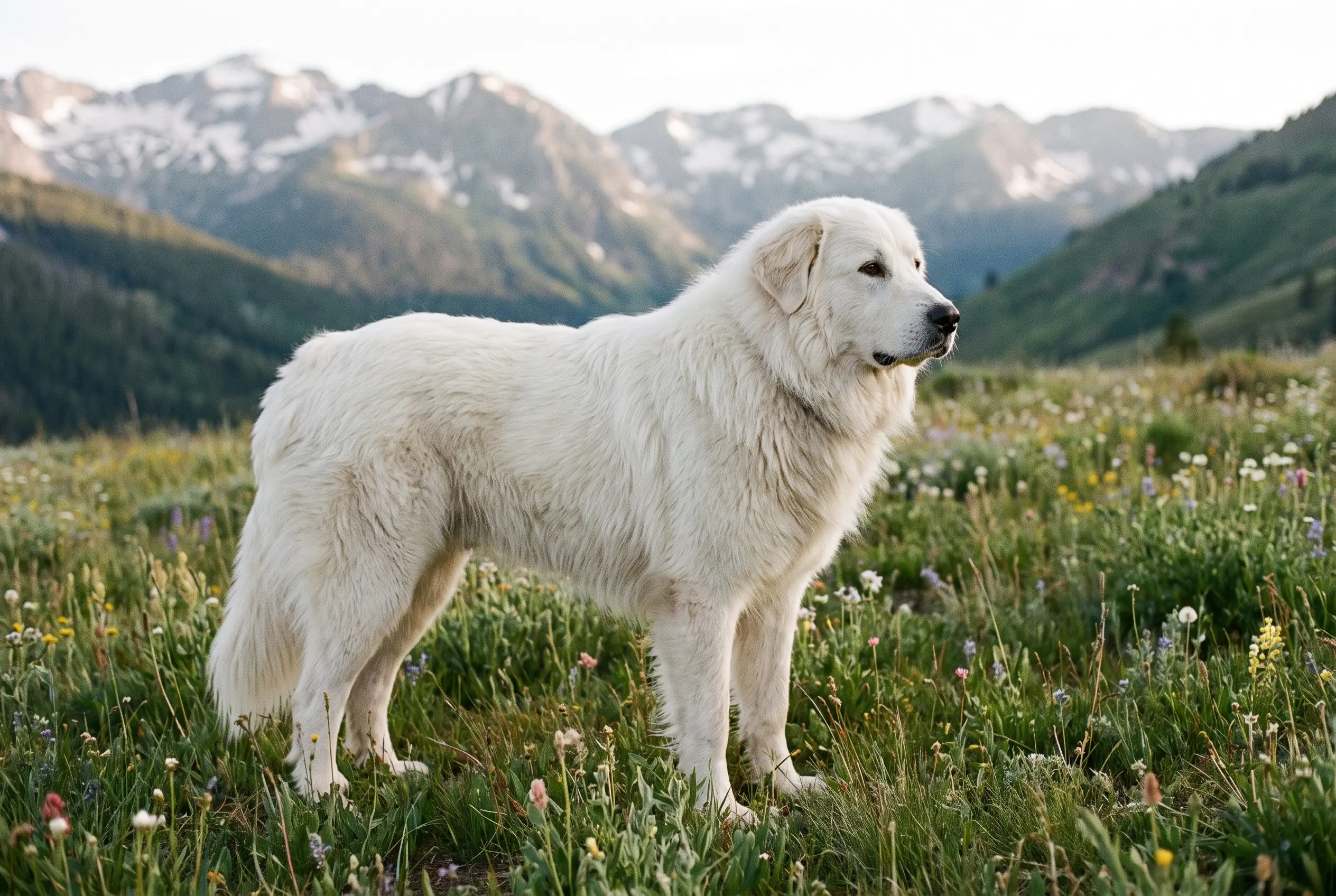
Great Pyrenees
A mountain of white calm that answers to the flock, not the whistle.
On these lists: Farm dogs
Vital stats
| Size | Giant · 65–82 cm |
| Weight | 36–54 kg |
| Life expectancy | 10–12 years |
| Energy | Moderate — 40–60 min/day |
| Shedding | Heavy, seasonal blows |
| Coat | Thick white double coat · badger or grey head markings |
| Group | Working · FCI №137 / AKC |
| Origin | Pyrenees Mountains, France |
| FCI group | 2 — Pinscher and Schnauzer, Molossoid and Swiss Mountain Dogs · FCI 137 |
Breed traits
Friendliness
Care
Mind
The Great Pyrenees by the numbers
The Great Pyrenees facts owners search for most — price, lifespan, weight, shedding and colours, in one place.
Widely bred, so you can usually find a litter from a registered breeder without a long wait. Ongoing costs run high — more food, bigger doses at the vet, and pricier insurance. Its coat also needs a professional groom every few weeks — a real line in the budget.
We don't quote a single figure: the real price swings with breeder, region, bloodline and health testing — and a rescue costs a fraction of a breeder's litter. Adopting is almost always the cheapest route.
Temperament
For centuries the Pyrenean Mountain Dog worked alone on high pastures, deciding for itself when a shadow was a wolf — no shepherd, no orders, no second opinions. That autonomy defines it still: serene and tender with its family and flock, vigilant after dark, and constitutionally unable to see why 'come' should interrupt more important surveillance. You don't command a Pyr; you negotiate.
Habits & quirks
The night shift
Pyrs were bred to guard while shepherds slept — expect patrols and booming announcements after dark.
The majestic sprawl
Sixty kilograms of white fur arranged across the coolest floor tile, doorway or draught available.
Selective deafness
Your recall was heard, evaluated against current guarding priorities, and respectfully declined.
Gentle with the small
The flock-guarding instinct transfers: children, cats and chickens under its care are treated with astonishing softness.
Health
The Great Pyrenees is a giant that grows slowly and carries real weight, so the joints are what you protect: keep the dog lean, grow a puppy gently, and buy from a breeder who health-tests their lines. That thick white coat is built for mountain cold, not summer heat, so it needs shade and cool water in warm weather and should never be shaved — the coat insulates both ways. Beyond that this is a hardy, low-drama breed; regular vet checks and an honest weight cover most of it.
Nutrition
| Exercise | Forty to sixty minutes of calm daily walking is plenty — this is an endurance guardian, not an athlete, and it dislikes heat. |
| Containment | A Pyr defines its territory generously and expands it on foot: high, secure fencing is essential, and off-lead trust is a mistake. |
| Grooming | Brush the double coat weekly — daily during the spectacular seasonal blows — and never shave it; the coat insulates against heat too. |
| Training | Socialise early and train with patience: independence is the breed's job description, so aim for cooperation rather than obedience. |
A Great Pyrenees is a big, slow-growing dog, so keep it lean and measure the meals — this is a calm endurance guardian, not an athlete burning calories all day. Feed a giant puppy a large-breed diet so it comes up slowly, because rushed growth is hard on joints carrying this much dog. Count treats into the day's total and keep ribs you can feel under that deep coat.
Puppy guide
A Great Pyrenees puppy grows into a giant, and its joints want protecting while it does. Keep exercise calm and moderate — steady daily walks rather than long runs, and go easy on stairs and jumping — and grow it slowly on a large-breed diet. Socialise it early and widely: this is an independent guardian breed, and the confident, well-mannered adult starts with a well-handled puppy. Get it used to weekly brushing from the start, too.
Training
The Great Pyrenees was bred to work alone on a mountainside and decide for itself, so it isn't wired for obedience the way a retriever is — you aim for cooperation, not blind recall. Socialise early and train with patience and rewards, keep sessions short and calm, and never expect off-lead reliability in open space; a Pyr defines its territory generously. Harsh handling gets you nowhere with a dog this self-possessed. Work with the independence rather than against it.
Life expectancy
Great Pyrenees live 10–12 years. The Great Pyrenees lives longer than most giant breeds, and steady care keeps it that way. Keep the dog lean and grown slowly to spare the joints, buy from a breeder who health-tests their lines, and don't let it overheat under that heavy coat. It's a hardy, long-working breed — regular vet checks and an honest weight are most of the job.
Popular Great mixes
Pyredoodle
A large, calm, often lower-shedding family cross with a guardian's watchful streak and a softer, more biddable side from the Poodle. It's still a big, slow-growing dog, so keep it lean, socialise it early and health-test the lines.
Similar breeds
Breeds with a similar build and background — worth a look if this one isn't quite the fit.
Breeds that look like this
Common questions
Do Great Pyrenees bark a lot?
Yes — barking is literally the job, and it intensifies at night when the breed's guarding shift begins. Rural or well-detached homes cope; terraced streets don't.
Are Great Pyrenees good family dogs?
Wonderfully gentle and protective with their own household, including children and smaller pets. The caveats are practical: size, shedding, barking and an independence that makes reliable recall unrealistic.
Can a Great Pyrenees live in a warm climate?
They cope better than expected because the double coat insulates in both directions, but they need shade, water and air-conditioned refuge in real heat. Never shave the coat — it protects against sunburn and overheating.
Does the Great Pyrenees shed a lot?
Yes — the Great Pyrenees is a heavy shedder, dropping hair year-round or in big seasonal moults. Brush it several times a week and expect regular vacuuming; it isn't the coat for you if loose fur is a dealbreaker.
Is the Great Pyrenees hypoallergenic?
Not really. No dog is truly hypoallergenic, and the Great Pyrenees's shedding coat releases plenty of the dander that sets off allergies. If someone at home is allergic, this isn't the easiest breed to live with — spend time around one first.
Is the Great Pyrenees easy to train?
They can be a challenge. The Great Pyrenees is intelligent but independent, and would rather make its own decisions than take orders. Reward-based training and patience work best; expect recall in particular to take time.
Stories featuring this breed
All stories →
How to stop a dog barking too much
Barking is communication, not defiance, and the fix depends entirely on which of four reasons is driving it. The reward-based method for each, and why shouting or a bark collar usually makes it worse.
How to socialize a puppy: the critical window, done right
A puppy's sensitive period for accepting new things as normal narrows sharply by around 16 weeks. What to expose it to, why every single experience has to end well, and where more is not automatically better.
National dog breeds: how a dog becomes a country's symbol
A nation doesn't just adopt a breed. Somewhere there's paperwork, a patron country, and an official standard. Here's the machinery, and the cases that actually hold up.