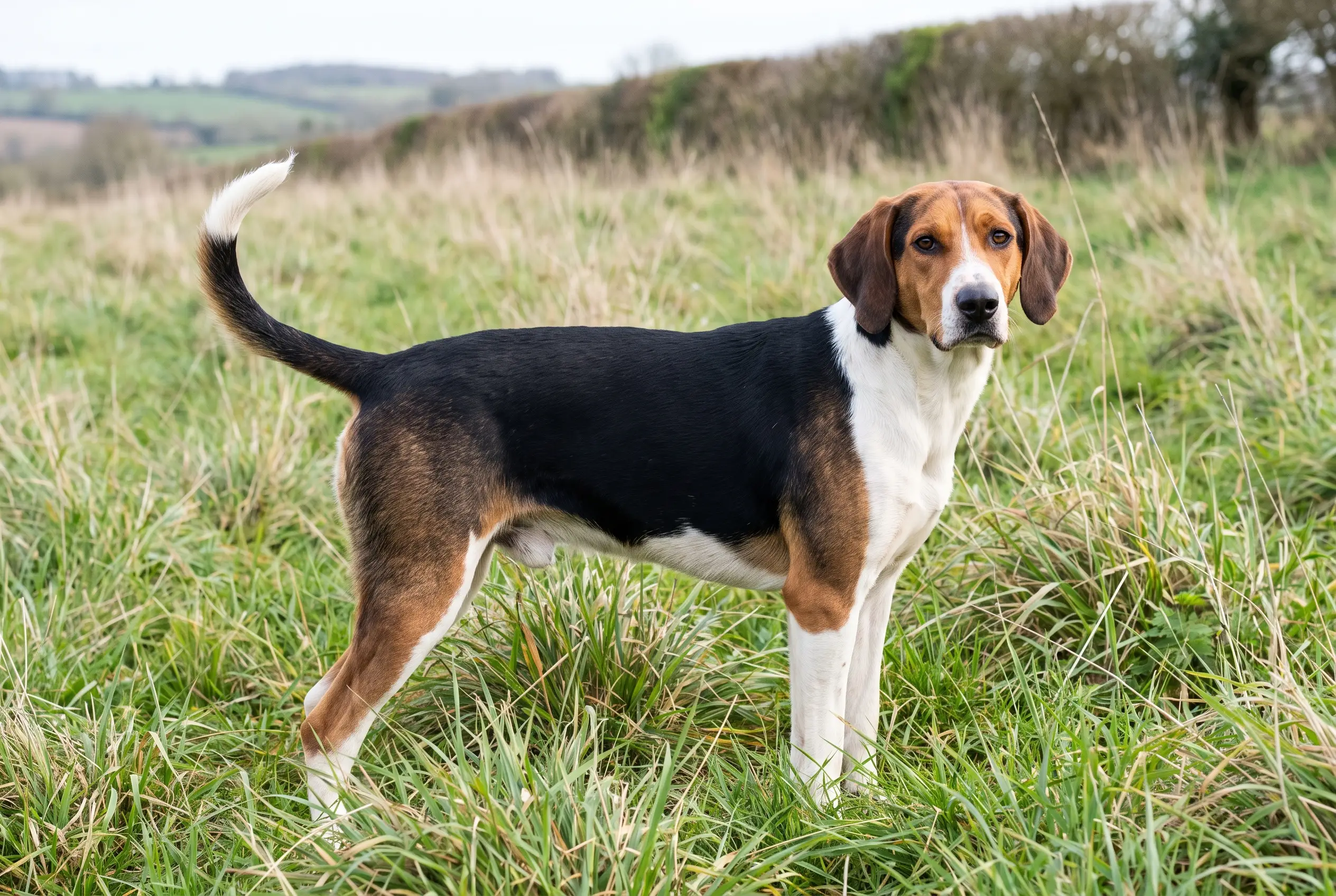
Anglo-Français de Petite Vénerie
Built for the hare and the rabbit, not shrunk from the Grand Anglo-Français that hunts deer.
Vital stats
| Size | Medium · 48–56 cm, ±2 cm tolerance for exceptional dogs |
| Weight | 16–20 kg — breed literature; the standard sets none |
| Life expectancy | 12–14 years — breed literature, not survey data |
| Energy | Very high — built to hunt hare on foot all day |
| Shedding | Low to moderate — short, dense coat |
| Coat | Short, dense, smooth · tricolour or bicolour, always with white |
| Group | Scenthound · Medium-sized Hound (FCI №325, Group 6) |
| Origin | France |
| FCI group | 6 — Scent hounds and related breeds · FCI 325 |
Breed traits
Friendliness
Care
Mind
The Anglo-Français de Petite Vénerie by the numbers
The Anglo-Français de Petite Vénerie facts owners search for most — price, lifespan, weight, shedding and colours, in one place.
Less common, so expect a waitlist and some travel to a reputable breeder — which pushes the price up. Plan for steady ongoing costs — mid-range food, routine vet care and insurance.
We don't quote a single figure: the real price swings with breeder, region, bloodline and health testing — and a rescue costs a fraction of a breeder's litter. Adopting is almost always the cheapest route.
Temperament
The standard has no dedicated behaviour section for this breed, which is itself worth saying plainly rather than papering over — most FCI hound standards give a paragraph of adjectives, and this one gives none. What it does specify, in the disqualifying faults, is the boundary: “aggressive or overly shy dogs” and “any dog clearly showing physical or behavioural abnormalities” are both disqualifying. Read against the breed's job — a pack hound worked shoulder to shoulder with others and handled directly by a huntsman on foot — that boundary is the temperament brief: stable, sociable with its own kind, responsive to a handler, nothing sharp and nothing shut down. Breed literature fills in the rest with a working dog's split personality: tenacious and courageous once a hare's line is found, calm and docile back at the kennel or the hearth.
Habits & quirks
The name is about the quarry, not the dog
Vénerie means hunting with a pack of hounds. Grande vénerie runs deer, wolf and boar with large hounds built for a day on horseback; petite vénerie runs hare, rabbit and sometimes fox on foot. This breed carries petite vénerie in its name because it was purpose-built for the second job — it is not a scaled-down or junior version of anything larger.
Anglo-Français means an actual cross, not a nickname
Anglo-Français hounds get that name because English scenthound blood — foxhounds and related English packs — was crossed into older French hound lines to sharpen speed and nose, then bred back toward a French type and silhouette. The result keeps the French look the standard asks for while running with more drive than the pure French hounds it descends alongside.
Three coats, one family
The standard allows tricolour (white and black with bright tan), a paler tricolour variant (white and black with pale tan), and a bicolour white-and-orange coat with a brown 'tobacco' nose instead of black. All three are the same breed under one standard, not separate colour breeds the way some of its French cousins are split.
Ears measured against the nose
The standard sets a specific bar for the ear leather: reaching at least two fingers' width past the border of the nose when drawn forward, set finely below eye level, flexible and slightly turned. Short of that mark is a fault a judge can point to directly.
Health
Breed literature reports no widely documented breed-specific conditions for the Anglo-Français de Petite Vénerie, which is honest rather than reassuring: the population outside French hunting circles is small, and there's no breed-wide survey behind that or behind the life-expectancy figure. Treat hip and elbow health as general good practice for any working scenthound, and pay attention to the low-set drop ears, which trap moisture and dirt and want checking and cleaning regularly, especially after time in cover. With so few litters bred for anything but the hunt, ask directly about the working lines behind a puppy rather than assuming a documented health scheme.
Nutrition
| Exercise | This is a working pack hound bred to hunt hare on foot for hours, not a companion dog with energy to spare. A securely fenced property and daily off-lead scent work — hunting, tracking, structured nose games — suit it far better than lead walks; a nose this good will follow a trail past any command it hasn't been solidly taught. |
| Grooming | The short, dense, smooth coat asks for little: a weekly brush handles loose hair, and there's no seasonal blowout to plan around. The drop ears set below eye level trap moisture and dirt more than the coat does, so check and clean them regularly, especially after time in cover. |
| Training | The standard says nothing directly about trainability, but its working-trial classification and its use in organised packs both assume a dog that takes direction from a huntsman while running with other hounds. Build recall early and hold it firmly against the pull of a scent trail; that pull is the entire reason the breed exists. |
| Health | Breed literature reports no widely documented breed-specific conditions, with hip and elbow health and the usual drop-ear infection risk flagged as general good practice for any working scenthound rather than a documented screening scheme. There is no breed-wide survey behind that claim or behind the life-expectancy figure above — outside French hunting circles the population is small, so ask directly about the working lines behind any litter. |
This is a working pack hound built to run hare on foot for hours, so feed it to the day it actually has — a hound out hunting burns far more than one resting between seasons, and the bowl should follow the work. Keep it lean and hard, with ribs you can feel under the short coat, because a scenthound carries condition better than fat. Weigh the meals against activity, count any training treats in the total, and let a working dog stay built like one.
How much should I feed an Anglo-Français de Petite Vénerie? →
Puppy guide
An Anglo-Français de Petite Vénerie puppy comes wired to follow its nose and give tongue, so the single most important thing you build in the first year is recall — locked in early, before the pup meets its first real trail, because a scent this good will pull past a command it hasn't solidly learned. Socialise it broadly; this is a pack breed, easy with its own kind and meant to be stable and sociable, and early exposure keeps that on track. Keep those drop ears clean from the start so handling them is routine, not a fight.
Training
The standard's working-trial classification and its use in organised packs both assume a hound that takes direction from a huntsman while running with others, so the raw material is there — but the nose runs the dog until you teach it otherwise. Build recall first and hold it firmly against the pull of a trail; that pull is the entire reason the breed exists. Keep sessions positive and consistent, give the nose real jobs — tracking, scent work, hunting itself — and remember you're steering drive, not suppressing it.
Life expectancy
Anglo-Français de Petite Vénerie hounds live 12–14 years — breed literature, not survey data. The life-expectancy figure for the Anglo-Français de Petite Vénerie comes from breed literature rather than any survey, so read it as a guide, not a guarantee. What keeps a working scenthound sound is straightforward: lean weight, real daily work for the nose and legs, clean ears, and parents from sound working lines. Give it the exercise it was built for and it holds condition for a long time.
Similar breeds
Breeds with a similar build and background — worth a look if this one isn't quite the fit.
Breeds that look like this
Common questions
Is the Anglo-Français de Petite Vénerie a small version of the Grand Anglo-Français?
No, and this is the single most common misreading of the name. Petite vénerie and grande vénerie describe two different kinds of hunt, not two sizes of dog: petite vénerie is hound-pack hunting of small game — hare and rabbit — while grande vénerie runs large game such as deer and boar. The three Grand Anglo-Français breeds (Tricolore FCI No. 322, Blanc et Noir FCI No. 323, Blanc et Orange FCI No. 324) were built for grande vénerie and stand notably taller. The Anglo-Français de Petite Vénerie (FCI No. 325) was bred separately, for the small-game job, and is not a junior or reduced-size edition of any of them.
What does 'Anglo-Français' actually mean here?
It means English hound blood was deliberately crossed into French pack-hound lines. Breeders brought in English scenthounds — foxhounds among them, alongside breeds such as the Harrier — to add speed and drive to older French stock, then bred the offspring back toward a French silhouette and character rather than an English one. The pure French hounds without that cross, such as the Français Tricolore (FCI No. 219), Français Blanc et Noir (FCI No. 220) and Français Blanc et Orange (FCI No. 316), sit alongside the Anglo-Français breeds in the same FCI section but carry no English blood in their standards' histories.
Are they good family pets?
Rarely kept as one, honestly. This is a working pack hound, developed for organised hare hunting on foot and still overwhelmingly bred and kept by hunters in France; the FCI standard describes utilisation, not household life, and gives no behaviour clause to quote either way. What it does guarantee is a dog disqualified for aggression or excessive shyness, and breed literature describes a hound that is calm at home between hunts. Anyone taking one on outside a hunting kennel should expect a very high exercise requirement, a nose-driven independence that resists an under-trained recall, and a breed with almost no presence in pet-focused breeding outside France.
Does the Anglo-Français de Petite Vénerie shed a lot?
Moderately. The Anglo-Français de Petite Vénerie sheds a fair amount, steadily through the year with heavier seasonal patches. A weekly brush keeps most of the loose hair off your floors and clothes.
Is the Anglo-Français de Petite Vénerie hypoallergenic?
Not really. No dog is truly hypoallergenic, and the Anglo-Français de Petite Vénerie's shedding coat releases plenty of the dander that sets off allergies. If someone at home is allergic, this isn't the easiest breed to live with — spend time around one first.
Is the Anglo-Français de Petite Vénerie easy to train?
Reasonably. The Anglo-Français de Petite Vénerie is trainable with consistency and rewards, though it isn't the quickest study. Keep sessions short and positive, and be patient with the basics like recall.