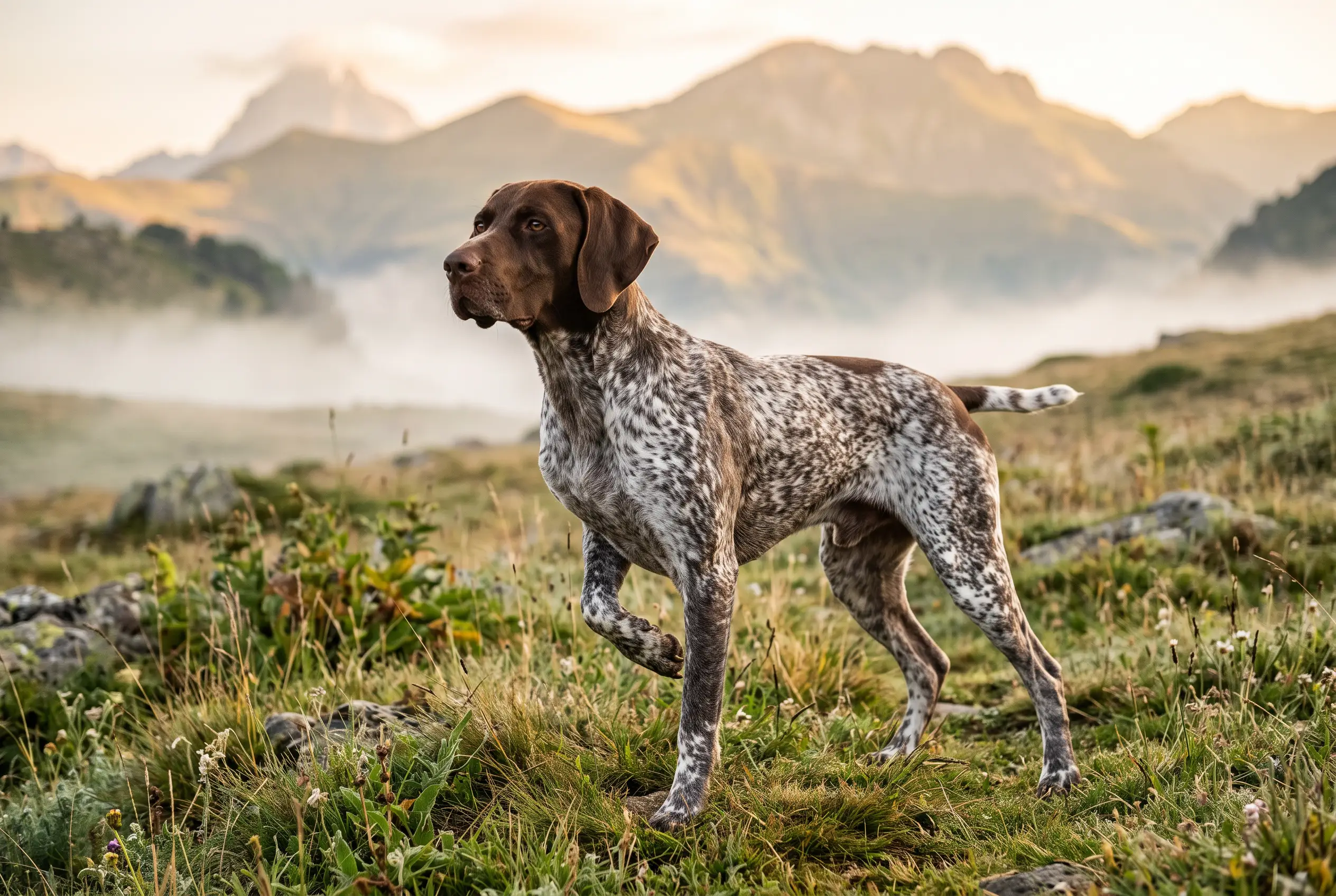
Braque Français (Pyrenees Type)
One old French pointer, two breeds on paper — this is the small, quick one from the Pyrenees.
Vital stats
| Size | Medium · 51–58 cm (dogs), 49–56 cm (bitches) |
| Weight | 18–25 kg — breed literature; the standard sets none |
| Life expectancy | 12–14 years — breed literature, not survey data |
| Energy | High — an all-day hunting pointer |
| Shedding | Low to moderate — short coat, light year-round drop |
| Coat | Short, fine hair · chestnut brown, solid or with white, speckling or tan |
| Group | Sporting · Continental Pointing Dogs (FCI №134, Group 7) |
| Origin | South-west France and the Central Pyrenees |
| FCI group | 7 — Pointing Dogs · FCI 134 |
Breed traits
Friendliness
Care
Mind
The Braque Français (Pyrenees Type) by the numbers
The Braque Français (Pyrenees Type) facts owners search for most — price, lifespan, weight, shedding and colours, in one place.
Less common, so expect a waitlist and some travel to a reputable breeder — which pushes the price up. Plan for steady ongoing costs — mid-range food, routine vet care and insurance.
We don't quote a single figure: the real price swings with breeder, region, bloodline and health testing — and a rescue costs a fraction of a breeder's litter. Adopting is almost always the cheapest route.
Temperament
Neither French Pointing Dog standard carries a behaviour clause; the only temperament rule in the text is that an aggressive or overly shy dog is disqualified. The character here therefore comes from the French breed club and hunting literature, and it is remarkably consistent: gentle, biddable, strongly attached to its handler, and soft — French sources call the breed sensitive, some say timid, and agree that a harsh correction sets it back further than it teaches. The same literature describes a close-to-medium worker with a fine nose that adapts its range to the ground, which is part of why French rough-shooters kept it through two centuries of fashionable foreign pointers. At home expect a dog that leans, follows and settles once it has been run, and an eye for birds that no amount of suburbia removes.
Habits & quirks
Defined by its differences
The whole Pyrenean standard is a list of departures from the Gascogne type: the same dog at reduced dimensions and lighter shapes, with tighter skin, less pendent lips, little or no dewlap and finer, shorter hair. For everything it does not mention, the Gascogne standard is the reference.
Ears that stop two centimetres short
Set on above the eye line and barely folded, the ear tips must end 2 cm from the nose leather — the Gascogne's must reach it. An ear that touches the nose is a listed fault, which makes ear length the quickest way to tell the two types apart.
Brown, four ways
The colour clause reads across from the Gascogne standard: chestnut brown; chestnut brown and white; chestnut brown and white strongly speckled; or chestnut brown with tan markings above the eyes, at the lips and on the legs. The nose is chestnut-brown, and pronounced depigmentation of it disqualifies.
A short tail, never no tail
The tail is fine, and the standard allows it docked or naturally short — but a dog born with no tail at all (anury) is disqualified. The Gascogne text excuses a well-carried long natural tail; the Pyrenean text simply does not mention one.
Health
The Pyrenean Braque Français has no breed-wide health survey and calls itself rustic in its own standard, so there is no documented list of conditions to screen against — the useful approach is general. It is a medium pointing breed, so the standing things to mind are hips, worth asking a breeder about, and the drop ears: fine, folded and warm inside, they trap moisture and want a weekly check and a clean, plus after any outing in cover. Outside France the population is small, so a health-testing breeder and a deep, well-managed pedigree matter more than usual. And as a deep-chested working dog it earns the ordinary bloat precaution: calm, unhurried meals with a gap around hard exercise.
Nutrition
| Exercise | This is an all-day hunting pointer, and a walk round the block is not the point. Plan on an hour or two of real running plus work for the nose — hunting, field-trial training, dummy searches or scent games. It suits people who run, hike or shoot; under-exercised, it turns restless and vocal. |
| Grooming | A weekly once-over with a hound glove keeps the coat done — the standard asks for hair finer and shorter than the Gascogne's. Check the drop ears weekly and after every outing in cover, because a folded ear over a warm canal is where trouble starts. Baths are rarely needed. |
| Training | French sources describe a sensitive dog, some say timid, and advise gentle, early education with early exposure to town noise. It wants to cooperate — the club literature's word is docile — so reward-based training moves fast and harsh corrections move backwards. Start recall and steadiness around birds young. |
| Health | A rustic breed by its own standard's wording, with no breed-wide health survey to cite. Ask breeders for hip results and keep an eye on the ears, the standing risks of medium pointing breeds; outside France the population is small, so pedigree depth deserves real attention. The 12–14 years in breed literature is a habit of the type, not study data. |
This is an all-day hunting pointer, and it eats to the work it has done, not to a fixed cup — a hunting day and a rest day are different rations, so weigh the meals and count the training treats in the daily total. Keep ribs you can feel under the fine, short coat, because weight on a light, quick frame steals the very speed and stamina the breed is prized for. The deep chest adds one habit worth keeping: two calm meals rather than one gulped bowl, and a clear gap around hard running instead of feeding right before or after.
Puppy guide
French sources call this a sensitive breed, some say timid, and that shapes the first months more than anything else: socialise early, gently and often, and make a point of easy, positive exposure to town noise and busy places while the puppy is young. Keep the bodywork light — short scent games for the nose, and no repetitive hard galloping or big jumps until the joints have set. Start recall and steadiness around birds young, because the pointing instinct is already there, and keep every session short and rewarding, because a harsh moment sets a sensitive pup back further than it teaches.
Training
The club literature's word is docile, and this is a dog that wants to cooperate, so reward-based training moves fast — and, because French sources call it sensitive, harsh corrections move it backwards, undoing more than they fix. Keep sessions short, kind and paid, and build the two things that matter around birds: a reliable recall and steadiness on point. Start both young while the habits are easy to set, and use a long line around game until the recall holds against a nose that never really clocks off.
Life expectancy
Braques Français of the Pyrenean type live 12–14 years — breed literature, not survey data. A rustic working breed with no documented breed-specific disease, the Pyrenean Braque Français holds the top of its range on the plain things: lean weight, ears kept clean and dry, real daily running and nose work, and parents from a health-testing breeder who, with the breed scarce outside France, keeps a careful eye on pedigree depth.
Similar breeds
Breeds with a similar build and background — worth a look if this one isn't quite the fit.
Breeds that look like this
Common questions
What is the difference between the Pyrenees and Gascogne types?
Since 18 January 1955 the FCI has counted them as two breeds: No. 133 for the Gascogne, No. 134 for the Pyrenean. The Gascogne is the old, big braque — 60–69 cm for males, looser skin, longer ears, a slight dewlap, thicker hair; the Pyrenean is the smaller, lighter version at 51–58 cm, with tighter skin, higher-set shorter ears and a finer coat. Head type and colours are the same, and by reputation the Pyrenean is the more commonly seen of the two in the field in France.
Are they good family dogs?
French breed literature is consistent on this: a gentle, people-attached dog that does well with children and gets along with other dogs, among the softest-tempered breeds in Group 7. The honest caveats are the exercise bill of a working pointer, a sensitivity that suits loud households badly, and a nose and pointing instinct that never clock off around birds. Nothing in the FCI standard speaks to temperament, so this rests on club and hunting sources.
Is it the same as a German Shorthaired Pointer?
No — a separate French breed, though both are continental pointers in FCI Group 7 that hunt, point and retrieve. The visible differences: the Pyrenean braque stays a size smaller, wears only chestnut brown and its combinations with white or tan where GSPs commonly carry black, and by reputation works closer to the gun. French fanciers count the braque français among the oldest of the continental pointers; treat lineage claims in either direction with care.
Does the Braque Français (Pyrenees Type) shed a lot?
Moderately. The Braque Français (Pyrenees Type) sheds a fair amount, steadily through the year with heavier seasonal patches. A weekly brush keeps most of the loose hair off your floors and clothes.
Is the Braque Français (Pyrenees Type) hypoallergenic?
Not really. No dog is truly hypoallergenic, and the Braque Français (Pyrenees Type)'s shedding coat releases plenty of the dander that sets off allergies. If someone at home is allergic, this isn't the easiest breed to live with — spend time around one first.
Is the Braque Français (Pyrenees Type) easy to train?
Yes. The Braque Français (Pyrenees Type) is one of the more trainable breeds — quick to learn and keen to work with you, which makes reward-based training straightforward. Start early, keep it positive, and it picks things up fast.