Braque Saint-Germain
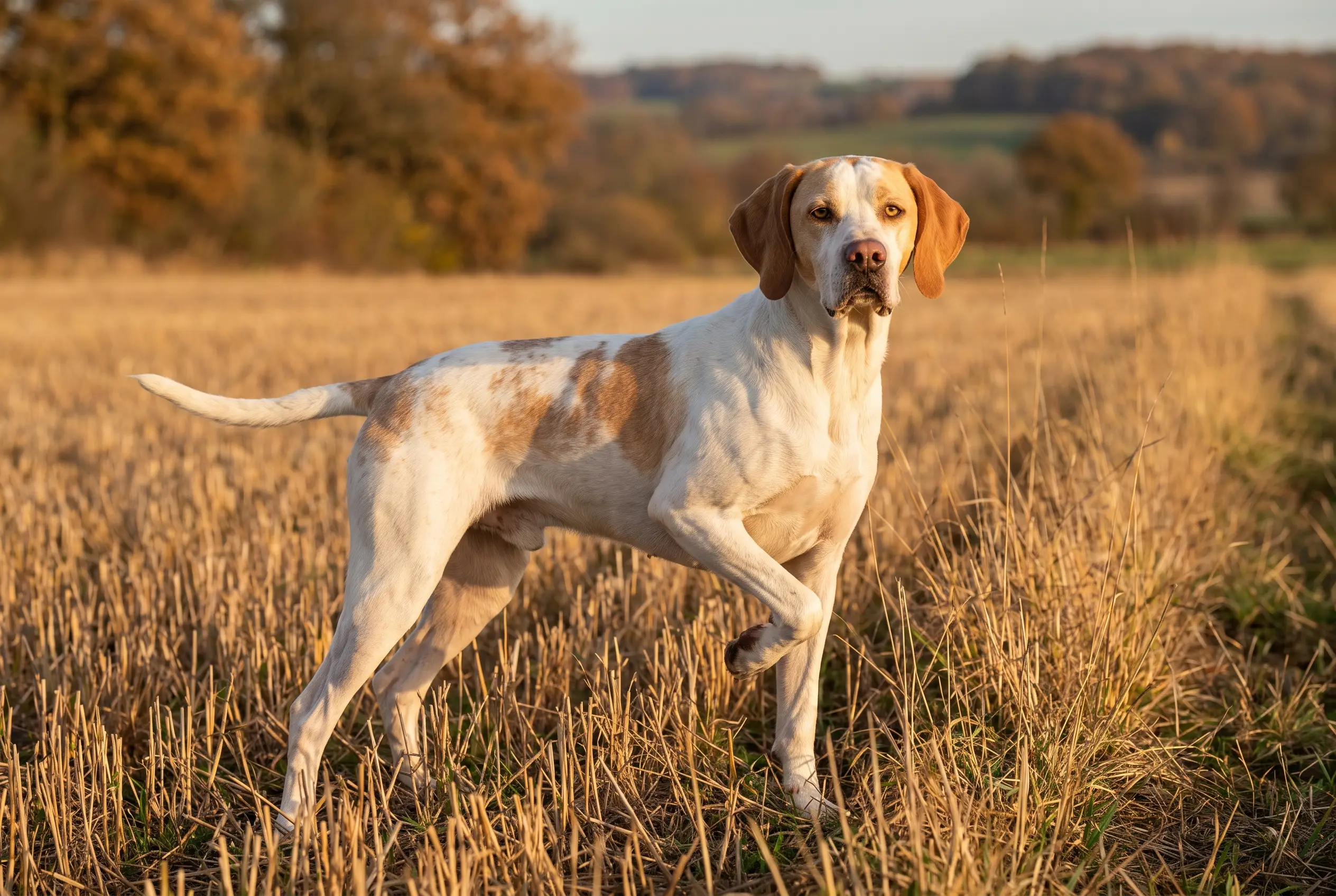
The royal kennels' fawn-and-white pointer, golden-eyed by rule, with black banned down to the toenails.
Vital stats
| Size | Medium-large · 56–62 cm (dogs), 54–59 cm (bitches) |
| Weight | 18–25 kg — breed literature; the standard sets none |
| Life expectancy | 12–15 years — breed literature, not survey data |
| Energy | High — a galloping gundog that needs real field time |
| Shedding | Light to moderate — short coat, year-round |
| Coat | Short, not too fine · dull white with orange (fawn) markings, fawn ears |
| Group | Sporting · Continental Pointing Dogs (FCI №115, Group 7) |
| Origin | France |
| FCI group | 7 — Pointing Dogs · FCI 115 |
Breed traits
Friendliness
Care
Mind
The Braque Saint-Germain by the numbers
The Braque Saint-Germain facts owners search for most — price, lifespan, weight, shedding and colours, in one place.
Less common, so expect a waitlist and some travel to a reputable breeder — which pushes the price up. Plan for steady ongoing costs — mid-range food, routine vet care and insurance.
We don't quote a single figure: the real price swings with breeder, region, bloodline and health testing — and a rescue costs a fraction of a breeder's litter. Adopting is almost always the cheapest route.
Temperament
The standard opens its temperament clause with 'hunter above all', then spends the rest of it on gentleness: very sociable, equable and affectionate, easy to train, and a dog that 'won't suffer brusque treatment' — a warning against rough handling written into the breed's own text. In the field it hunts pheasant, partridge and woodcock with passion on any terrain, quests at an average range rather than the horizon-chasing sweep of its English Pointer ancestor, and retrieves with a soft mouth. At home the standard calls it very close to man, happiest living with the family, and owners should take that literally: this is a house companion that hunts, not a kennel dog. The engine is still a gundog's, so a bored, under-run Saint-Germain will invent work of its own.
Habits & quirks
Not one black hair
The general appearance clause says it plainly: fawn and white 'without any black being present'. Black on the nose, lips, palate or even in the toenails is a disqualifying fault — the whole dog runs on pink and fawn pigment.
Golden eyes, in writing
The standard wants well-open, golden-yellow eyes with a 'candid and mild' look. Lemon eyes are a fault; brown or black eyes disqualify outright, which makes this one of the few breeds where a brown-eyed dog cannot be shown.
Feather first
The utilisation line reads 'principally on feather', and the temperament clause names the birds: pheasant, partridge and woodcock, on any terrain, brought back with a soft mouth. Fur is allowed work, but birds are the job.
Handle it gently
'Won't suffer brusque treatment during its training' is the standard's own phrasing. This is a soft-tempered gundog that shuts down under harsh corrections and, everything considered, trains easily without them.
Health
The Braque Saint-Germain is a hardy pointing dog with no breed-wide health survey behind it, and the population is small enough that pedigree depth matters — ask a breeder about the hip results on both parents and how closely related the lines are. None of that is a documented club scheme; it's ordinary good practice for a pointing breed. Day to day, the things to watch are a gundog's: check the long, creased ears after any work in cover, keep the dog lean, and give the drive a real outlet so it doesn't turn into trouble at home.
Nutrition
| Exercise | Plan on an hour or two of free running a day — the standard's normal gait is the gallop, supple and made to be maintained. Field work, dummy retrieves or nose games meet the pointing instinct; lead walks alone leave it half spent. The standard says nothing on hours; this is standard practice for a working pointer. |
| Grooming | The short, not-too-fine coat is as easy as dog coats get: a weekly rubber-mitt once-over, more during moults, and a check of the long, creased ears after cover work. Baths only when it has found something to roll in. |
| Training | Easy by the standard's own account, provided the handler stays soft: reward-based methods, short sessions, no harsh corrections. Start steadiness to birds and recall early — the passion for pheasant and partridge does not wait for permission. |
| Health | A hardy gundog with no breed-wide health survey; the population is small, so ask breeders about pedigree depth and hip results. That advice is general good practice for pointing breeds, not a documented club scheme — flag, not fact. |
Feed a Saint-Germain to the work it actually does: a dog running fields all autumn and the same dog resting through summer do not need the same bowl. Weigh the meals rather than eyeballing them, count the training treats into the day's total, and aim for ribs you can feel under the short coat. Lean is the goal — extra weight on a galloping build steals the very endurance the breed is bred for.
Puppy guide
A Saint-Germain puppy comes wired to chase birds, and the first year is about shaping that instinct, not fighting it. Keep the hard running light while the joints are still forming, but socialise widely and build a reliable recall early — the passion for pheasant and partridge arrives long before the manners do, and a dog that has learned to check in is a dog you can still hunt with. Handle everything gently: this is a soft breed that shuts down under a heavy hand, puppy or grown.
Training
The breed standard says it plainly: this dog won't suffer brusque treatment, and, handled softly, it trains easily. Keep sessions short and reward-based, drop the harsh corrections entirely — here they don't just fail, they close the dog down — and start recall and steadiness to birds early. A Saint-Germain wants to please and learns fast; the whole job is staying calm enough to let it.
Life expectancy
Braque Saint-Germains live 12–15 years — breed literature, not survey data. Breed literature puts the Braque Saint-Germain at {life}, a healthy span for a working pointer, though there's no survey behind the number. You hold a dog at the top of that range the same way you keep it sound: lean weight year-round, parents whose hips were checked, and enough real running to keep the engine and the mind busy.
Similar breeds
Breeds with a similar build and background — worth a look if this one isn't quite the fit.
Breeds that look like this
Common questions
Is the Braque Saint-Germain related to the English Pointer?
Directly. The standard's history section describes the breed as descended from an English pointer crossed with a continental pointer, around 1830 in the royal kennels at Compiègne and then Saint-Germain-en-Laye, the town that named it. The English side shows in the outline and the gallop; the continental side in the closer quest, the fawn-and-white coat and the softer temper.
How rare is it?
Genuinely rare, and almost entirely French. Breed sources report around forty LOF registrations a year — 44 in 2024 — and estimate fewer than 500 living studbook dogs, with breeding outside France anecdotal. It was the opposite once: the most shown pointing breed at France's first dog shows in the 1860s.
Is it a good family dog?
The standard says so in as many words: very sociable, equable, affectionate, very close to man, and a dog that appreciates living with the family. The honest caveats are a gundog's exercise bill, a hunting passion that needs managing around birds, and the practical difficulty of finding one at all outside France.
Does the Braque Saint-Germain shed a lot?
Moderately. The Braque Saint-Germain sheds a fair amount, steadily through the year with heavier seasonal patches. A weekly brush keeps most of the loose hair off your floors and clothes.
Is the Braque Saint-Germain hypoallergenic?
Not really. No dog is truly hypoallergenic, and the Braque Saint-Germain's shedding coat releases plenty of the dander that sets off allergies. If someone at home is allergic, this isn't the easiest breed to live with — spend time around one first.
Is the Braque Saint-Germain easy to train?
Yes. The Braque Saint-Germain is one of the more trainable breeds — quick to learn and keen to work with you, which makes reward-based training straightforward. Start early, keep it positive, and it picks things up fast.