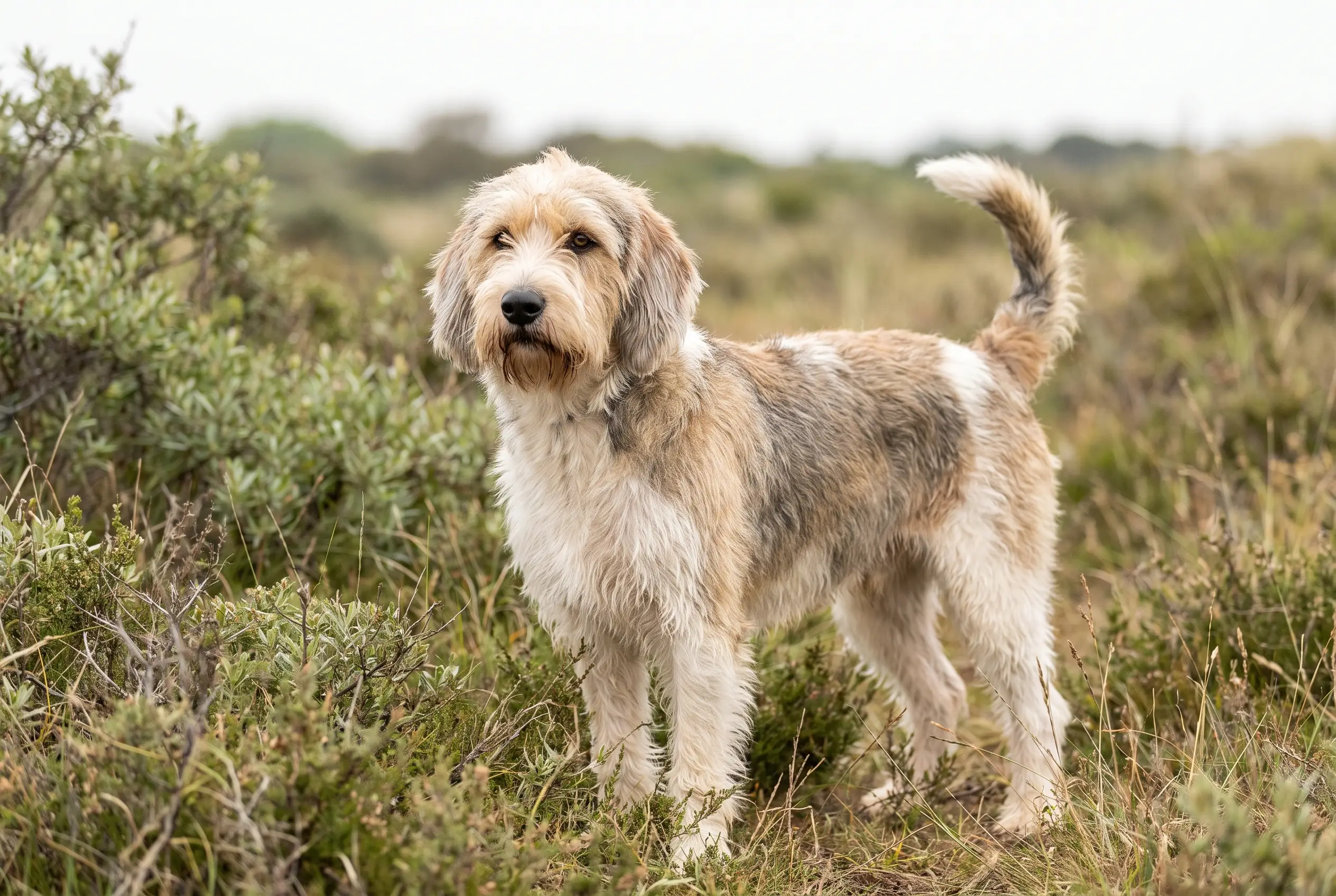
Briquet Griffon Vendéen
Its own name is the job description — briquet is old French for "medium-sized hound."
Vital stats
| Size | Medium · 50–55 cm (males), 48–53 cm (females) |
| Weight | 18–24 kg — breed literature; the standard sets none |
| Life expectancy | 10–12 years — breed literature, not survey data |
| Energy | High — 60+ min/day of real work, not just a walk |
| Shedding | Light-moderate |
| Coat | Long, harsh coat without exaggeration · black, orange or fawn patterns with white, tan or black overlay |
| Group | Hound · Medium-sized Hounds (FCI №19, Group 6) |
| Origin | Vendée, France |
| FCI group | 6 — Scent hounds and related breeds · FCI 19 |
Breed traits
Friendliness
Care
Mind
The Briquet Griffon Vendéen by the numbers
The Briquet Griffon Vendéen facts owners search for most — price, lifespan, weight, shedding and colours, in one place.
Less common, so expect a waitlist and some travel to a reputable breeder — which pushes the price up. Plan for steady ongoing costs — mid-range food, routine vet care and insurance.
We don't quote a single figure: the real price swings with breeder, region, bloodline and health testing — and a rescue costs a fraction of a breeder's litter. Adopting is almost always the cheapest route.
Temperament
The standard gives the working character in two short, specific clauses. Behaviour: "Fine nose; fast dog with pleasant voice, does not refuse bramble; very nimble on rough terrain, hunts rather with nose to the wind." Temperament: "It takes a lot of initiative, has stamina and is robust. It must be equally good at working a cold track, at starting game and at driving it." Then the line that matters most for anyone not actually hunting with it: "The Briquet is a passionate hunter; it is up to his master to make him obey." Read plainly, that's a dog built to make its own calls in the field, not one that arrives biddable by default — the obedience the standard assumes is something you build, with early and consistent handling.
Habits & quirks
The name is the job description
In French, briquet just means a medium-sized hound. The standard notes this is "the only breed having kept this name" — the old label for the size class between basset and grand hound, worn by one breed instead of a whole category.
Nose to the wind
The standard's own phrase for its style: it doesn't put its head down and plod a line like some scenthounds — it "hunts rather with nose to the wind," reading air scent while staying nimble on rough ground.
Ears built to dodge brambles
Narrow, supple ear leather, set low below eye level, turned inward and falling short of the muzzle tip — tailored for a dog the standard says "does not refuse bramble."
Camouflage with old names
Among the permitted colours are fawn-and-black combinations the standard still calls by their traditional hunting names: hare colour, wolf colour, badger colour, wild boar colour.
Health
The Briquet has no breed-specific health list in its standard, and no wide survey stands behind the lifespan usually quoted for it — which, for a working French hound, is honest rather than alarming. Ask a breeder about hip screening and pedigree depth; with a population this small, how related the parents are matters. Then treat ears as routine: drop ears set low, a harsh coat, and a beard that collects everything mean a weekly check and clean keep most trouble away.
Nutrition
| Exercise | Bred to hunt large game, fox and hare with the gun, in a small pack, over a full working day. An hour or more of real off-lead activity daily is the floor; scent games or hunting-adjacent work suit it better than a lead walk ever will. |
| Grooming | The harsh, long coat sheds dirt more than it sheds itself, but it mats without a weekly brush. The beard and moustaches collect debris after fieldwork, and the low-set ears need a regular look. |
| Training | The standard is candid about this one: it takes initiative and works a cold track on its own judgement. Reward-based, consistent handling from puppyhood earns cooperation from a nose this independent; confrontation won't. |
| Health | The standard sets no breed-specific health list, and no wide survey backs the 10–12 years usually quoted. Ask breeders about hip screening and pedigree depth, and treat ear care as routine — standard fare for a drop-eared, harsh-coated hunting hound. |
Bred to hunt a full day in a pack, the Briquet does best fed to the work in front of it — a dog running country all season and the same dog quiet in the off months eat differently. Weigh the meals, count any scent-game or training treats into the total, and keep the ribs easy to feel under the harsh coat. Lean keeps a hunting hound nimble on the rough ground it was built for.
Puppy guide
A Briquet puppy is a nose on legs, and the first year is about building cooperation before that nose fully takes over. Get a recall started early and reward it heavily, socialise widely with people and other dogs — this is a pack hound that should like company — and keep the hard running light while the joints close. Reward-based, patient handling from the start earns you a hunting dog that still checks in; confrontation just teaches it to switch you off.
Training
The standard is candid: this hound takes initiative and works a cold track on its own judgement, so it never arrives biddable by default. Reward-based, consistent handling from puppyhood is what earns cooperation from a nose this independent — confrontation gets you nowhere. Keep sessions short and worth its while, put in the recall long before you need it, and accept that obedience is something you build here, patiently, rather than something the breed owes you.
Life expectancy
Briquet Griffon Vendéens live 10–12 years — breed literature, not survey data. Breed literature puts the Briquet at {life}, with no wide survey behind it — a fair, honest range for a hardy working hound. The things that keep a dog at the top of it are the ordinary ones: parents with hips screened, a lean body its whole life, ears kept clean, and enough real work to keep a hunting hound sound in body and content in mind.
Similar breeds
Breeds with a similar build and background — worth a look if this one isn't quite the fit.
Breeds that look like this
Common questions
What does "Briquet" mean?
It's old French hunting vocabulary, not a proper name — a briquet is simply a medium-sized hound, sized between the tall running hounds and the low bassets. The standard makes the point directly: this is "the only breed having kept this name," the term everyone's dogs once used before breeders split the type into taller and shorter lines.
How does it differ from the Grand Basset Griffon Vendéen and Petit Basset Griffon Vendéen?
Mostly by legs. All three are rough-coated Vendée hounds bred for the same work at different heights: the Grand Basset Griffon Vendéen (FCI №33, 39–44 cm) and Petit Basset Griffon Vendéen (FCI №67, 34–38 cm) are both bassets, low-set on short legs to work cover at a walking pace. The Briquet (FCI №19, 50–55 cm) stands on ordinary straight legs — taller than either basset, and shorter than the Grand Griffon Vendéen (FCI №282) it was bred down from. Briquet is the old French word for exactly that in-between size.
Is the Briquet Griffon Vendéen rare?
Yes, genuinely so, even by French-hound standards. It's FCI-recognised and hunted seriously at home — a Briquet pack won France's national roe-deer trophy in 1995 — but no registry publishes a current worldwide count, and it isn't recognised by the AKC. Outside France it's close to unseen; finding one usually means a direct conversation with a French hunting kennel.
Does the Briquet Griffon Vendéen shed a lot?
Moderately. The Briquet Griffon Vendéen sheds a fair amount, steadily through the year with heavier seasonal patches. A weekly brush keeps most of the loose hair off your floors and clothes.
Is the Briquet Griffon Vendéen hypoallergenic?
Not really. No dog is truly hypoallergenic, and the Briquet Griffon Vendéen's shedding coat releases plenty of the dander that sets off allergies. If someone at home is allergic, this isn't the easiest breed to live with — spend time around one first.
Is the Briquet Griffon Vendéen good with children?
They can be. The Briquet Griffon Vendéen is reasonably sociable and can be good with children in the right home, especially when socialised early. Supervise around young kids and teach dog and child to respect each other.
Is the Briquet Griffon Vendéen easy to train?
They can be a challenge. The Briquet Griffon Vendéen is intelligent but independent, and would rather make its own decisions than take orders. Reward-based training and patience work best; expect recall in particular to take time.