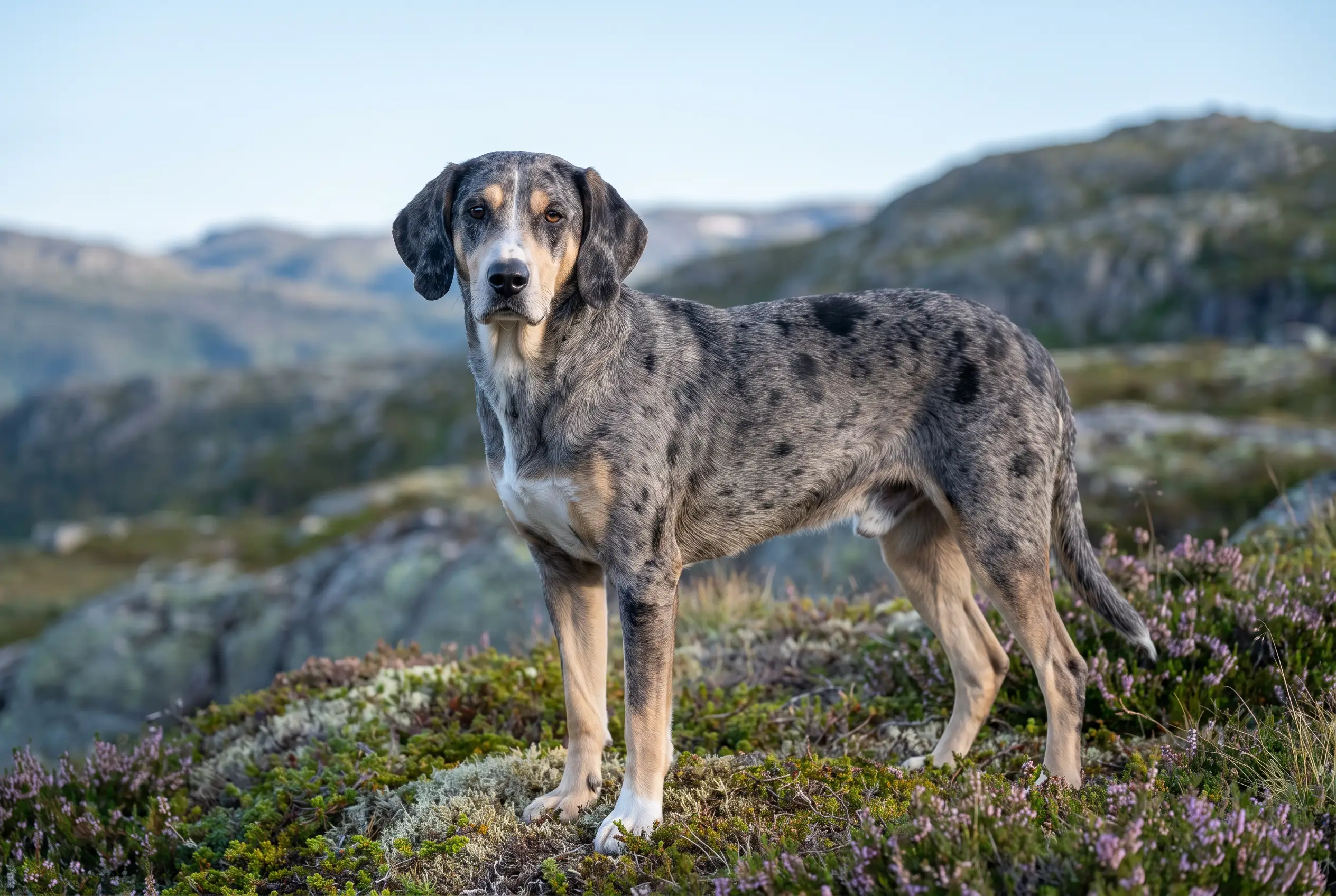
Dunker
The Norwegian scent hound that comes in blue marble, named after the captain who built it.
Vital stats
| Size | Medium · 50–58 cm (dogs), 47–54 cm (bitches) |
| Weight | 18–25 kg — breed literature; the standard sets none |
| Life expectancy | 12–13 years — breed literature, not survey data |
| Energy | High — a working scenthound, daily exercise plus trail work |
| Shedding | Moderate — hard, dense, close coat |
| Coat | Straight, hard, dense, not too short · diluted black and tan, or blue-marbled (merle) with pale tan and white |
| Group | Hound · Medium-sized Hounds (FCI №203, Group 6) |
| Origin | Norway |
| FCI group | 6 — Scent hounds and related breeds · FCI 203 |
Breed traits
Friendliness
Care
Mind
The Dunker by the numbers
The Dunker facts owners search for most — price, lifespan, weight, shedding and colours, in one place.
Less common, so expect a waitlist and some travel to a reputable breeder — which pushes the price up. Plan for steady ongoing costs — mid-range food, routine vet care and insurance.
We don't quote a single figure: the real price swings with breeder, region, bloodline and health testing — and a rescue costs a fraction of a breeder's litter. Adopting is almost always the cheapest route.
Temperament
The standard's own words carry the case: "considered to be the hardy and robust scent hound of old times, a dog with an excellent temperament," characterised by "strong nerves" and by "being especially sociable and trusting." It credits the breed as "an excellent combination of a hunting and companion dog," and adds that its "good temperament and open nature" make it easy to train. That is a scenthound's working file, not a lapdog's, and it shows: the nose leads, and a bored Dunker will go looking for a trail of its own. But the trust and steadiness the standard describes are exactly why it also does well as a household dog for people who give it daily work.
Habits & quirks
Marbled by design, not the only option
The standard names two coats: diluted black with tan markings, or blue-marbled (merle) with pale tan and white markings. Jet black with warm tan is "less desirable," and 50% or more white is "undesirable" — so the famous blue marble is typical, not universal, and even it has limits.
Wall eyes are written into the standard
Eyes should be dark, but the standard makes one explicit exception: "wall eyes are permitted in blue marbled (merle) dogs." It is the merle gene's effect on eye pigment, named plainly rather than treated as a flaw.
A pieced-together breed by design
Captain Dunker didn't refine one regional strain — he crossed several Norwegian scent hound lines, including local hare hounds from around the country, to build the breed from scratch in the early 1800s.
Still a small population
After a mid-20th-century stretch of close breeding narrowed the gene pool, controlled outcrossing was permitted to rebuild genetic diversity without losing type. The standard's own closing note on history: "the population figure is still low."
Health
The single most important health rule for this breed is a breeding one: never pair two merle Dunkers. Merle-to-merle breeding raises the odds of double-merle puppies, which is widely linked to deafness and eye defects — the standard's own history also flags a mid-20th-century inbreeding problem that controlled outcrossing was used to correct, and the population stays small. So ask a breeder directly about hearing and eye testing and how the line was outcrossed. Day to day it's a hardy working hound; check the hanging ears regularly, as with any drop-eared breed.
Nutrition
| Exercise | A working scenthound bred for hunting trials needs a real daily outing plus something for its nose — tracking, long hikes with sniffing time built in, or scent games at home. A walk with no trail work is only half the job. |
| Grooming | The hard, dense, close coat sheds moderately and asks for a weekly brush, nothing more. Check the hanging ears regularly, as with most hound breeds. |
| Training | The standard credits its "good temperament and open nature" with making it easy to train, and that matches breeders' reports. The harder part is recall once a scent trail takes over — start that early and keep rewards high-value. |
| Health | Never pair two merle Dunkers: merle-to-merle breeding raises the odds of double merle puppies, a widely documented risk across merle breeds that brings hearing and vision problems, not a clause the FCI standard spells out for this breed specifically. The standard's own history section flags a mid-20th-century inbreeding problem that controlled outcrossing was used to correct, and the population remains small, so ask breeders directly about hearing and eye testing and how the line was outcrossed. |
A working scenthound covers real ground on a trail, so feed the Dunker to its actual workload and keep it lean — a fit hound tires later and holds a scent longer. Weigh the meals, count the scent-work and training treats in the day's total, and aim for ribs you can feel under that hard, dense coat. A trailing dog also drinks and burns more on a long day out than on a quiet one, so match the bowl to the day.
Puppy guide
A Dunker puppy is a friendly, open-natured hound that the standard itself credits with being easy to train, so use that early window well. Busy the nose with short scent games, socialise widely, and start recall from the very first week, because the day a scent trail takes over is the day a young hound stops listening. Keep the growing body's exercise sensible and its mind busier than its legs — a bored scenthound puppy grows into a bored scenthound that invents its own trails.
Training
The standard credits the Dunker's good temperament and open nature with making it easy to train, and breeders agree — the easy part is teaching it things. The hard part is recall once a scent trail takes over, so start that early, keep the rewards genuinely high-value, and use a long line while it's reliable-enough rather than reliable. Keep sessions short and varied, and remember the nose will always be the strongest voice in the room.
Life expectancy
Dunkers live 12–13 years — breed literature, not survey data. The Dunker is a hardy working hound, and you keep it sound for the long haul with the basics: a lean weight, real daily work for the nose, ears kept clean, and — because the population is small and carries the merle gene — a breeder who tests hearing and eyes and never doubles up on merle. The years quoted come from breed literature rather than a survey, so treat them as a guide.
Similar breeds
Breeds with a similar build and background — worth a look if this one isn't quite the fit.
Breeds that look like this
Common questions
What's the difference between the Dunker, the Haldenstøver and the Hygenhund?
All three are Norwegian scenthounds in FCI Group 6, Section 1.2, and all three sit within a couple of centimetres of each other in height — but the coats give them away. The Dunker (FCI №203) is the one that comes in blue-marbled merle, alongside a plainer black-and-tan; wall eyes are standard-permitted only here. The Haldenstøver (FCI №267), named for the town of Halden, is white with black patches and tan shading — no merle at all, and at 52–60 cm for dogs it runs the tallest of the three. The Hygenhund (FCI №266), bred by Hans Fredrik Hygen, has the widest colour range of the three — red-brown or yellow-red, black and tan, or white with red-brown or black-and-tan markings — but never merle either. If the coat is blue-grey and mottled, it's a Dunker.
Is it true you shouldn't breed two merle Dunkers together?
Correct, and it's basic merle genetics rather than anything specific to this breed. Merle is a dominant gene that dilutes and mottles the coat; a dog with one copy is a normal, healthy merle. Breed two merle dogs together and, on average, a quarter of the litter inherits two copies — "double merle" — which is strongly linked to deafness and eye defects, including missing or malformed eyes. The Dunker standard permits wall eyes in merle dogs and caps white markings at under 50%, both signs the breed's own history has brushed up against this territory, though the standard doesn't spell out a merle-to-merle breeding ban. Responsible breeders pair merle with a solid-coloured dog, never with another merle.
Are Dunkers good family pets, or only hunting dogs?
The standard calls it "an excellent combination of a hunting and companion dog" with "strong nerves" and a temperament that is "especially sociable and trusting" — on paper, a strong family candidate. In practice, it is still a scenthound built for hunting trials: it needs real daily exercise and mental work, not just a yard, and an under-exercised one will find its own entertainment by following its nose. Outside Norway the population is small, so expect a wait and a breeder who asks as many questions as you do.
Does the Dunker shed a lot?
Moderately. The Dunker sheds a fair amount, steadily through the year with heavier seasonal patches. A weekly brush keeps most of the loose hair off your floors and clothes.
Is the Dunker hypoallergenic?
Not really. No dog is truly hypoallergenic, and the Dunker's shedding coat releases plenty of the dander that sets off allergies. If someone at home is allergic, this isn't the easiest breed to live with — spend time around one first.
Is the Dunker easy to train?
Reasonably. The Dunker is trainable with consistency and rewards, though it isn't the quickest study. Keep sessions short and positive, and be patient with the basics like recall.