Haldenstøver
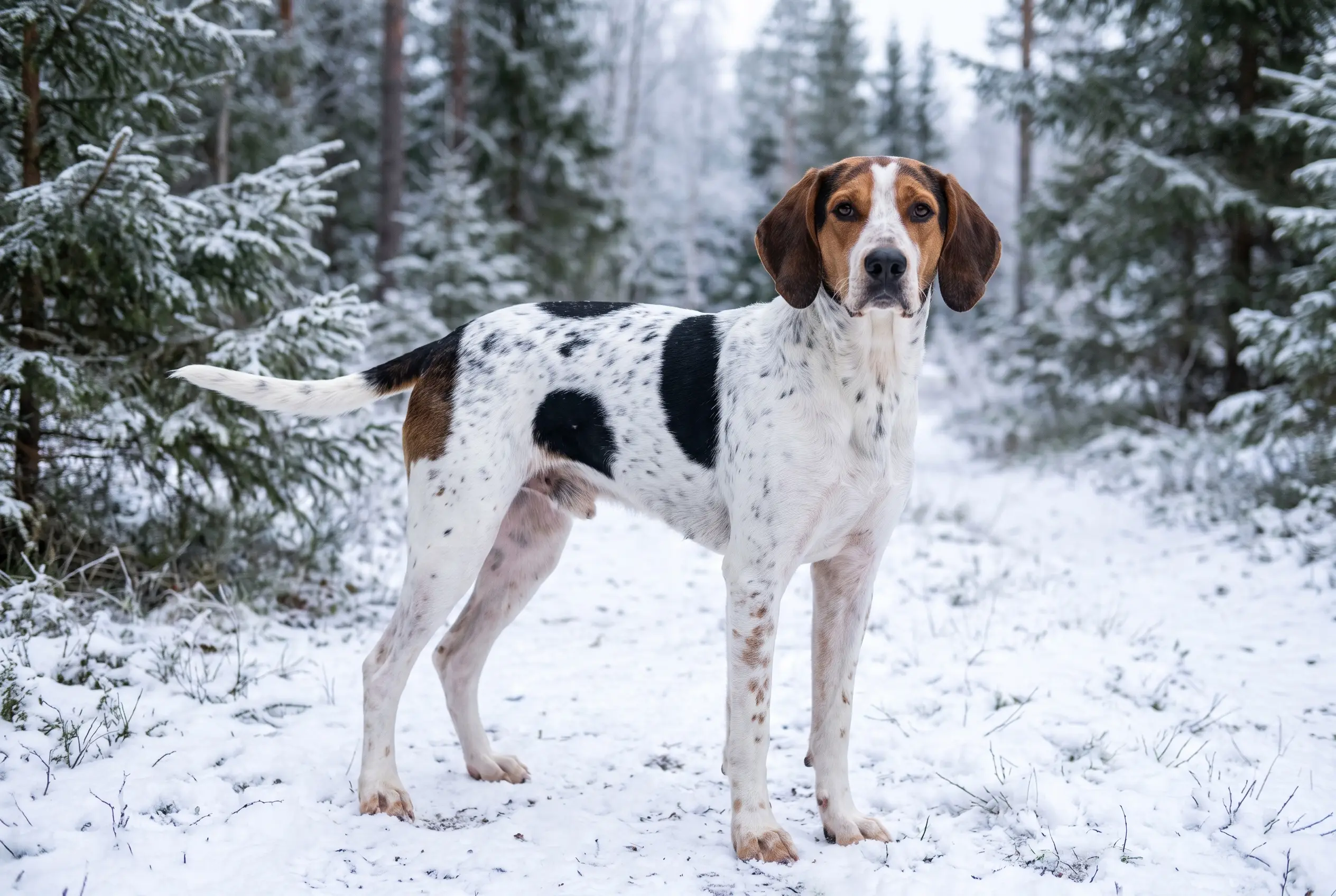
White with a black saddle and tan shading, and the scarcest of Norway's three native hare hounds.
Vital stats
| Size | Medium · 52–60 cm (dogs), 50–58 cm (bitches) |
| Weight | 18–24 kg — breed literature; the standard sets none |
| Life expectancy | 12–13 years — breed literature, not survey data |
| Energy | High — built to run a scent line for hours |
| Shedding | Moderate — harsh, dense double coat |
| Coat | Harsh, very dense and straight, with a dense undercoat |
| Group | Scenthound · Medium-sized Hounds (FCI №267, Group 6) |
| Origin | Halden, Østfold, Norway |
| FCI group | 6 — Scent hounds and related breeds · FCI 267 |
Breed traits
Friendliness
Care
Mind
The Haldenstøver by the numbers
The Haldenstøver facts owners search for most — price, lifespan, weight, shedding and colours, in one place.
Less common, so expect a waitlist and some travel to a reputable breeder — which pushes the price up. Plan for steady ongoing costs — mid-range food, routine vet care and insurance.
We don't quote a single figure: the real price swings with breeder, region, bloodline and health testing — and a rescue costs a fraction of a breeder's litter. Adopting is almost always the cheapest route.
Temperament
The FCI standard is short on behaviour: general appearance calls for a dog that is 'proud, strong, but not heavy', and the only disqualifying faults tied to character are 'aggressive or overly shy dogs' and any dog 'clearly showing physical or behavioural abnormalities'. Norway's own kennel club fills in the rest, describing the breed as having strong nerves and being 'particularly sociable and trustworthy', with an open, biddable nature that makes it good to train. In practice that reads as a hound that works independently on a trail but comes home easy to live with — provided it gets the early socialisation the standard's own faults list implies it needs.
Habits & quirks
One colour story, no exceptions
The standard allows exactly one pattern: white with black patches, tan shading on head and legs and sometimes between the patches — and it specifically warns that black must not predominate. Small black or tan spots on their own count as mismarked.
Ears cut to the muzzle
Set neither too high nor too low, the ear leathers should reach precisely to the middle of the muzzle when pulled forward — a specific enough measure that it works as a field check against look-alike hounds.
Runs the trail alone
Breed literature describes it hunting one-on-one with its handler rather than in a pack, tracking hare at a steady gallop rather than working a line shoulder to shoulder with other hounds.
A breed kept alive on purpose
The population nearly collapsed to distemper in 1931 and again during the Second World War; Norway now keeps a semen bank preserving genetic material from ten dogs specifically to protect what is left of the breed's gene pool.
Health
Norwegian sources report no significant hereditary disease burden in the Haldenstøver, hip dysplasia included, which is a genuinely good record for a hound. The real health question here isn't a condition, it's numbers: the breed is rare enough that Norway keeps a conservation semen bank for it, and a thin gene pool is its own risk. So ask breeders hard questions about pedigree depth and how closely related the parents are, keep the dog lean and fit, and give it the daily work it's built for — the soundest Haldenstøver is a well-bred, well-exercised one.
Nutrition
| Exercise | A real daily run, not a lead-only walk — this is a hound built to cover ground on a scent for hours. Long off-lead time somewhere safe, tracking games or organised hunting trials all give it the outlet it was bred for. |
| Grooming | The harsh, dense double coat sheds moderately and needs a weekly brush; NKK's own breed notes call bathing a wash-as-needed job rather than a routine. |
| Training | Start young. The standard disqualifies both aggression and excessive shyness, which tells you where breeders aim, but breed literature is candid that an unsocialised Halden can turn wary of strangers, children or other animals — early, consistent, reward-based work heads that off. |
| Health | Norwegian sources report no significant hereditary disease burden, including hip dysplasia, despite the breed's small population. That population is the real health risk: ask breeders about pedigree depth, since the gene pool is thin enough that Norway maintains a conservation semen bank for it. |
Feed a Haldenstøver to its workload — a hound built to run a scent line for hours eats more on a working day than a quiet one, so match the ration to what the dog actually did. Weigh the meals, count the training treats in the day's total, and aim for ribs you can feel under the dense double coat. Keep it lean and fit: this is an athletic working hound, and it moves, recovers and holds up best carrying no extra weight.
Puppy guide
Start socialising a Haldenstøver puppy early and keep at it. The breed's standard disqualifies both aggression and excessive shyness, and breed literature is candid that an unsocialised Halden can turn wary of strangers, children and other animals — so wide, gentle, early exposure is the single most useful thing you do in the first year. Build recall before the nose takes over, keep the growing joints to gentle exercise rather than forced distance, and get him used to the household routine of an active, outdoors home.
Training
The Haldenstøver is an open, biddable hound that its own kennel club calls sociable and trustworthy, which makes it good to train — but it's still a scenthound that works a trail independently, so recall around a live scent needs real, early investment. Keep sessions short and reward-based, start young, and lean on the early socialisation the standard's own faults list points to: the aim is a dog that hunts on its own out there and comes home easy to live with.
Life expectancy
Haldenstøvers live 12–13 years — breed literature, not survey data. The Haldenstøver is a healthy, hardy hound with no significant hereditary disease reported, so the 12–13 years usually quoted comes down to the basics and to good breeding. Keep it lean and well-exercised, and put real weight on pedigree depth when you choose a puppy — the breed's small, carefully managed gene pool is the thing that most affects a long, sound life, which is exactly why Norway maintains a conservation semen bank for it.
Similar breeds
Breeds with a similar build and background — worth a look if this one isn't quite the fit.
Breeds that look like this
Common questions
How do you tell a Haldenstøver apart from a Dunker or a Hygenhund?
Colour is the fastest tell. The Haldenstøver (FCI №267) is white with black patches and tan shading — white is the base colour. The Dunker (FCI №203) is built the other way round: diluted black or blue-marbled (merle) with tan and white markings, often with pale walleyes from the merle gene. The Hygenhund (FCI №266) usually runs red-brown or yellow-red, sometimes black-and-tan, sometimes white with red-brown patches — but never the Haldenstøver's black-patched white. All three are FCI Group 6 medium-sized Norwegian hare hounds with working trials, which is why they get confused; the coat pattern settles it in seconds.
Is the Haldenstøver a good family dog?
For an active household, yes. Norway's kennel club describes it as sociable and trustworthy, and it is bred as a working companion as much as a hunter. It needs real daily exercise and early socialisation, and breed literature notes it can be reserved with strangers, children or other animals if that socialisation is skipped — the standard itself disqualifies both aggression and excessive shyness, so neither extreme is meant to be typical.
How rare is the Haldenstøver, really?
Very. NIBIO, Norway's national institute for genetic resources, puts recent annual puppy registrations with the Norwegian Kennel Club at roughly 7 to 21 — a figure it calls dangerously low — against the Dunker's 131 to 180 a year and the Hygenhund's 27 to 44 a year in the years each was last measured. It is the scarcest of the three Norwegian hare hounds by a wide margin, and outside Norway it is close to unknown.
Does the Haldenstøver shed a lot?
Moderately. The Haldenstøver sheds a fair amount, steadily through the year with heavier seasonal patches. A weekly brush keeps most of the loose hair off your floors and clothes.
Is the Haldenstøver hypoallergenic?
Not really. No dog is truly hypoallergenic, and the Haldenstøver's shedding coat releases plenty of the dander that sets off allergies. If someone at home is allergic, this isn't the easiest breed to live with — spend time around one first.
Is the Haldenstøver easy to train?
Reasonably. The Haldenstøver is trainable with consistency and rewards, though it isn't the quickest study. Keep sessions short and positive, and be patient with the basics like recall.