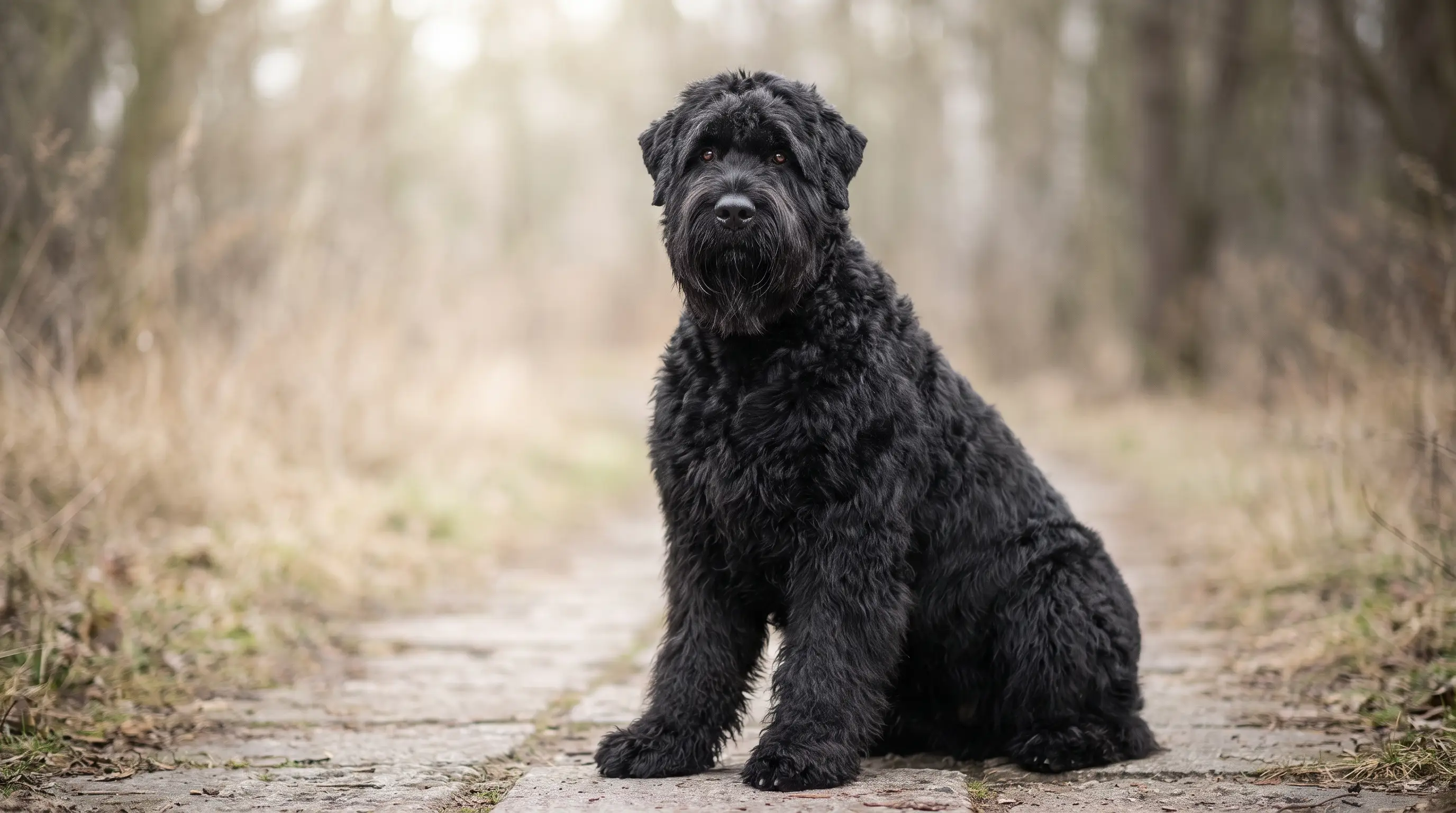
Black Russian Terrier
The Black Pearl of Russia — a guard dog designed to specification, loyal to the bone.
Vital stats
| Size | Giant · 66–72 cm |
| Weight | 45–60 kg |
| Life expectancy | 10–12 years |
| Energy | Moderate-high — 60 min/day |
| Shedding | Low, but the coat mats without care |
| Coat | Dense, wavy double coat · black |
| Group | Working · FCI №327 / AKC |
| Origin | Moscow region, Russia |
| FCI group | 2 — Pinscher and Schnauzer, Molossoid and Swiss Mountain Dogs · FCI 327 |
Breed traits
Friendliness
Care
Mind
The Black Russian Terrier by the numbers
The Black Russian Terrier facts owners search for most — price, lifespan, weight, shedding and colours, in one place.
Less common, so expect a waitlist and some travel to a reputable breeder — which pushes the price up. Ongoing costs run high — more food, bigger doses at the vet, and pricier insurance. Its coat also needs a professional groom every few weeks — a real line in the budget.
We don't quote a single figure: the real price swings with breeder, region, bloodline and health testing — and a rescue costs a fraction of a breeder's litter. Adopting is almost always the cheapest route.
Temperament
Bred to patrol borders and guard installations, the Black Russian is watchful, self-assured and silent until there's a reason not to be. With its family — children included — it is gentle and almost gravely devoted; with strangers it withholds judgement. That protective wiring needs an owner who trains early, socialises widely and leads calmly.
Habits & quirks
Silent sentry
It doesn't fuss or patrol noisily — it positions itself where everything can be seen.
The wet beard
Every drink of water is shared generously with your floors and trousers.
One-household heart
Its loyalty isn't general-purpose; it belongs entirely to its own people.
Door protocol
Visitors are assessed at the threshold and released into the house on probation.
Health
The Black Russian Terrier is a giant working dog, and its health revolves around two things: the joints of a big, fast-growing frame and a specific screenable disorder. Ask a breeder for hip and elbow scores on both parents, and for a hyperuricosuria (HU) test, a simple DNA check that responsible breeders run as a matter of course. In puppies, the priority is slow, lean growth: a giant breed that shoots up too fast on too many calories pays for it in its joints later, so keep the youngster lean and go easy on high-impact exercise while the frame is still forming. Beyond that, the dense double coat is a grooming commitment rather than a health risk — left unbrushed it mats to the skin, which traps damp and irritates. Keep him lean, keep the coat open, and buy from lines that test.
Nutrition
| Training | Start obedience and broad socialisation in puppyhood — a 55 kg guardian must be reliable, not just loved. |
| Grooming | Brush the dense coat several times weekly and trim every couple of months; the beard needs regular washing. |
| Exercise | An hour a day of walks plus a job — obedience, carting or protection sport suit its working mind. |
| Health | Screen breeding lines for hips, elbows and hyperuricosuria; keep growth slow and lean in puppies. |
This is a 45–60 kg working dog, and how you feed it matters most while it is growing. A giant-breed puppy does best on steady, unhurried growth, so feed a diet formulated for large or giant breeds and resist the urge to push weight on for size — fast growth on a heavy frame is exactly what its joints don't want. In the adult, feed to the work it does and keep it genuinely lean: you should feel ribs under that dense coat even when you can't see them. Weigh the meals rather than filling the bowl by eye, fold treats into the day's total, and take the coat into account — a thick double coat hides a few extra kilos until they are a real problem.
Puppy guide
A Black Russian Terrier puppy is a giant guardian in the making, and the first year does two jobs at once. The body needs slow, careful raising: sensible exercise on soft ground, lean weight, and patience while a big frame finishes growing. The mind needs even more work — this is a protective breed by design, so start obedience and broad, positive socialisation early and keep it up, introducing the puppy to as many people, places and situations as you can while it is young and open. A confident, well-socialised adult that has met the world is a calm guardian; an under-socialised one is a 55 kg problem. Get it used to being brushed, bathed and handled from the start, because the grooming this coat needs is a lifelong routine, not an occasional chore.
Training
A Black Russian Terrier is calm, clever and deeply loyal, but it is also a giant guard dog that withholds judgement on strangers, so training is not optional and it is not a puppyhood phase — it is a lifelong duty. Start obedience and broad socialisation early, while the puppy is small enough to manage, because a 55 kg guardian must be reliable, not merely loved. Lead calmly and consistently: this breed reads its person closely and responds to a confident, fair handler far better than to force. Reward-based methods suit its serious, willing mind, and the goal throughout is a dog that is settled and biddable in public, with its protective instinct shaped by you rather than left to its own judgement.
Life expectancy
Black Russian Terriers live 10–12 years. The Black Russian Terrier is a giant breed, and giants ask for a particular kind of care to reach a good old age: lean weight from puppyhood on, so the joints are never carrying more than they should; parents screened for hips, elbows and hyperuricosuria; slow, unhurried growth in the first year; and a coat kept brushed out so the skin underneath stays healthy. Give it real work for its guarding mind, keep it lean and moving, and this devoted guardian ages as well as its size allows.
Similar breeds
Breeds with a similar build and background — worth a look if this one isn't quite the fit.
Breeds that look like this
Common questions
Are Black Russian Terriers good family dogs?
With their own family, yes — calm, affectionate and notably gentle with children they know. They remain wary of strangers, so management and training are lifelong duties.
Are Black Russian Terriers actually terriers?
In name only — they're classified as working dogs, built from Giant Schnauzers, Rottweilers, Airedales and others. Nothing about 55 kg of guard dog behaves like a terrier.
Do Black Russian Terriers shed?
Very little, but the dense wavy coat mats readily without several brushings a week and regular trims. Low-shedding here does not mean low-maintenance.
Is the Black Russian Terrier hypoallergenic?
No dog is truly hypoallergenic, but the Black Russian Terrier comes closer than most: its low-shedding coat releases less of the dander that triggers allergies. Many allergy sufferers manage well with this breed, but spend time around one before committing.
Is the Black Russian Terrier easy to train?
Reasonably. The Black Russian Terrier is trainable with consistency and rewards, though it isn't the quickest study. Keep sessions short and positive, and be patient with the basics like recall.