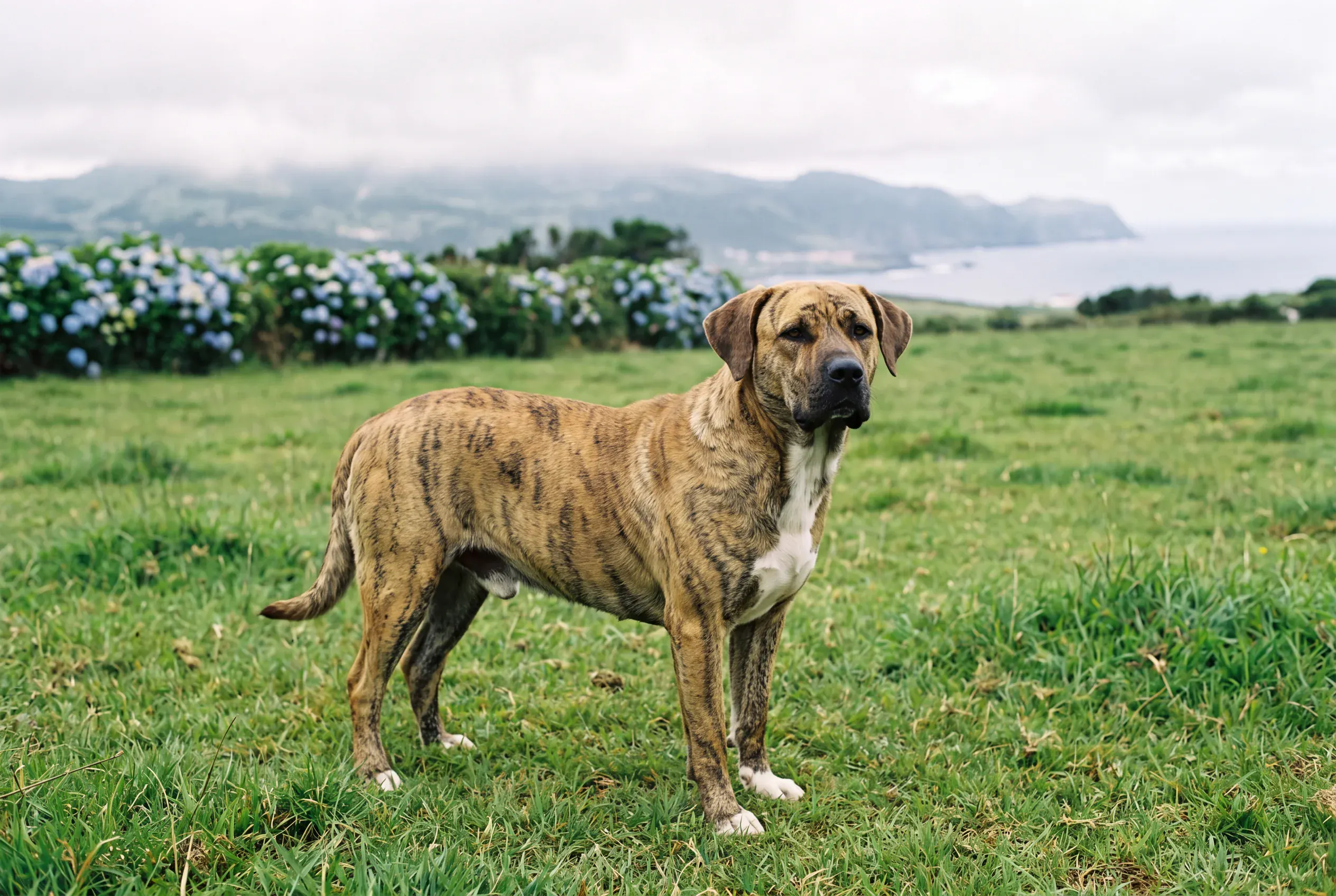
Cão Fila de São Miguel
Moves cattle by mouth, and knows how low to bite.
Vital stats
| Size | Medium-large · 48–60 cm |
| Weight | 20–35 kg |
| Life expectancy | 12–14 years |
| Energy | High — a working driver, not a patroller |
| Shedding | Low to moderate — short, dense, harsh coat |
| Coat | Short and harsh · always brindled, on fawn, pale fawn with black overlay or grey |
| Group | Working · Mastiff (FCI №340, Group 2) |
| Origin | São Miguel, Azores, Portugal |
| FCI group | 2 — Pinscher and Schnauzer, Molossoid and Swiss Mountain Dogs · FCI 340 |
Breed traits
Friendliness
Care
Mind
The Cão Fila de São Miguel by the numbers
The Cão Fila de São Miguel facts owners search for most — price, lifespan, weight, shedding and colours, in one place.
Less common, so expect a waitlist and some travel to a reputable breeder — which pushes the price up. Ongoing costs run high — more food, bigger doses at the vet, and pricier insurance.
We don't quote a single figure: the real price swings with breeder, region, bloodline and health testing — and a rescue costs a fraction of a breeder's litter. Adopting is almost always the cheapest route.
Temperament
The standard opens with a cattle dog par excellence, adds that it is equally a good guard dog for properties and people, then draws the line most owners end up living on: a very determined character towards strangers but docile with its owner. It also calls the breed very intelligent and very receptive, and that is the half people underestimate. This is a dog that picks up the routine of a farm in days, reads its handler closely and works willingly. It then applies the same initiative to a courier at the gate. Nerves are not part of the picture. Aggressive or overly shy are both listed as eliminating faults, so a correct Fila de São Miguel neither panics nor starts anything; it makes a decision. Living with that takes a household that sets rules early and keeps them, years of wide socialising, and no expectation of a dog that is pleased to see visitors. People who have kept one describe an easy dog indoors and a serious one at the boundary.
Habits & quirks
Bites low, deliberately
The standard spells the working method out: driving dairy herds the dog bites low to avoid harming the cows' udders, and when dealing with stray cattle it may bite higher. A breed standard that describes where a dog puts its teeth is rare. It is also the plainest statement of what this animal is for.
Turns stock instead of following it
A heading dog works at a distance on eye and position. This one closes, takes hold, turns the animal and lets go. The build follows from the job: a broad square skull, very powerful jaws, a wide mouth, all on a frame a little longer than it is tall.
Rolls a bit behind
The standard calls the movement free and easy and notes that the dog rolls slightly at the rear. On steep volcanic pasture and in sunken walled lanes, a dog that moves economically and turns on the spot is worth more than a fast one.
Comes off the cattle and onto the gate
The same dog that spends the morning shifting cows spends the afternoon deciding who belongs on the property. Guarding people and buildings sits in the standard alongside the cattle work, and in a pet home it is the half you actually live with.
Health
The Cão Fila de São Miguel is generally sound, but there's little published health data — the population is small and a lot of it sits outside pedigree recording, so the individual breeder matters more than any breed average. Ask for hip and elbow scores and an eye check, and read the pedigree yourself to see how closely the litter is bred. One thing to learn before you need it: this is a big, deep-chested dog, and deep-chested dogs this size can bloat, so know the signs of a suddenly hard, swollen belly and treat it as the emergency it is.
Nutrition
| Exercise | Around two hours a day of real work or a decent substitute: long walks over varied ground, hill work, tracking, drag or cart work, obedience with a purpose attached. Throwing a ball in a park does not touch it. A Fila de São Miguel with nothing to do gives its attention to the fence line and to whoever walks past it. |
| Grooming | The coat is short, smooth, dense and harsh, with light fringing on the tail, in the anal region and behind the thighs. A rubber curry once a week covers it and shedding is modest for the size. The skin is thick and pigmented, and worth checking over after a day in scrub. |
| Training | Early, fair, and consistent to a degree most people find tiring. The breed is quick and willing with someone it accepts, which means bad habits set as fast as good ones. Two things need deliberate work from puppyhood: impulse control and bite inhibition in a dog bred to use its mouth on livestock, and months of calm repeated exposure to strangers, other dogs and traffic. A trainer who knows working molossers is worth paying for. |
| Health | Generally sound, with little published data because the population is small and much of it sits outside pedigree recording. Ask breeders for hip and elbow scores and an eye check, and read the pedigree yourself for how closely bred the litter is. As with any deep-chested dog this size, learn to recognise bloat before you need to. |
This is a large working molosser, so feed to what it actually does — a dog in real daily work needs more than one having a quiet week, and the amount should track the workload. Weigh the meals rather than eyeballing them, keep him lean and well-muscled over that big frame, and don't let a working dog carry spare weight. Because he's deep in the chest, split the day into two meals instead of one large bowl and let him settle quietly around eating rather than working on a full stomach.
Puppy guide
A Fila puppy grows into a large guardian that makes its own decisions about strangers, so the first year is mostly about shaping that judgement. Two jobs start in puppyhood: impulse control and bite inhibition, in a dog bred to use its mouth on livestock, and months of calm, repeated exposure to strangers, other dogs and traffic so the guarding instinct settles within sensible limits. This is a quick, willing puppy that learns bad habits as fast as good ones, so be consistent from day one, set the house rules early, and get a securely fenced space sorted before the dog outgrows a wish.
Training
Train early, fairly, and with a consistency most people find tiring — the Fila is quick and willing once it accepts you, which means bad habits set as fast as good ones. Two things need deliberate work from the start: impulse control and bite inhibition in a dog bred to grip livestock, and months of calm, repeated socialising around strangers, other dogs and traffic to keep a guarding breed's suspicion in bounds. This is not a breed to learn on; a trainer who knows working molossers is worth paying for, and the earlier you bring one in, the easier the adult dog.
Life expectancy
The Cão Fila de São Miguel lives 12–14 years. The Fila de São Miguel is a hardy working breed, and keeping one at the top of its range is mostly about living it the way it's built to live: real daily work or a solid substitute, a lean and well-muscled body, and a breeder who bred thoughtfully from a small population. Stay alert to bloat, keep the weight honest, and a well-exercised Fila stays a sound, steady dog into old age.
Similar breeds
Breeds with a similar build and background — worth a look if this one isn't quite the fit.
Breeds that look like this
Common questions
How does it actually work cattle?
By taking hold of them. The FCI standard puts it plainly: while driving dairy herds it bites low, to avoid harming the cows' udders, and when dealing with stray cattle it may bite higher. So this is a gripping-and-turning dog rather than a heading dog that works at a distance on eye and position, and it is not a flock guardian that lives with the animals and sees off predators. The work is short, physical and decisive. Close, grip, turn the animal, release. On São Miguel that meant moving dairy cattle between volcanic pastures and along walled lanes, and catching a beast that had got loose. The practical consequence for anyone who owns one: this is a dog bred to put its mouth on something large and moving, and that has to be managed by training rather than wished away.
Why is it usually pictured with cropped ears?
Because that is the traditional presentation on São Miguel, and the FCI standard still describes it. The current text says the ears are cropped with rounded tips in countries where ear cropping is not forbidden, and describes the natural ear as medium-sized, triangular and dropping without touching the cheeks. The tail is treated the same way, docked at the second or third vertebra on the same condition. Cropping for appearance is prohibited across most of Europe under the European Convention for the Protection of Pet Animals, and Portugal, the breed's own country, gives effect to that convention in national law. A dog bred in the Azores today is therefore a drop-eared dog. The cropped outline comes from older photographs and from countries where the prohibition does not apply.
Is this a realistic dog for most homes?
No, and it is worth reading that answer before the photographs win the argument. This is a 20 to 35 kg working dog with, in the standard's own words, a very determined character towards strangers, bred to make its own calls about large animals and act on them. It needs securely fenced ground, daily physical work, an owner who trains consistently rather than when they remember, and years of the deliberate socialising that keeps a guarding breed's suspicion within sensible limits. It is not a first dog, not an apartment dog, and not one to leave loose in a garden with visitors coming and going. In the right hands it is steady, affectionate and easy indoors, and it works hard. The right hands means somebody who has kept a working guarding breed before, or who has hired a trainer who has.
Does the Cão Fila de São Miguel shed a lot?
Moderately. The Cão Fila de São Miguel sheds a fair amount, steadily through the year with heavier seasonal patches. A weekly brush keeps most of the loose hair off your floors and clothes.
Is the Cão Fila de São Miguel hypoallergenic?
Not really. No dog is truly hypoallergenic, and the Cão Fila de São Miguel's shedding coat releases plenty of the dander that sets off allergies. If someone at home is allergic, this isn't the easiest breed to live with — spend time around one first.
Is the Cão Fila de São Miguel good with children?
It depends. The Cão Fila de São Miguel tends to be more reserved, so it suits older, calmer children better than boisterous toddlers. Early socialisation and careful, supervised introductions matter more with this breed.
Is the Cão Fila de São Miguel easy to train?
Reasonably. The Cão Fila de São Miguel is trainable with consistency and rewards, though it isn't the quickest study. Keep sessions short and positive, and be patient with the basics like recall.