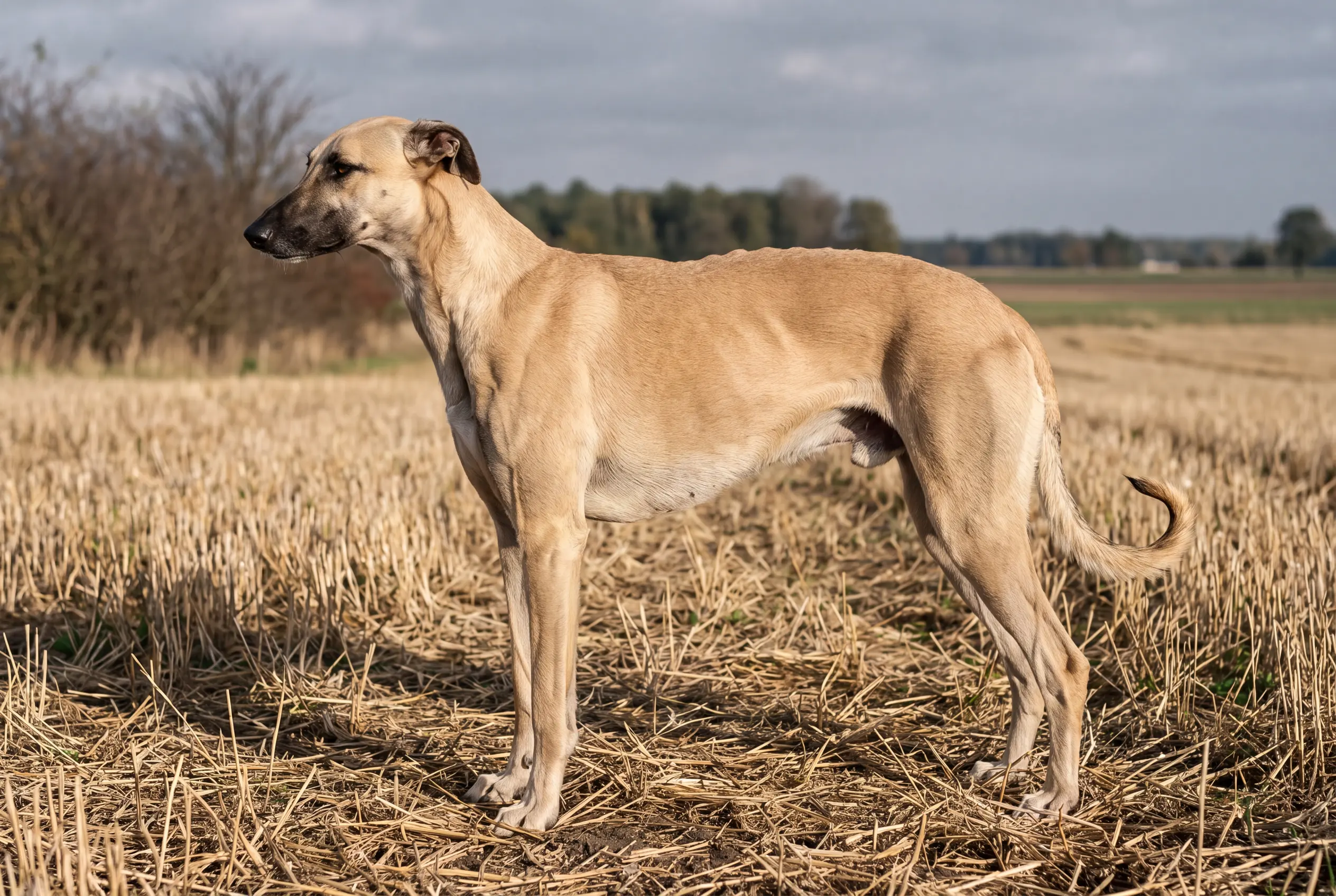
Chart Polski
Poland's big-boned courser, rebuilt from thirty dogs.
Vital stats
| Size | Large · 68–80 cm |
| Weight | 27–32 kg |
| Life expectancy | 10–12 years |
| Energy | High — a courser's stamina, not a track sprinter's |
| Shedding | Moderate — short coat, steady year-round drop |
| Coat | Short, springy and harsh · all colours permitted |
| Group | Hound · Sighthound (FCI №333, Group 10) |
| Origin | Poland |
| FCI group | 10 — Sighthounds · FCI 333 |
Breed traits
Friendliness
Care
Mind
The Chart Polski by the numbers
The Chart Polski facts owners search for most — price, lifespan, weight, shedding and colours, in one place.
Less common, so expect a waitlist and some travel to a reputable breeder — which pushes the price up. Ongoing costs run high — more food, bigger doses at the vet, and pricier insurance.
We don't quote a single figure: the real price swings with breeder, region, bloodline and health testing — and a rescue costs a fraction of a breeder's litter. Adopting is almost always the cheapest route.
Temperament
The FCI standard gives four words, self-assured, confident, reserved and brave, then adds a line most sighthound standards leave out: in action he reacts quickly and brutally. Take that as a fair warning. At home a Chart Polski is closely attached to its people and can be openly affectionate with them, but it does not extend that to visitors, and it treats the front door and the garden gate as its own business in a way a Greyhound never does. With other dogs it can be blunt, especially dog to dog of the same sex. The hunting is fully intact. It was bred to catch and hold game as heavy as a wolf, and the distance between watching something and running it down is very short.
Habits & quirks
Decides and acts in the same second
The standard's own phrase is that he reacts quickly and brutally. In practice that means no visible wind-up before a chase starts, whether the trigger is a hare, a cat, or a strange dog that came in too fast.
Minds the gate
Most sighthounds sleep through the doorbell. This one gets up and goes to look. Owners describe a dog that walks the fence line and announces visitors, which is closer to a guarding breed than to a coursing one.
Sights first, sniffs later
The standard dwells on the eyes: rather large, set slightly oblique, with a lively and penetrating look. It works off movement at distance, so it will lock on to something at the far end of a field well before you notice it.
Runs long, not just fast
It was made for broken ground in a Polish winter, not a straight 500 m of sand. Less top speed than a Greyhound, considerably more staying power, and it comes home muddy.
Health
The Chart Polski is sound overall, but the modern breed was rebuilt from a small number of dogs, so the gene pool is narrow — ask a breeder about pedigree depth as well as hip and eye screening. Two things are worth knowing before you ever need them. Like other sighthounds, it can be sensitive to anaesthetic, so tell any vet it's a sighthound before a procedure. And like other deep-chested breeds this size, it can bloat: a suddenly hard, swollen belly is an emergency, not a wait-and-see. Keep the dog lean and well-muscled and you're doing most of the day-to-day work.
Nutrition
| Exercise | Around ninety minutes a day, split between lead walks and genuine running in a fenced field or behind a lure. A big sighthound with nowhere to open up gets restless indoors, and pavement loops on their own will not cover it. |
| Grooming | A rubber mitt once a week handles the short springy coat, a little more often when it drops. Leave the longer harsh hair on the buttocks and under the tail alone; the standard asks for modest breeches and a brush, so it is meant to be there. |
| Training | It learns quickly and is not biddable in the retriever sense: it weighs up whether a request is worth answering. Short reward-based sessions from puppyhood, and social exposure to as many people, dogs and places as you can manage, because a poorly socialised Chart Polski turns into a suspicious adult in a large, strong body. |
| Health | Sound overall, though the reconstruction left a narrow gene pool, so ask about pedigree depth alongside hip and eye screening. Tell any vet it is a sighthound before anaesthesia, the drug sensitivity being what it is in the group, and treat a suddenly hard, swollen belly as an emergency. |
This is a big, lean, working sighthound, and it's meant to look it — you should see a waist and feel the last ribs, with muscle over the frame rather than fat. Feed to keep that athletic outline, adjusting for how much it actually runs, and don't try to fill it out; a heavy Chart Polski loses the very thing the breed is for. Because it's deep in the chest, split the day into two meals rather than one big bowl, and let it settle quietly before and after eating rather than running on a full stomach.
Puppy guide
A Chart Polski puppy grows into a large, strong, naturally reserved dog, and the single most important job of that first year is socialising — as many friendly people, steady dogs and new places as you can manage, because a poorly socialised one becomes a suspicious adult in a powerful body. Start short, rewarding training sessions early, and teach that everyday visitors are normal. Build recall from the beginning while you still can, but never rely on it once the prey drive is switched on: a puppy this fast learns to run before it learns to come back.
Training
The Chart Polski learns quickly, but it isn't biddable the way a retriever is — it weighs up whether a request is worth answering, and decides. Keep sessions short, positive and worth its while, and start them in puppyhood. The two priorities are wide social exposure, so the natural wariness stays within sensible limits, and a recall you build carefully and then back up with hardware: long lines, fenced ground and lure coursing, because the moment something runs, obedience is off the table. Work with the sighthound, not against it, and it's a rewarding dog; try to drill it like an obedience breed and you'll both lose.
Life expectancy
Chart Polski live 10–12 years. The Chart Polski is a hardy sighthound, and keeping one at the top of its range is mostly about respecting what it is: a lean, well-muscled body, real running behind a fence to burn its stamina off, and a breeder who bred for health out of a narrow gene pool. Stay alert to bloat, flag the sighthound anaesthetic sensitivity to your vet, and an active Chart Polski ages into a fit, dignified old dog.
Similar breeds
Breeds with a similar build and background — worth a look if this one isn't quite the fit.
Breeds that look like this
Common questions
Can a Chart Polski go off the lead, and can it live with a cat?
Assume no to the first. This is a working sighthound that was still catching its own dinner two generations ago, and recall stops existing the moment something runs, so owners use long lines, fenced ground and lure coursing rather than trusting obedience. Small pets are a harder question here than with most sighthounds. Some Chart Polski do settle with a household cat they were raised alongside, plenty never do, and a rabbit or a small dog moving fast in the garden is a different problem again from a cat asleep on the sofa. If you already have small animals, go and meet adults from the breeder's own lines before committing.
How is it different from a Greyhound?
Bigger and heavier in the bone. The FCI standard defines the breed partly by that contrast: stronger and less fine than the other short-haired sighthounds, short-coupled, wide across the loin, with powerful jaws and a tail that curves up into a sickle or a ring. The coat is harsher, the ears fold back against the neck rather than sitting in a tight rose, and the temperament is the real gap. A Greyhound is generally easy with strangers; a Chart Polski keeps its distance from them and keeps an eye on its own gate.
Is the breed an old survival or a modern reconstruction?
Some of each. Dogs of this type are recorded in Polish hunting literature from the 13th century and appear with striking consistency in paintings through the 19th, which is why the FCI standard was drafted partly from that iconography. The living population is another matter: it was rebuilt from a small number of dogs found in the countryside, descendants of old kennels and imports, starting in the 1970s. Numbers outside Poland are still small, so expect a waiting list and a long drive rather than a local litter.
Does the Chart Polski shed a lot?
Moderately. The Chart Polski sheds a fair amount, steadily through the year with heavier seasonal patches. A weekly brush keeps most of the loose hair off your floors and clothes.
Is the Chart Polski hypoallergenic?
Not really. No dog is truly hypoallergenic, and the Chart Polski's shedding coat releases plenty of the dander that sets off allergies. If someone at home is allergic, this isn't the easiest breed to live with — spend time around one first.
Is the Chart Polski good with children?
They can be. The Chart Polski is reasonably sociable and can be good with children in the right home, especially when socialised early. Supervise around young kids and teach dog and child to respect each other.
Is the Chart Polski easy to train?
Reasonably. The Chart Polski is trainable with consistency and rewards, though it isn't the quickest study. Keep sessions short and positive, and be patient with the basics like recall.