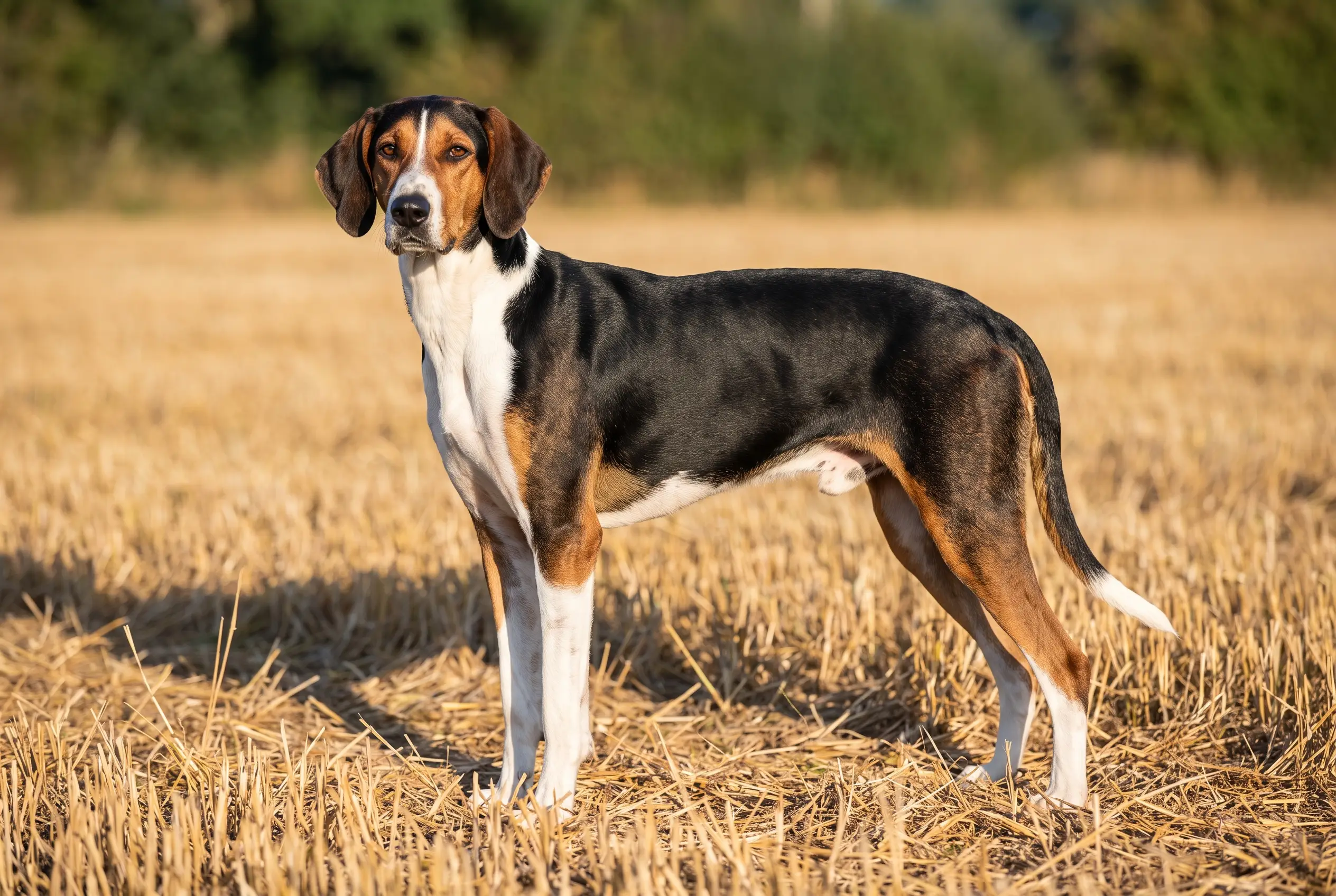
Français Tricolore
France's tricolour pack hound, deliberately rebuilt to keep English Foxhound blood out.
Vital stats
| Size | Large · 62–72 cm (males), 60–68 cm (bitches) |
| Weight | 22–36 kg — breed literature; the standard sets none |
| Life expectancy | 12–15 years — breed literature, not survey data |
| Energy | Very high — built for a full day's gallop |
| Shedding | Moderate — short, fine coat |
| Coat | Short and fine · tricolour: black mantle, bright or copper tan, white |
| Group | Hound · Large-sized Hounds (FCI №219, Group 6) |
| Origin | France |
| FCI group | 6 — Scent hounds and related breeds · FCI 219 |
Breed traits
Friendliness
Care
Mind
The Français Tricolore by the numbers
The Français Tricolore facts owners search for most — price, lifespan, weight, shedding and colours, in one place.
Less common, so expect a waitlist and some travel to a reputable breeder — which pushes the price up. Ongoing costs run high — more food, bigger doses at the vet, and pricier insurance.
We don't quote a single figure: the real price swings with breeder, region, bloodline and health testing — and a rescue costs a fraction of a breeder's litter. Adopting is almost always the cheapest route.
Temperament
The FCI standard has almost nothing to say about character directly — no clause of adjectives the way many French hound standards carry. What it gives, in general appearance, is a single word: elegant. And among the disqualifying faults, it states plainly that a Français Tricolore must be neither aggressive nor overly shy, and that any dog clearly showing physical or behavioural abnormalities is out — which sets the outer limits without describing what sits between them. Breed literature fills the gap with a consistent picture: independent, lively and hard-working, bred to hunt in packs of dozens and reluctant to settle well alone. The same literature calls it genuinely difficult to train outside a hunting context, which tracks with a dog selected for nose, voice and pack instinct rather than one-on-one obedience — the standard itself offers no training guidance at all.
Habits & quirks
Measured against the Poitevin
The standard defines much of this breed by comparison rather than plain description: the stop more accentuated than in the Poitevin, the lips more substantial than in the Poitevin, the ear leathers broader than those of the Poitevin. The Poitevin is the constant reference point, not an aside.
No trace of England
Among the faults, the standard names any apparent trace of English hound blood, especially in the head, and calls out 'smoky' coloured heads outright as a sign of cross-breeding with the White and Black Hound. It is the standard's own line in the sand between the Français breeds and their English-crossed Anglo-Français cousins.
Wolf colour, officially
Alongside the standard bright tricolour, the standard admits a grizzled variant it calls the 'wolf colour' — tan and black running together into a muted grey-brown rather than sitting in clean blocks.
A trace of throat, allowed
The neck is long and rather strong, and the standard allows it to carry a slight trace of dewlap — one of the few places this dog is permitted any looseness on a frame built everywhere else lean and hard-running.
Health
The standard sets no weight and says nothing about health, and there is no breed-wide survey behind the lifespan usually quoted — the breed lives almost entirely inside French hunting kennels rather than as pets. Screening for hips and general soundness tends to come from hunt-club habit rather than a documented scheme, so ask a breeder directly what they test. As with any large, deep-chested hound, it is worth knowing the signs of bloat.
Nutrition
| Exercise | This is a pack hound built to run big game for a full day at a stretch, not a dog for a lead walk around the block. Give it hours of real distance with a job for the nose — hunting or organised tracking, where it exists — because breed literature is blunt that a bored, under-exercised one turns miserable fast. |
| Grooming | The short, fine coat needs only a weekly brush and sheds moderately; there is little else to it. Give the drop ears a regular look, since any long, close-set hound ear traps moisture and dirt. |
| Training | The standard is silent here — no temperament clause, no training guidance — and breed literature calls the Français Tricolore independent and genuinely hard to train outside a hunting context. It was selected for nose, voice and pack instinct, not for taking direction from one handler at a time. |
| Health | The standard sets no weight and says nothing about health, and there is no breed-wide survey behind the 12–15 years usually quoted. The population lives almost entirely inside French hunting kennels rather than as pets, so screening practice — hips, general soundness — comes from hunt-club habit rather than a documented scheme. |
This is a very high-energy pack hound built for a full day's gallop, so feed to that work — a hound in season and one between meets are not the same dog at the bowl. Split the day's food for a deep-chested hound rather than one large meal, keep him lean, and count everything the dog gets on a hunting day, when the demand runs highest.
Puppy guide
A Français Tricolore is a large hound bred to run big game all day, and a puppy needs its first year for steady growth, not early mileage — keep hard exercise light while the joints form. Socialize him well, and begin recall and scent games early, because the nose, voice and pack instinct that define the breed appear young. Bred to live among dozens of packmates, a puppy does best with company and a job rather than time alone.
Training
Breed literature is blunt: the Français Tricolore is independent and genuinely hard to train outside a hunting context. It was selected for nose, voice and pack instinct, not for taking direction from one handler at a time, and the standard offers no training guidance at all. Recall is the work that never really ends — a driven pack hound on a fresh scent takes some holding, so early and consistent handling matters, and a real job for the nose helps more than drilling obedience.
Life expectancy
Français Tricolore hounds live 12–15 years — breed literature, not survey data. The lifespan usually quoted for the Français Tricolore comes from breed literature, not a survey, so take it as a guide rather than a promise. As a lean, hard-running hound, one kept at a working weight, given real daily distance and bred by someone who screens for hips and general soundness has the best shot at a long, sound life.
Similar breeds
Breeds with a similar build and background — worth a look if this one isn't quite the fit.
Breeds that look like this
Common questions
What's the difference between the 'Français' hounds and the 'Anglo-Français' hounds?
Blood and history. The three Français breeds — Tricolore (FCI №219), Blanc et Noir (№220) and Blanc et Orange (№316) — were rebuilt in 1957 mainly from older French strains like the Poitevin and the Billy, and their standards actively exclude outside blood: the Français Tricolore's own standard disqualifies any apparent trace of English hound blood. The four Anglo-Français breeds — Grand Anglo-Français Tricolore (№322), Blanc et Noir (№323), Blanc et Orange (№324) and the smaller Anglo-Français de Petite Vénerie (№325) — exist because of exactly that cross: 19th-century breeders deliberately bred English Foxhound speed and drive into French scenting stock. Same colours, same country, opposite ancestry.
Is the Français Tricolore the same dog as the Grand Anglo-Français Tricolore?
No, though the two can look close enough to confuse at a glance — both are large tricolour French pack hounds. The Français Tricolore (FCI №219) traces to the Poitevin and Billy lines, and its standard disqualifies English blood; the Grand Anglo-Français Tricolore (№322) is built on deliberate English Foxhound crosses and carries that ancestry by design. Breeders describe the Anglo-Français type as running faster and more independently in the field; the distinction matters far more to a hunt master assembling a pack than to anyone meeting either dog on a walk, which happens rarely for both.
Are Français Tricolores kept as pets?
Almost never, and it is worth saying plainly. Breed literature describes it as practically unheard of for one to live as a companion animal outside a hunting kennel — it wants a pack of its own kind, hours of daily distance, and a job for its nose, and owners report it turns miserable without other dogs around. Anyone wanting a scent hound as a household pet has breeds actually developed for that role; this is not one of them.
Does the Français Tricolore shed a lot?
Moderately. The Français Tricolore sheds a fair amount, steadily through the year with heavier seasonal patches. A weekly brush keeps most of the loose hair off your floors and clothes.
Is the Français Tricolore hypoallergenic?
Not really. No dog is truly hypoallergenic, and the Français Tricolore's shedding coat releases plenty of the dander that sets off allergies. If someone at home is allergic, this isn't the easiest breed to live with — spend time around one first.
Is the Français Tricolore good with children?
They can be. The Français Tricolore is reasonably sociable and can be good with children in the right home, especially when socialised early. Supervise around young kids and teach dog and child to respect each other.
Is the Français Tricolore easy to train?
They can be a challenge. The Français Tricolore is intelligent but independent, and would rather make its own decisions than take orders. Reward-based training and patience work best; expect recall in particular to take time.