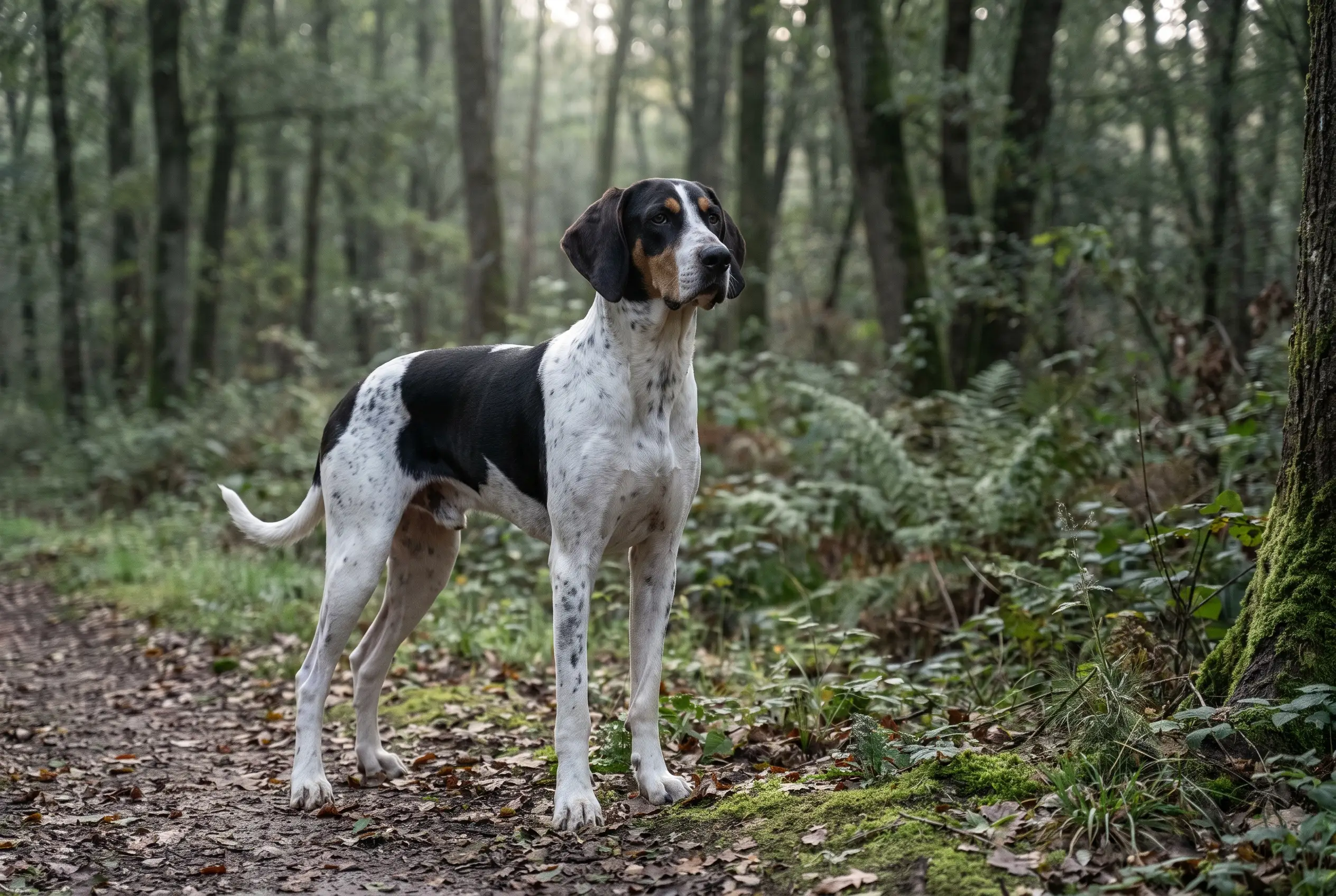
Français Blanc et Noir
A black-and-white deer hound whose own standard disqualifies a tricolour coat and penalises any trace of English Foxhound in the head.
Vital stats
| Size | Large · 65–72 cm (males), 62–68 cm (females) |
| Weight | 27–32 kg — breed literature; the standard sets none |
| Life expectancy | 10–11 years — breed literature, not survey data |
| Energy | High — built for a full day's pack hunt over rough ground |
| Shedding | Moderate — short, dense coat |
| Coat | Short, strong and dense · obligatory white and black, mantled or patched · tricolour disqualifies |
| Group | Hound · Large-sized Scenthound (FCI №220, Group 6) |
| Origin | France |
| FCI group | 6 — Scent hounds and related breeds · FCI 220 |
Breed traits
Friendliness
Care
Mind
The Français Blanc et Noir by the numbers
The Français Blanc et Noir facts owners search for most — price, lifespan, weight, shedding and colours, in one place.
Less common, so expect a waitlist and some travel to a reputable breeder — which pushes the price up. Ongoing costs run high — more food, bigger doses at the vet, and pricier insurance.
We don't quote a single figure: the real price swings with breeder, region, bloodline and health testing — and a rescue costs a fraction of a breeder's litter. Adopting is almost always the cheapest route.
Temperament
The standard's behaviour clause is short and specific: these dogs are very appreciated by many deer hunts for the following qualities: fine noses, diligence, seriousness and throat. It is a friendly dog, close to humans and easy to manage in the kennels. Read that last clause carefully — in the kennels, not in the living room. This is a hound bred to live and work in a pack of a dozen or more dogs, run hard all day on a strong nose and a carrying voice, then settle among its packmates. The friendliness is real and well documented, but it describes a dog that trusts the huntsman feeding forty hounds at once, not necessarily one that thrives alone in a house. Away from a pack and a job, the same diligence and voice tend to look for somewhere else to go.
Habits & quirks
No English blood allowed in the head
The standard names a severe fault in unusual detail: any indication of English Foxhound blood in the head — a skull too voluminous, a muzzle too short and not squared off at the end when seen from the side. It is the clearest line separating a Français hound from an Anglo-Français one: the same job, the same country, but a pedigree the standard actively polices against outside blood.
Tricolour disqualifies, on the spot
Colour is obligatory white and black — mantled or patched, with black or bluish speckling and tan points allowed only above the eyes, on the cheeks, under the ears and at the tail's base. A tricolour coat does not just lose points, it disqualifies outright — which happens to be the coat of its closest cousin, the Français Tricolore (FCI No. 219). Same family, same standard body, one colour line neither breed may cross.
Blue skin under the white
The standard describes the skin itself: white under the white hair, black under the black, and sometimes patches of blue or pale blue showing through on the belly and inner thighs. It is the sort of detail a judge finds by parting the coat, not something visible from ringside.
The roebuck mark
Most dogs carry a pale tan dot above each eye and tan on the cheeks, under the ears and at the base of the tail; many also show a tan patch high on the thigh that the standard names, without further explanation, the roebuck mark.
Health
The standard says nothing about health, and there is no breed-wide survey behind the lifespan usually quoted in French breed literature — the population is small and lives almost entirely inside French hunting kennels. As a large, deep-chested hound, it is worth asking a breeder about hip soundness and learning the signs of bloat, which any big barrel-chested dog can be prone to. With so few dogs and nearly all of them in France, pedigree depth is worth asking about too.
Nutrition
| Exercise | This is a pack hound built to gallop after deer all day over rough ground; its preferred gait, per the standard, is a supple, extended gallop it can hold without visible effort. A dog like this needs real daily distance, not a lead walk around the block, and does best with a job for its nose — hunting, tracking or organised scent work with other dogs. Under-exercised, the drive and voice the standard praises turn into an indoor problem fast. |
| Grooming | The short, dense coat needs only a weekly brush. The real attention goes to the ears — set at eye level and long enough to reach the nose leather when pulled forward — and to the neck, where the standard allows a slight trace of dewlap that can trap dirt in its folds. |
| Training | The standard calls it friendly, close to humans and easy to manage in the kennels — a line written about a hound living among dozens of packmates under a huntsman's routine, not a single dog in a house. It answers well to calm, consistent handling, but the instinct to run a scent in full voice with the pack sits deep; owners keeping one outside a hunting context report that early, ongoing recall work matters more here than in most breeds, because a nose and voice this strong will win the argument if you let one start. |
| Health | The standard says nothing about health, and there is no breed-wide survey behind the 10–11 years usually quoted in French breed literature. As a large, deep-chested hound it is worth asking breeders about hip soundness and knowing the signs of bloat; the population is small and almost entirely inside France, so pedigree depth is worth asking about too. |
This is a pack hound built to gallop after deer all day, so feed to the real workload — a hound in the hunting season and one resting between meets do not eat alike. Split the day's food across meals rather than one large bowl and let a working dog settle before and after eating, sensible practice for any deep-chested breed. Keep him lean and hard: this is a dog meant to hold an extended gallop without visible effort, and weight steals exactly that.
Puppy guide
A Français Blanc et Noir is a large, slow-maturing hound, and a puppy's first year is about steady growth, not early athletics — keep hard exercise light while the joints and frame are forming. Socialize him well beyond the kennel, and start recall and gentle scent games early, because the nose and voice that define the breed switch on young. This is a dog bred to live among a dozen packmates; a puppy raised with company and a job settles far better than one left to its own devices.
Training
The standard calls it friendly, close to humans and easy to manage in the kennels — but that line was written about a hound living among dozens of packmates under a huntsman's routine, not a single dog in a house. It answers well to calm, consistent handling, yet the instinct to run a scent in full voice sits deep. Recall is the lifelong project: a nose and voice this strong will win the argument if you let one start, so early, ongoing work matters more here than in most breeds.
Life expectancy
Français Blanc et Noir hounds live 10–11 years — breed literature, not survey data. The often-quoted lifespan for the Français Blanc et Noir comes from breed literature rather than any survey, so treat it as a rough guide. As a large hound you keep one sound the usual way — a lean working weight, real daily distance, and a breeder who can talk honestly about hips and the small gene pool this breed lives in.
Similar breeds
Breeds with a similar build and background — worth a look if this one isn't quite the fit.
Breeds that look like this
Common questions
What's the difference between the Français Blanc et Noir and the Français Tricolore?
Coat colour, mainly, and both standards enforce it directly. The Français Blanc et Noir must be white and black — a tricolour coat disqualifies it outright — while the Français Tricolore (FCI No. 219) carries that third colour, tan, as its defining feature. A third relative, the Français Blanc et Orange (FCI No. 316), swaps the black for orange. All three are built the same way and hunt the same way, and they share the name 'Français' specifically because none of them carries English Foxhound blood — that is what separates the whole trio from the Anglo-Français line.
How is it different from the Grand Anglo-Français Blanc et Noir?
Same coat, same job, opposite answer on bloodline. The Grand Anglo-Français Blanc et Noir (FCI No. 323) is exactly what its name says — a French pack hound crossed with English Foxhound stock for extra drive and cry, one of three Grand Anglo-Français coat varieties alongside Blanc et Orange (No. 324) and Tricolore (No. 322), plus the smaller Anglo-Français de Petite Vénerie (No. 325). The Français Blanc et Noir's own standard goes the other way: it lists any indication of English Foxhound blood in the head as a severe fault. Same colour pattern, same country, opposite verdict on the same historical cross.
Are they good family dogs?
Rarely, and rarely kept as one. This is a pack hound bred, and still mostly used, for organised deer hunts in France, at home in a kennel with a dozen or more other hounds rather than a single household. The standard calls it friendly and easy to manage, which is true, but it also wants a full day of hard running and carries a voice that travels when the dog is excited or working a scent — neither suits most houses or neighbours. An active rural home with room for a pack instinct is a far better match than an apartment.
Does the Français Blanc et Noir shed a lot?
Moderately. The Français Blanc et Noir sheds a fair amount, steadily through the year with heavier seasonal patches. A weekly brush keeps most of the loose hair off your floors and clothes.
Is the Français Blanc et Noir hypoallergenic?
Not really. No dog is truly hypoallergenic, and the Français Blanc et Noir's shedding coat releases plenty of the dander that sets off allergies. If someone at home is allergic, this isn't the easiest breed to live with — spend time around one first.
Is the Français Blanc et Noir easy to train?
Reasonably. The Français Blanc et Noir is trainable with consistency and rewards, though it isn't the quickest study. Keep sessions short and positive, and be patient with the basics like recall.