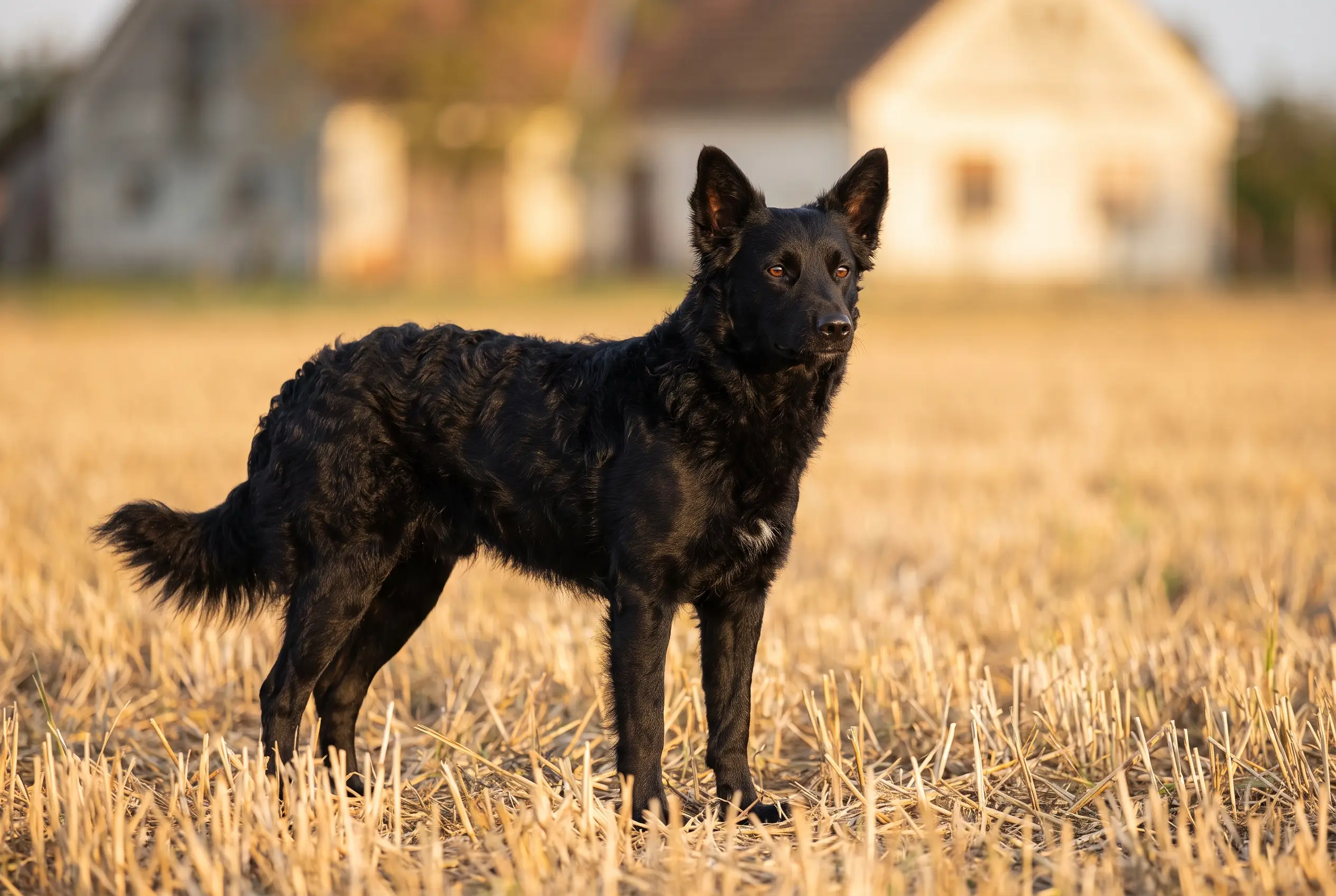
Croatian Sheepdog
Knee-high, black, and shouting at Slavonian cattle since 1374.
Vital stats
| Size | Medium · 45–50 cm (dogs), 43–48 cm (bitches) |
| Weight | 13–20 kg — the FCI standard sets a height but no weight |
| Life expectancy | 12–14 years |
| Energy | Very high — bred to move stock all day, then watch the yard |
| Shedding | Moderate, with two heavy moults — the black undercoat goes grey as it drops |
| Coat | Black, wavy to curly, 6–14 cm over a dense undercoat · short on head and legs, white allowed only as a chest patch to 5 cm |
| Group | Herding · Sheepdogs, without working trial (FCI №277, Group 1) |
| Origin | Slavonia, Croatia |
| FCI group | 1 — Sheepdogs and Cattledogs · FCI 277 |
Breed traits
Friendliness
Care
Mind
The Croatian Sheepdog by the numbers
The Croatian Sheepdog facts owners search for most — price, lifespan, weight, shedding and colours, in one place.
Less common, so expect a waitlist and some travel to a reputable breeder — which pushes the price up. Plan for steady ongoing costs — mid-range food, routine vet care and insurance.
We don't quote a single figure: the real price swings with breeder, region, bloodline and health testing — and a rescue costs a fraction of a breeder's litter. Adopting is almost always the cheapest route.
Temperament
The standard asks for a lively temperament and a balanced disposition, a dog fond of and devoted to his owner, and lists astuteness, courage, liveliness, endurance, patience and level-headedness during work. Every word of that is written about a dog at work, and it shows. A Croatian Sheepdog is quick, opinionated and close to impossible to tire. It learns fast, then wants somewhere to spend what it has learned. It usually fixes on one person in the house and works properly for that person alone; Croatian breeders will tell you a finished working dog takes months to start working for a new owner, and some never quite do. Around stock it drives from behind, grips at heels and noses, and barks the whole time. Remove the stock and none of that switches off — it gets pointed at joggers, bicycles, children running across the garden and the doorbell instead. It is a working dog that struggles as an ornament.
Habits & quirks
Barks as a tool
Voice is part of how this dog moves livestock, so a young one barks at everything while it sorts out what counts. Working adults narrow it down to the job. A Croatian Sheepdog kept indoors with nothing to move never gets that far.
Grips the nose and the heels
It pushes from behind and cuts in at the front, taking hold at the heels and the nose of cattle, and Croatian herders say it will grab a throat and still leave no mark. On a lawn the same technique finds trouser legs.
Some are born without a tail
A naturally short tail, or none at all, is written into the standard as permitted, alongside the usual sabre or sickle carriage. Both turn up in the same litter.
Picks a handler
It bonds hard to one person and stays merely polite with the rest of the household. Puppies start showing interest in stock at three to four months, and the dogs do their best work between two and five years old.
Health
The Croatian Sheepdog is a working landrace with very little on its health record — no large survey exists, and no inherited disease is strongly tied to the breed. That is reassuring rather than a promise: screen hips as you would for any active medium-sized dog, and treat the small gene pool as your real question for a breeder. Ask about the pedigree and see whether they can talk about it honestly. Working life runs to about ten years and most dogs live 12–14, kept sound by the exercise and the job the breed is built for.
Nutrition
| Exercise | Two long outings a day, with a task inside at least one of them: herding, agility, tracking, flyball, a long run beside a bike. Croatian breeders keep these dogs outdoors with a yard for a reason. A fit adult that has not worked will find its own work, and you will hear it. |
| Grooming | The easy part. The wavy coat sheds dirt on its own and a brush once a week keeps it open; the short hair on the head and legs needs nothing. Twice a year the dense undercoat comes out in quantity, often turning greyish or slightly brown on the way out, which the standard says is fine. |
| Training | The standard calls the breed easy to train, and it is — including the things you did not mean to teach. Socialise early, because a Croatian Sheepdog left out of the world turns suspicious of it. Give it something to control before it picks its own target, and build recall around livestock and traffic properly, because the herding instinct arrives at three or four months and does not ask permission. |
| Health | A working landrace with little on the record: no large health survey exists for the breed, and no inherited disease is strongly associated with it. Screen hips as you would for any active medium-sized dog, and use the small size of the gene pool as your question to a breeder — ask about the pedigree and see whether they can talk about it. Working life runs to about ten years, total lifespan usually 12–14. |
This is a hard-working dog that is close to impossible to tire, and it eats like one when it's working — but a herder on the farm and a companion doing two walks a day are not the same order. Feed to what the dog actually does, weigh the meals rather than guessing, and count training treats into the day's total, because a food-motivated dog this quick will happily earn its way to overweight. Keep it lean over that active frame; you want to feel ribs under the wavy coat. A good complete food matched to age and workload covers it.
Puppy guide
A Croatian Sheepdog puppy comes switched on, and the herding instinct arrives at three or four months whether you're ready or not. Socialise hard and early, because a puppy left out of the world grows suspicious of it, and this is a breed that needs to meet people, dogs, traffic and children while its mind is still open. Start recall before the instinct has a target, and build it properly around anything that moves — bikes, joggers, livestock — because chasing is the factory setting. Give the brain small jobs from the start; it learns fast, and it is going to learn something whether or not you chose it.
Training
The standard calls this breed easy to train, and it is — including the lessons you never meant to give. It learns fast and then looks for somewhere to spend what it has learned, so the job is to point that energy before it points itself at joggers, bicycles and the doorbell. Give it something to control, keep sessions varied, and put real work into recall around livestock and traffic while it's young. Socialise early and keep it up: a Croatian Sheepdog left out of the world turns suspicious, and a suspicious herder is a hard dog to live with.
Life expectancy
Croatian Sheepdogs live 12–14 years. Croatian Sheepdogs are tough, long-lived farm dogs, with working life running to about ten years and most dogs reaching the top of that range. You keep one there the way the breed was built to live: lean weight, hard daily exercise with a job inside it, and a breeder who can talk openly about hips and the small gene pool behind the dog. Body and mind both need work here — a bored herder ages no better than an idle one.
Similar breeds
Breeds with a similar build and background — worth a look if this one isn't quite the fit.
Breeds that look like this
Common questions
Is a Croatian Sheepdog a good family dog?
In the right family, yes. At home it is affectionate and quick to please, and it is not an aggressive breed — the standard disqualifies both aggression and nervousness. But six centuries of selection went into moving cattle by barking at them and nipping them, and none of that stops at the front door. Expect noise, expect it to herd children and bicycles unless you hand it something better, and expect it to want a job every single day. Families who hike, run or do dog sport get on with it well. Anyone hoping for a quiet black dog will not.
Do they bark a lot?
Yes, and it is not a fault in the breed — barking is how the dog does its job. A young one uses it constantly before it works out when it counts, and real work plus training narrows it down over the first couple of years. Nothing removes it. If you have close neighbours or thin walls, settle this question before you take a puppy, not after.
Is it the same as a Mudi?
No, though the family resemblance is real: both are small Pannonian farm herders with pricked ears, short hair on the head and the front of the legs, and longer wavy hair over the body. The Mudi is Hungarian, FCI standard 238, comes in black, fawn, ash, brown and merle, and stands 41–47 cm in males. The Croatian Sheepdog, FCI standard 277, is only ever black and runs a little taller at 45–50 cm. The white markings are a quick way to tell the standards apart: the Mudi's tolerates a small white patch on the chest and small white marks on the toes, while the Croatian Sheepdog's allows the chest patch of up to 5 cm and nothing anywhere else.
Does the Croatian Sheepdog shed a lot?
Yes — the Croatian Sheepdog is a heavy shedder, dropping hair year-round or in big seasonal moults. Brush it several times a week and expect regular vacuuming; it isn't the coat for you if loose fur is a dealbreaker.
Is the Croatian Sheepdog hypoallergenic?
No dog is truly hypoallergenic, but the Croatian Sheepdog comes closer than most: its low-shedding coat releases less of the dander that triggers allergies. Many allergy sufferers manage well with this breed, but spend time around one before committing.
Is the Croatian Sheepdog easy to train?
Yes. The Croatian Sheepdog is one of the more trainable breeds — quick to learn and keen to work with you, which makes reward-based training straightforward. Start early, keep it positive, and it picks things up fast.