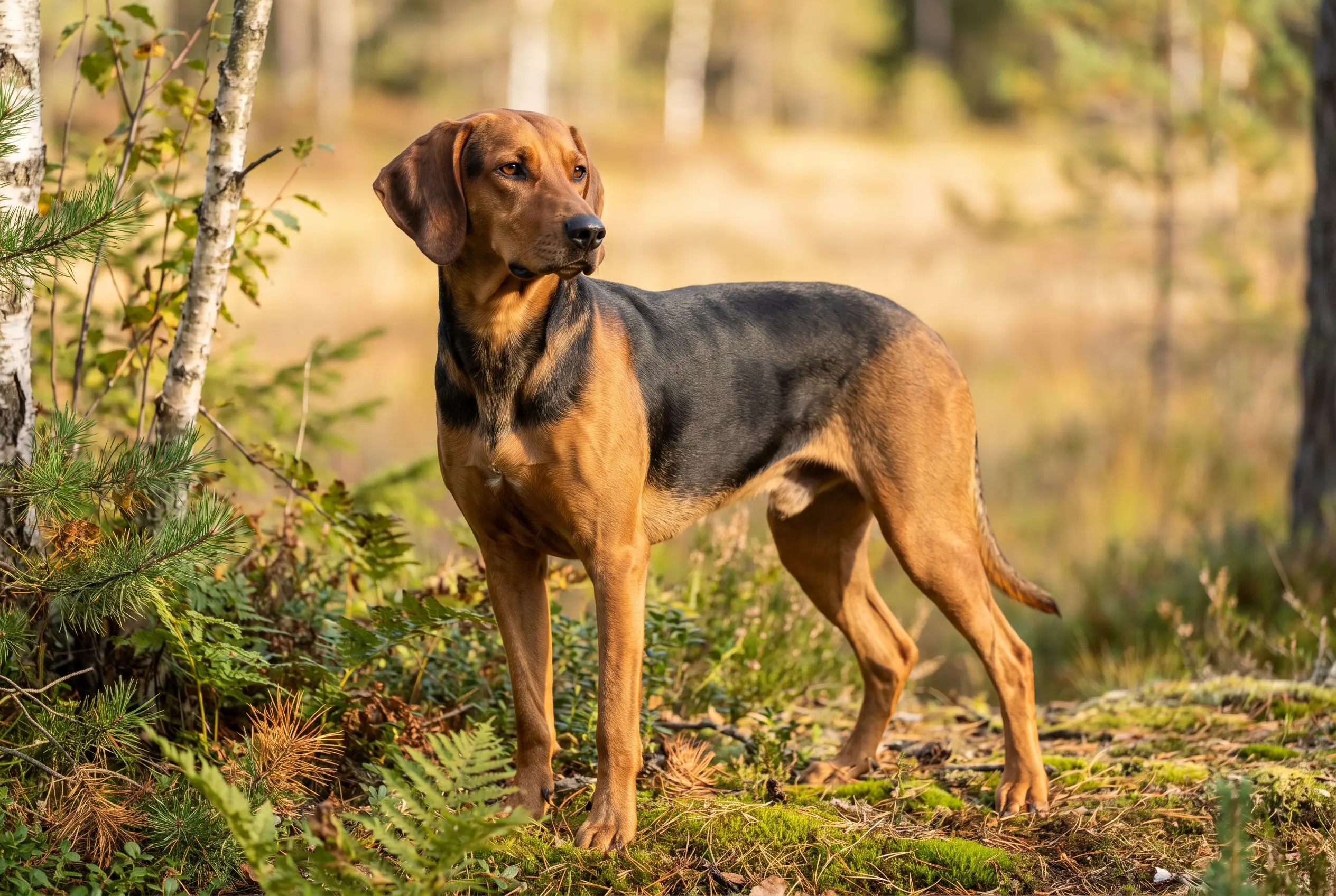
Schillerstövare
Bred by one farmer from two dogs at an 1886 show, and reckoned the fastest of Sweden's hounds.
Vital stats
| Size | Medium · 53–61 cm (males), 49–57 cm (females) |
| Weight | 18–25 kg — breed literature; the standard sets none |
| Life expectancy | 12–13 years — breed literature, not survey data |
| Energy | High — built for daily hunting and open country, not apartment life |
| Shedding | Low — short harsh coat, a weekly brush is enough |
| Coat | Short, harsh, lying close to the body · tan with a well-defined black mantle |
| Group | Scenthound · Medium-sized Hound (FCI №131, Group 6) |
| Origin | Sweden |
| FCI group | 6 — Scent hounds and related breeds · FCI 131 |
Breed traits
Friendliness
Care
Mind
The Schillerstövare by the numbers
The Schillerstövare facts owners search for most — price, lifespan, weight, shedding and colours, in one place.
Less common, so expect a waitlist and some travel to a reputable breeder — which pushes the price up. Plan for steady ongoing costs — mid-range food, routine vet care and insurance.
We don't quote a single figure: the real price swings with breeder, region, bloodline and health testing — and a rescue costs a fraction of a breeder's litter. Adopting is almost always the cheapest route.
Temperament
The standard's entire behaviour clause reads, in full, "Lively and attentive." That brevity is typical of a working hound bred by hunters who cared about nose and voice, not couch manners. Breed literature fills in the rest: dynamic, devoted to its handler, and independent enough that a scent trail will override instructions if recall hasn't been drilled in early. It isn't built to work alongside its own kind — the utilization clause bars pack work and coupled hunting by name — so the temperament that shows up at home tends to read as solo operator rather than team player, loyal to its people but not automatically sociable with strange dogs.
Habits & quirks
Hunts alone, on purpose
The utilization clause is unusually specific for an FCI standard: a scent hound that gives tongue on hare and fox, and explicitly "not a pack hound, nor hunted in couples or used for hunting deer." Most stövare work this way, but the Schillerstövare's standard spells it out by name.
The mantle has a shape
Black is only permitted to cover the back of the neck, the back itself, the upper shoulders, the sides of the trunk, the loin and the top of the tail — tan takes the head, throat, chest, legs and underside. A mantle that spreads lower, or black hair mixed into the tan on an adult dog, is a listed fault.
Ears that lift when it's interested
Triangular, soft, hanging ears set high on the skull, reaching no further than halfway down the muzzle — the standard allows them to rise slightly above the skull line when the dog is alert, about as much expression as this breed's face gives away.
Named for a farmer's brother-and-sister pair
The breed traces to two dogs, Tamburini and Ralla 1, shown by farmer Per Schiller at Sweden's first dog show in 1886. The Swedish Kennel Club recognised the breed in 1907; later infusions of Swiss hounds and British harriers set the coat and body type the standard describes today.
Care
| Exercise | The standard's own description of the body is built around "the impression of speed and strength," and breed literature is blunt about what that means day to day — this is not an apartment dog. Give it daily off-lead running or real hunting work in open country; a lead-only walk barely touches what it's built for. |
| Grooming | The coat is harsh, close-lying and short, so a weekly brush covers it. The ears are the actual job: hanging, soft and folded against the cheek, they trap moisture and need a regular check and clean. |
| Training | It's devoted to its handler but scent-led the moment it's on a trail, so recall needs to be solid before it's ever off lead near game. Breed literature calls for firm, consistent training and early socialisation rather than a soft hand. |
| Health | The standard lists no breed-specific disqualifying health conditions beyond normal conformation faults, and breed literature describes the Schillerstövare as hardy, with no widely reported inherited disease — though that reflects a small, largely Scandinavian population rather than a formal health survey. |
Life expectancy
This breed has a typical life expectancy of 12–13 years — breed literature, not survey data.
Similar breeds
Breeds with a similar build and background — worth a look if this one isn't quite the fit.
Breeds that look like this
Common questions
Is the Schillerstövare the same as the Hamiltonstövare?
No — different breeds, different standards. The Schillerstövare (FCI No. 131) is tan with a black mantle; its standard allows only slight white on the chest and toes. The Hamiltonstövare (FCI No. 132) is tricolour and carries real white as part of its standard pattern. At a glance, both are black-saddled Swedish scenthounds of similar size, which is exactly why they get mixed up — the amount of white on the dog is the tell.
What does "stövare" actually mean?
It's the Swedish word for a hound that works a scent trail alone rather than in a pack. The Schillerstövare's own standard makes this literal: its utilization clause rules out pack hunting and deer by name, restricting the breed to hare and fox, worked solo.
Are they good family dogs, or strictly hunters?
Bred and still used mainly as hunters, but breed literature describes it as devoted to its household and easygoing at home once its exercise needs are met. It isn't suited to apartment life or being left idle all day — without real running room and a job, the same drive that makes it fast in the field shows up indoors as restlessness.
Does the Schillerstövare shed a lot?
Not much. The Schillerstövare is a low-shedding breed, so loose hair around the home stays minimal. It still needs regular grooming, but you won't be fighting drifts of fur.
Is the Schillerstövare hypoallergenic?
No dog is truly hypoallergenic, but the Schillerstövare comes closer than most: its low-shedding coat releases less of the dander that triggers allergies. Many allergy sufferers manage well with this breed, but spend time around one before committing.
Is the Schillerstövare easy to train?
They can be a challenge. The Schillerstövare is intelligent but independent, and would rather make its own decisions than take orders. Reward-based training and patience work best; expect recall in particular to take time.