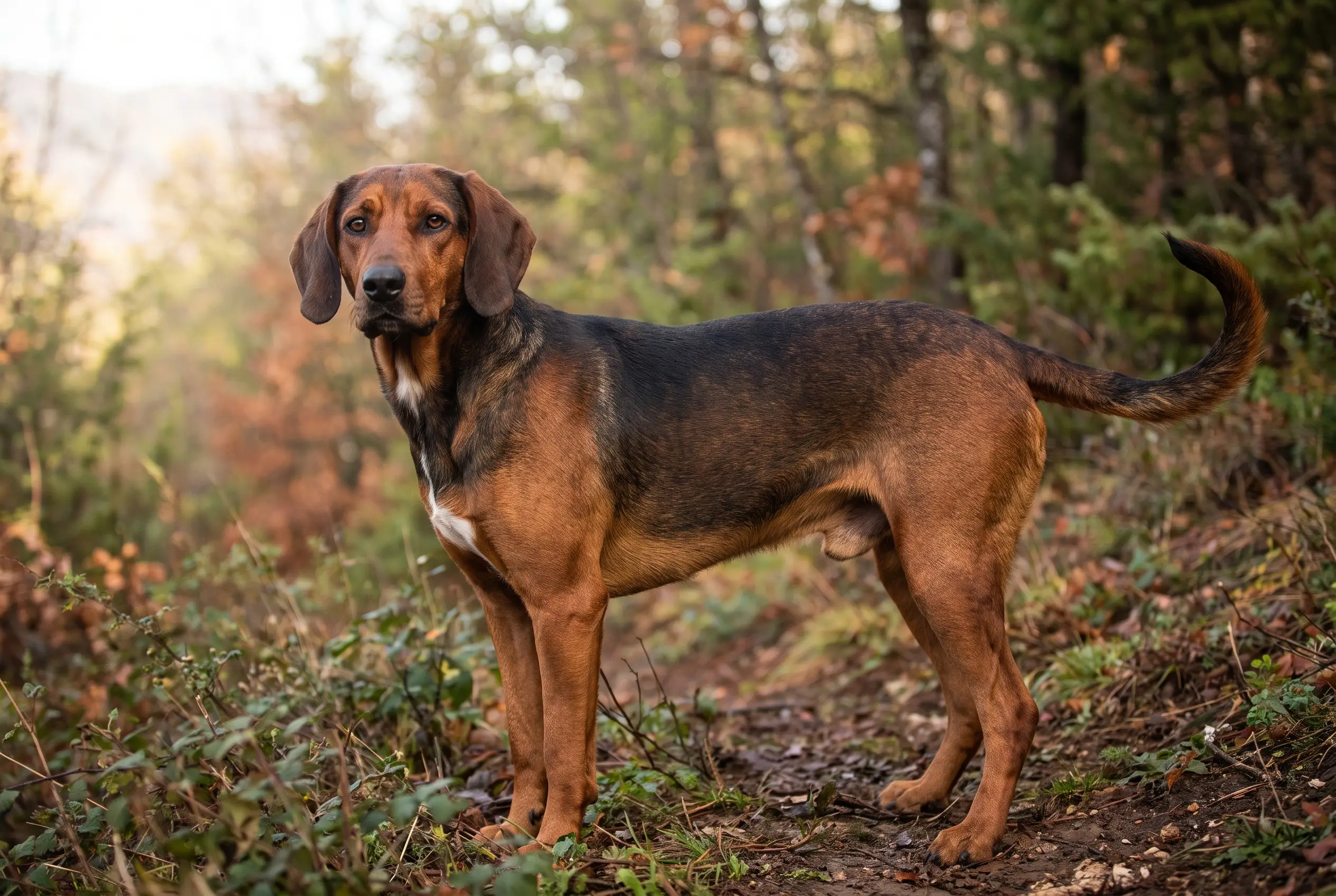
Srpski Gonič
Fox-red with a black saddle, and a nose the Balkans have hunted behind since before anyone wrote it down.
Vital stats
| Size | Medium · 46–56 cm (dogs), 44–54 cm (bitches) |
| Weight | 18–25 kg — breed literature; the standard sets none |
| Life expectancy | 12–14 years — breed literature, not survey data |
| Energy | High — bred to trail all day, needs real daily work |
| Shedding | Moderate — short double coat, sheds year-round |
| Coat | Short, dense, gleaming double coat · fox-red to rust under a black mantle or saddle |
| Group | Hound · Medium-sized Hounds (FCI №150, Group 6) |
| Origin | Serbia |
| FCI group | 6 — Scent hounds and related breeds · FCI 150 |
Breed traits
Friendliness
Care
Mind
The Srpski Gonič by the numbers
The Srpski Gonič facts owners search for most — price, lifespan, weight, shedding and colours, in one place.
Less common, so expect a waitlist and some travel to a reputable breeder — which pushes the price up. Plan for steady ongoing costs — mid-range food, routine vet care and insurance.
We don't quote a single figure: the real price swings with breeder, region, bloodline and health testing — and a rescue costs a fraction of a breeder's litter. Adopting is almost always the cheapest route.
Temperament
The standard's behaviour clause runs four words: kind, with lively temperament, dependable, showing remarkable tenacity. Kind and dependable describe a dog that settles into a household without drama; lively and tenacious describe what happens the moment a scent trail opens up. This is a working trailing hound judged with a working trial, and its nose does not switch off because the leash is on — breed literature adds that it hunts with a distinctive, carrying voice, so a bored or under-exercised Srpski Gonič is a loud one. It is not listed as reserved or wary with people the way some hounds are; the standard's only hard line on character comes in the disqualifications, where aggressive or overly shy dogs are struck out entirely.
Habits & quirks
One coat, no exceptions
The standard allows exactly one colour scheme: fox-red to rust with a black mantle or saddle running up to the temples. A round white chest patch under 2 cm is tolerated; white anywhere else on the dog disqualifies, as does a coat that leaves the pattern out entirely.
Tail down, not up
The tail should extend the line of the croup, curve slightly upward, and be carried below the topline. A tail that curls, rides high, hooks at the tip, or arcs over the back is a disqualifying fault, not a stylistic quirk.
One missing tooth is written into the rules
The standard disqualifies a missing tooth as a rule — except it specifically tolerates the absence of both first premolars (2PM1). That single named exception is the only dental gap a judge is meant to let pass.
Ten percent longer, not more
The body is meant to measure 10% longer than the dog stands tall at the withers, per the standard's own proportions. Exceed that and 'body too long' is called out by name among the disqualifying faults — the ratio is a target, not a floor.
Care
| Exercise | This is a trailing hound built to work rough ground all day, not a dog satisfied by a lap around the block. Give it an hour or more daily with real scent work — tracking, drag lines, or an actual hunting outing where legal — and keep it on lead or in a secured area off-trail, since a hound this nose-driven will follow a scent past the point of hearing you. |
| Grooming | The short, dense double coat needs a weekly brush and sheds moderately year-round rather than in one dramatic blow. The pendulous ears, set close to the cheeks, trap moisture after wet ground work — check and clean them regularly, more often through hunting season. |
| Training | The standard calls it dependable, which is a decent baseline for trainability, but a scent hound's nose competes with any command once a trail is live. Keep sessions short and reward-based, start recall early, and treat off-lead reliability as something you build in a fenced field before you trust it in open country. |
| Health | The standard is silent on health beyond requiring functionally and clinically healthy dogs with breed-typical conformation for breeding. Breed literature, not the standard, flags hip dysplasia and ear infections as concerns worth screening for; outside the Balkans the population is small, so ask breeders about hip results and pedigree depth. |
Life expectancy
This breed has a typical life expectancy of 12–14 years — breed literature, not survey data.
Similar breeds
Breeds with a similar build and background — worth a look if this one isn't quite the fit.
Breeds that look like this
Common questions
Is the Serbian Hound the same as the Serbian Tricolour Hound?
No — same regional root, two separate FCI breeds. The tricolour type was bred as a variety of the plain Serbian Hound until a separate standard was drawn up in 1946; it now carries its own FCI number, 229, as the Serbian Tricolour Hound (Srpski Trobojni Gonič). The giveaway is colour: the Srpski Gonič covered here is strictly fox-red with a black saddle and, at most, one small white chest patch; the Trobojni Gonič carries visible white as part of a true black, tan and white tricolour.
Why do so many Balkan hound breeds share the word 'Gonič'?
Because gonič is simply South Slavic for a scenthound — it names a job, not one breed, the way 'braque' does in French. The FCI recognises several separate breeds carrying it: this plain-coated Srpski Gonič (No. 150), the tricolour Srpski Trobojni Gonič (No. 229), the Posavski Gonič (No. 154), the smooth-coated Istarski Kratkodlaki Gonič (No. 151) and its wire-coated cousin the Istarski Oštrodlaki Gonič (No. 152), the shaggy Bosanski Oštrodlaki Gonič-Barak (No. 155), and the Crnogorski Planinski Gonič (No. 279). Each has its own standard, its own colour rules, and, for several of them, a different sponsoring country today than when Yugoslavia still existed as one state.
What country does its standard credit, and has that changed?
The current FCI standard lists origin as Serbia, plainly, with no separate patronage line. That's a settled answer, but the paperwork got there in stages: the breed was administered by the Yugoslav Cynological Association through most of the 20th century, renamed from Balkan Hound to Serbian Hound by FCI vote in 1996, and its standard has since been revised and republished under Serbia's name as the former Yugoslav republics set up their own national kennel clubs. Several of its Gonič relatives carry similar histories, with FCI patronage now split across Serbia, Croatia, Bosnia and Herzegovina, and Montenegro rather than one shared authority.
Does the Srpski Gonič shed a lot?
Moderately. The Srpski Gonič sheds a fair amount, steadily through the year with heavier seasonal patches. A weekly brush keeps most of the loose hair off your floors and clothes.
Is the Srpski Gonič hypoallergenic?
Not really. No dog is truly hypoallergenic, and the Srpski Gonič's shedding coat releases plenty of the dander that sets off allergies. If someone at home is allergic, this isn't the easiest breed to live with — spend time around one first.
Is the Srpski Gonič good with children?
Generally yes. The Srpski Gonič is a friendly, people-loving breed that usually does well with children when raised and socialised well. As with any dog, teach children to be gentle and supervise around toddlers.
Is the Srpski Gonič easy to train?
Reasonably. The Srpski Gonič is trainable with consistency and rewards, though it isn't the quickest study. Keep sessions short and positive, and be patient with the basics like recall.