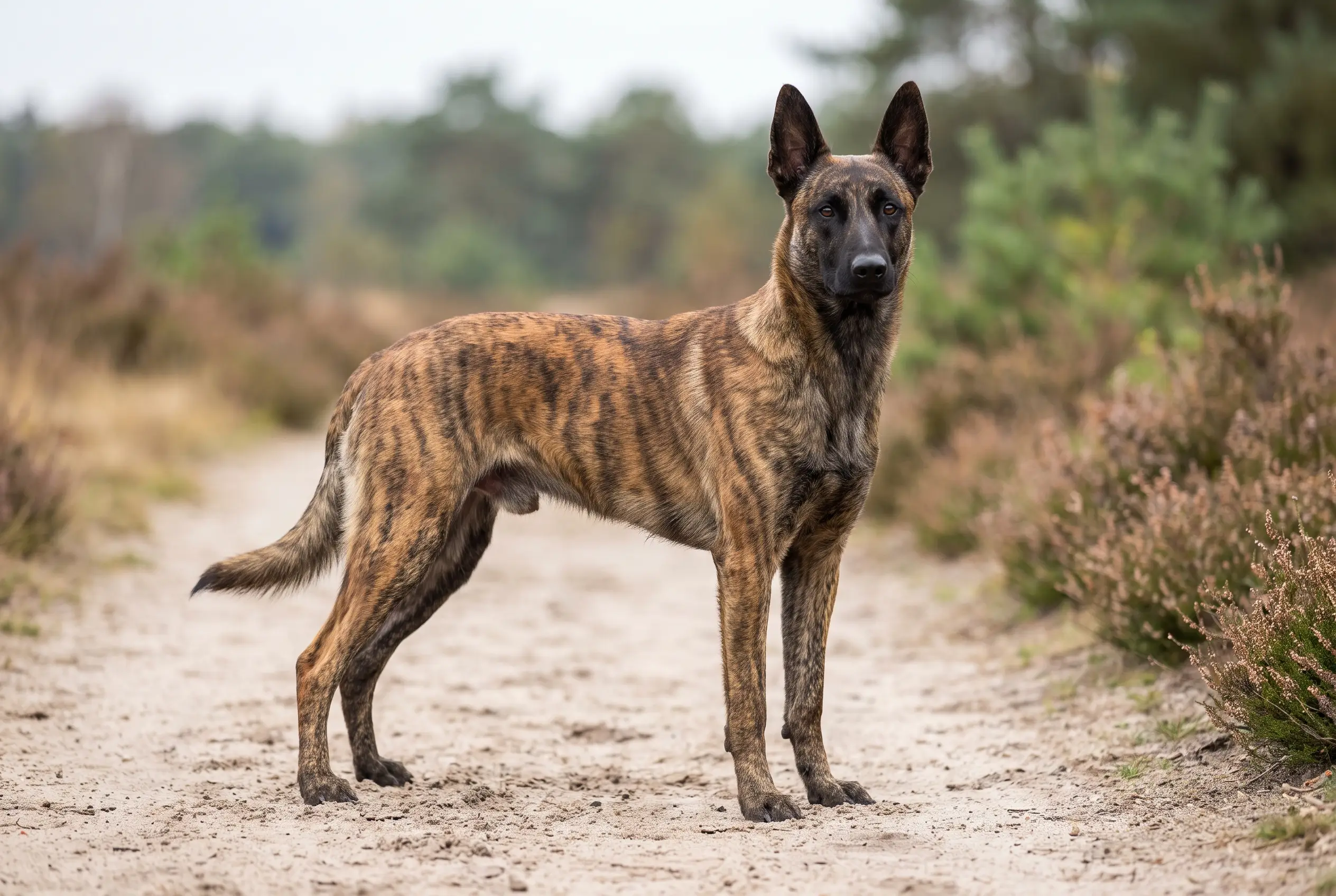
Dutch Shepherd
Brindle by rule, in three different coats.
Vital stats
| Size | Medium · 55–62 cm |
| Weight | 23–30 kg |
| Life expectancy | 12–14 years |
| Energy | Very high — needs a job, not only a walk |
| Shedding | Moderate to high — every variety carries a woolly undercoat |
| Coat | Short-haired, long-haired or rough-haired · always brindle on gold or silver |
| Group | Herding · Sheepdog, with working trial (FCI №223, Group 1) |
| Origin | Netherlands |
| FCI group | 1 — Sheepdogs and Cattledogs · FCI 223 |
Breed traits
Friendliness
Care
Mind
The Dutch Shepherd by the numbers
The Dutch Shepherd facts owners search for most — price, lifespan, weight, shedding and colours, in one place.
Widely bred, so you can usually find a litter from a registered breeder without a long wait. Ongoing costs run high — more food, bigger doses at the vet, and pricier insurance.
We don't quote a single figure: the real price swings with breeder, region, bloodline and health testing — and a rescue costs a fraction of a breeder's litter. Adopting is almost always the cheapest route.
Temperament
The standard asks for a dog that is loyal and reliable, alert, watchful, active, independent, persistent, intelligent and willing to obey, and it says outright that the dog should deal with a task on its own once it has been handed one. That last part is the bit people underestimate. This is not a shepherd that waits to be told each step; it works out an answer and commits to it, which is superb on a flock and awkward in a house with no rules. It bonds hard to its own people, is reserved rather than friendly with strangers, and reacts to movement — joggers, cyclists, the children running down the hall all get herded unless that instinct is given somewhere else to go. There is also a real split inside the breed. Lines bred for Dutch police-dog sport carry more drive, more hardness and a lower threshold than lines bred for the show ring or family homes, and a puppy from the first kind in a home built for the second kind is how most Dutch Shepherds end up in rescue. Ask the breeder which they breed, and believe the answer.
Habits & quirks
Wears its passport
Brindle became the only permitted colour in 1914, chosen to keep the breed visibly apart from the German and Belgian shepherds. A Dutch Shepherd that is not striped is not a Dutch Shepherd.
Solves it alone
The standard wants a dog that handles an assigned task independently. Left with no task, it assigns itself one, and its judgement about which one is worse than yours.
Movement is the trigger
A bike, a jogger, a running child, a football. The herding reflex fires at speed, not at the animal, so recall and an off switch matter more here than obedience titles do.
Notices the gate
On the farm it announced anyone who walked into the yard. In a suburb it announces the postman, the neighbour and the delivery van, and it means it every time.
Health
A sound breed on the whole, but with a few specific things to screen for. OFA records show hip dysplasia in about 9 percent of the dogs screened and elbow dysplasia in about 5.5 percent, on small samples, so ask to see hip and elbow scores on both parents. Ask too for a clear SLC25A12 result for inflammatory myopathy, a fatal muscle disease first identified in this breed, and — for a rough-haired puppy — a goniodysplasia eye examination on both parents. Masticatory myositis and allergies also turn up. Beyond the paperwork, the healthiest thing you can give this dog is a real job and a lean weight.
Nutrition
| Exercise | An hour or two a day of something with structure in it: tracking, herding, obedience, bite sport, agility, long scent games. Distance on its own does not tire this dog out; a fit Dutch Shepherd walked ten kilometres is simply a fitter Dutch Shepherd. |
| Grooming | Depends on the coat. The short one wants a brush now and then and sheds steadily. The long one needs a proper going-over once a week, more through the ruff and breeches. The rough one is hand-plucked about twice a year, as the standard specifies, and clipping it wrecks the harsh texture. |
| Training | Start early and never really stop. It learns quickly, remembers everything and pushes back against force, so build with rewards, clear rules and short sessions. Socialise heavily before sixteen weeks, because the natural reserve towards strangers hardens with age. |
| Health | A sound breed on the whole. OFA records show hip dysplasia in about 9 percent of dogs screened and elbow dysplasia in about 5.5 percent, on small samples. Ask for hip and elbow scores, a clear SLC25A12 result for inflammatory myopathy — a fatal muscle disease first identified in this breed — and, for a rough-haired puppy, a goniodysplasia eye examination on both parents. Masticatory myositis and allergies also turn up. |
This is a very high-drive working dog that needs a job rather than only a walk, and it burns fuel accordingly — so feed to the actual workload, not a fixed scoop. Weigh the meals, count the training treats in the day's total (there will be a lot of them with a dog this trainable), and keep it lean and muscled, with ribs you can feel under the coat. A dog in hard dog-sport training and a dog on a quiet week do not eat the same, so adjust as the week does.
Puppy guide
A Dutch Shepherd puppy is switched on, quick to learn and quick to bond, and the single most important job in the first year is socialisation — the natural reserve towards strangers hardens with age, so introduce the world heavily before sixteen weeks. Start training in short, rewarding sessions from day one, teach an off switch as deliberately as a sit, and give the sharp herding instinct an outlet before it starts herding the joggers and the children. Keep the body's work sensible while the joints are forming; the mind can take far more than the legs.
Training
Start early and never really stop. This is one of the most trainable dogs there is — it learns fast, remembers everything and wants to work — but it also pushes back against force, so build with rewards, clear rules and short sessions rather than pressure. Give it a real curriculum: tracking, herding, obedience, bite sport or agility, not just a walk. The independence the standard asks for is superb on a flock and a handful in a house with no rules, so channel it into a job and the manners follow.
Life expectancy
Dutch Shepherds live 12–14 years. The Dutch Shepherd is a genuinely sound, long-lived working breed, and you keep it at the top of that range the way you keep it happy: a lean, muscled weight, parents screened for hips, elbows, the SLC25A12 muscle-disease gene and (for the rough coat) eyes, and a life with enough real work in it to keep body and mind sound. The years quoted are a breed-literature estimate rather than a survey figure, so read them as a guide.
Similar breeds
Breeds with a similar build and background — worth a look if this one isn't quite the fit.
Breeds that look like this
Common questions
How is a Dutch Shepherd different from a Belgian Malinois?
Colour settles it on sight: the Dutch Shepherd must be brindle, the Malinois is fawn with a black mask and black overlay, and only the Dutch breed also comes in long and rough coats. Underneath they are close cousins from neighbouring countries, built on the same regional farm-dog stock, and Belgian Malinois were crossed in after the Second World War to rebuild Dutch numbers before the Dutch club stopped the practice. On temperament the honest answer is that the difference is small and the overlap is huge. Well-bred Dutch Shepherds tend to settle a little more easily indoors and Malinois tend to run at a higher idle, but the breeding line matters far more than the breed name. In the Dutch police-sport world the labels dissolve altogether: many KNPV dogs called Dutch Shepherds have no pedigree and carry Malinois blood, because those dogs are selected on nerve and bite work rather than on a studbook.
What is the difference between the three coats?
One breed, three varieties in FCI standard 223. Short-haired is the common one, with fairly hard close-fitting hair over a woolly undercoat, and it shows the brindle at its sharpest. Long-haired is long, straight and harsh to the touch, with a distinct ruff and breeches, feathering down the backs of the forelegs and no fringes on the ears. Rough-haired, which the FCI text calls wire hair, is dense, tousled and harsh with a beard, whiskers and coarse eyebrows that make the head look square, and the tousled texture mutes the striping. It is the scarce one — a few hundred dogs — and it needs hand-plucking rather than clipping. Nothing else changes between the three: same size, same standard, same job.
Is a Dutch Shepherd a good family dog?
In the right family, yes. It is affectionate at home, clean, healthy, easy to keep and genuinely good with children it lives with. But it is a working shepherd with real drive, it herds movement, it is reserved with strangers and it needs a job every day of its life. A first-time owner, a full workday away from home or a plan built around walks will produce a dog that barks, chases, guards and takes the house apart. Working-line puppies from police-sport breeding are harder again and belong with handlers who train, not with pet homes.
Does the Dutch Shepherd shed a lot?
Moderately. The Dutch Shepherd sheds a fair amount, steadily through the year with heavier seasonal patches. A weekly brush keeps most of the loose hair off your floors and clothes.
Is the Dutch Shepherd hypoallergenic?
Not really. No dog is truly hypoallergenic, and the Dutch Shepherd's shedding coat releases plenty of the dander that sets off allergies. If someone at home is allergic, this isn't the easiest breed to live with — spend time around one first.
Is the Dutch Shepherd easy to train?
Yes. The Dutch Shepherd is one of the more trainable breeds — quick to learn and keen to work with you, which makes reward-based training straightforward. Start early, keep it positive, and it picks things up fast.