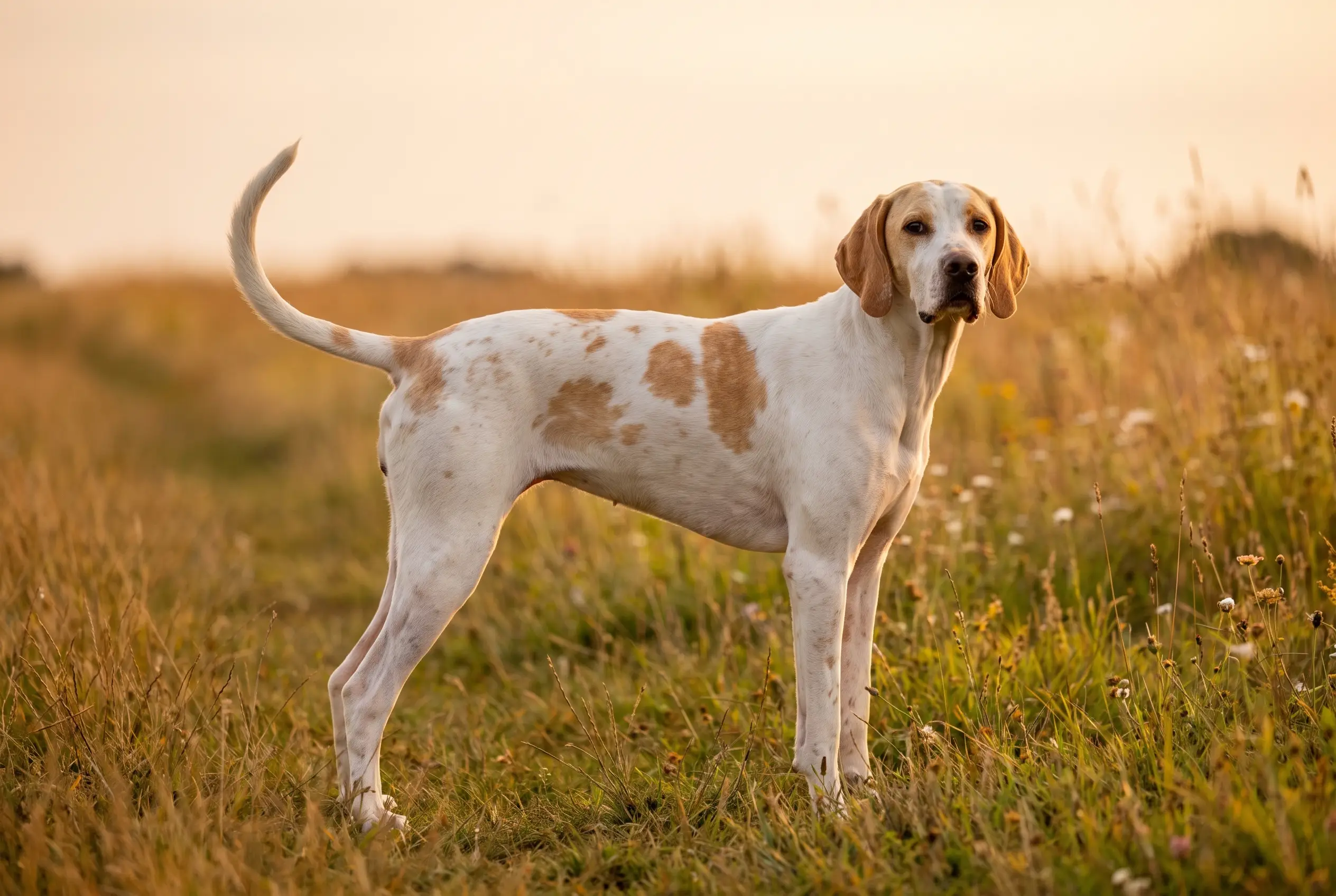
Français Blanc et Orange
No English blood in its pedigree, and almost none left in France's registry either.
Vital stats
| Size | Large · 62–70 cm |
| Weight | 25–30 kg — breed literature; the standard sets none |
| Life expectancy | 10–12 years — breed literature, not survey data |
| Energy | High — bred for a full day's pack hunt |
| Shedding | Low-to-moderate — short, fine coat |
| Coat | Short and fine · white with lemon or orange patches, never dark enough to read red |
| Group | Hound · Large-sized Hounds (FCI №316, Group 6) |
| Origin | France |
| FCI group | 6 — Scent hounds and related breeds · FCI 316 |
Breed traits
Friendliness
Care
Mind
The Français Blanc et Orange by the numbers
The Français Blanc et Orange facts owners search for most — price, lifespan, weight, shedding and colours, in one place.
Less common, so expect a waitlist and some travel to a reputable breeder — which pushes the price up. Ongoing costs run high — more food, bigger doses at the vet, and pricier insurance.
We don't quote a single figure: the real price swings with breeder, region, bloodline and health testing — and a rescue costs a fraction of a breeder's litter. Adopting is almost always the cheapest route.
Temperament
The standard has no dedicated behaviour clause at all, a gap common in FCI texts from this era, written before a temperament section became standard practice. The closest it comes is in the disqualifying faults: an aggressive or an overly shy dog fails outright, and so does any dog that clearly shows physical or behavioural abnormalities. That is the entire official record on temperament. Breed literature fills the rest in — hunters and breed sources describe a dog that is affectionate with its handlers but strongly independent, with the nose, voice and drive of a working scenthound bred to read a scent for itself mid-hunt rather than wait on instruction. It is built to run inside a pack under a huntsman's direction, not to sit in a living room waiting for one.
Habits & quirks
Colour goes to the skin
The standard doesn't stop at the coat: it specifies the skin itself runs white with yellow or orange patches under the coloured hair, the palate can be yellow, and even the scrotum follows the same white-or-yellow rule. Colour here is a whole-dog trait, not just a fur pattern.
Orange, never red
White and orange is one of only two colourways the standard allows, and it draws the line precisely: orange "on condition that [it] is not too dark going on to red." Cross it and it's a fault; black or red hair anywhere in the coat disqualifies the colour outright.
Ears measured in fingers
The standard sets the ear length by where it reaches when drawn forward: "to about two fingers from the on-set of the nose." Set slightly below eye level, the leather itself is called supple, fine and slightly twisted — a specific, checkable shape rather than a general description.
Hare feet, front and back
Both forefeet and hind feet are called hare-feet in the standard, a tighter, more oval foot than the round "cat feet" asked for on other breeds, matched to a gait the same text describes as "rather easy, gallop light and sustained" — a hound built to cover ground all day.
Health
Breed literature reports no widely documented health problems and calls the constitution rustic, but no survey backs that up, and with barely any litters recorded in recent French registrations, the working population is tiny — so genetic diversity is an open question rather than a settled fact. General large-hound care applies: ask a breeder about hip soundness, learn the signs of bloat in a deep-chested dog, and ask honestly about how closely related the available dogs are.
Nutrition
| Exercise | This is a pack hound bred to gallop a full day's stag or roe-deer hunt alongside other hounds and a huntsman. Outside that context it needs a serious daily substitute — hours of real running and scent work, not a lead walk — and breed literature calls it independent enough to keep working long after a less driven dog would give up. |
| Grooming | The short, fine coat needs a weekly brush and little else. Breed literature flags no coat-specific problems beyond the obvious: the coat gives limited protection from cold and wet, so it wants indoor shelter rather than an outdoor kennel in poor weather. |
| Training | The standard says nothing about trainability directly — its only behavioural language disqualifies an aggressive or overly shy dog. In practice this is a nose-led scenthound raised inside a pack hierarchy rather than drilled for individual obedience; breed sources call it intelligent but strongly independent, which fits a dog selected for initiative mid-hunt rather than for taking direction off one. |
| Health | Breed literature reports no widely documented breed-specific health problems and calls the constitution rustic. No health survey backs that claim up, and with essentially no litters recorded in the most recent national registrations, the working population is small enough that genetic diversity is an open question rather than a settled one. |
A pack hound bred to run a full day's stag or roe-deer hunt needs feeding to that workload, and breed literature calls it independent enough to keep going long after a softer dog would stop. Split the day's ration across meals for a deep-chested hound rather than feeding one heavy bowl, and keep him lean. One extra note from the breed's own descriptions: the short, fine coat gives limited protection from cold and wet, so a working dog needs proper shelter and enough fuel in poor weather.
Puppy guide
This is a large, slow-growing hound, so a puppy's first year is about steady, unhurried development — keep hard exercise light while the frame is still forming. Socialize him widely, and start recall and simple nose games early, because this is a dog bred to read a scent for itself and act on it. Raised inside a pack rather than drilled alone, the breed settles best with canine company and a real outlet from the start.
Training
The standard says nothing about training directly; its only behavioural lines simply rule out an aggressive or an overly shy dog. In practice this is a nose-led scenthound raised inside a pack hierarchy, not a dog selected to take direction from one handler — breed sources call it intelligent but strongly independent. Expect to earn recall and keep earning it, and give the nose a legitimate job rather than fighting the instinct behind it.
Life expectancy
Français Blanc et Orange hounds live 10–12 years — breed literature, not survey data. The lifespan usually quoted for the Français Blanc et Orange is breed literature, not survey data, so read it loosely. The breed is called rustic and generally hardy, but it is one of the rarest hounds still recognised anywhere, and its long-term soundness rests on a very small population — a lean weight, real daily work and an honest conversation with a breeder about the gene pool are the best any owner can do.
Similar breeds
Breeds with a similar build and background — worth a look if this one isn't quite the fit.
Breeds that look like this
Common questions
What's the difference between a Français and an Anglo-Français hound?
Blood. The three "Français" hounds — Tricolore (FCI №219), Blanc et Noir (№220) and this one, Blanc et Orange (№316) — descend from old French hound stock with no English blood at all. The three Grand Anglo-Français breeds carry the same three coats on dogs built from 19th-century crosses with the English Foxhound, standardised under the "Anglo-Français" name in 1957: Tricolore (№322), Blanc et Noir (№323) and Blanc et Orange (№324), the direct Anglo-French counterpart of this breed. A fourth, smaller Anglo-Français de Petite Vénerie (№325) repeats the same cross at a size built for smaller game. Colour tells you the coat; the name tells you whether an English Foxhound sits in the pedigree.
How rare is the Français Blanc et Orange?
Among the rarest working dog breeds still recognised anywhere. The Société Centrale Canine's most recently published LOF figures, covering 2022 and 2023, don't list the Français Blanc et Orange at all, while every other Group 6 breed with even a single registration in either year does appear — down to breeds with just one dog recorded. Its absence points to zero litters registered in both years. Its tricolour relative fared only a little better: 74 registrations in 2022, none in 2023. Older figures put the breed's numbers low even before that: a widely cited 2007 LOF count had it at 9 registrations, ranked 244th among French breeds. Today it survives mainly inside a handful of hunting équipages rather than as a breeding population with any real depth.
Can you keep a Français Blanc et Orange as a pet?
Almost nobody does. It's bred and kept as a pack hound for organised stag and roe-deer hunting under the French vénerie system, run in a group of hounds directed by a huntsman rather than exercised individually off lead. Breed literature describes it as affectionate with its handlers but strongly independent, and the standard itself addresses temperament only through its disqualifying faults, where an aggressive or an overly shy dog fails outright. A household would need to replace a full day of pack hunting with an equivalent daily outlet, and given the registration numbers above, finding one outside a French hunting kennel is close to impossible.
Does the Français Blanc et Orange shed a lot?
Moderately. The Français Blanc et Orange sheds a fair amount, steadily through the year with heavier seasonal patches. A weekly brush keeps most of the loose hair off your floors and clothes.
Is the Français Blanc et Orange hypoallergenic?
Not really. No dog is truly hypoallergenic, and the Français Blanc et Orange's shedding coat releases plenty of the dander that sets off allergies. If someone at home is allergic, this isn't the easiest breed to live with — spend time around one first.
Is the Français Blanc et Orange good with children?
They can be. The Français Blanc et Orange is reasonably sociable and can be good with children in the right home, especially when socialised early. Supervise around young kids and teach dog and child to respect each other.
Is the Français Blanc et Orange easy to train?
Reasonably. The Français Blanc et Orange is trainable with consistency and rewards, though it isn't the quickest study. Keep sessions short and positive, and be patient with the basics like recall.