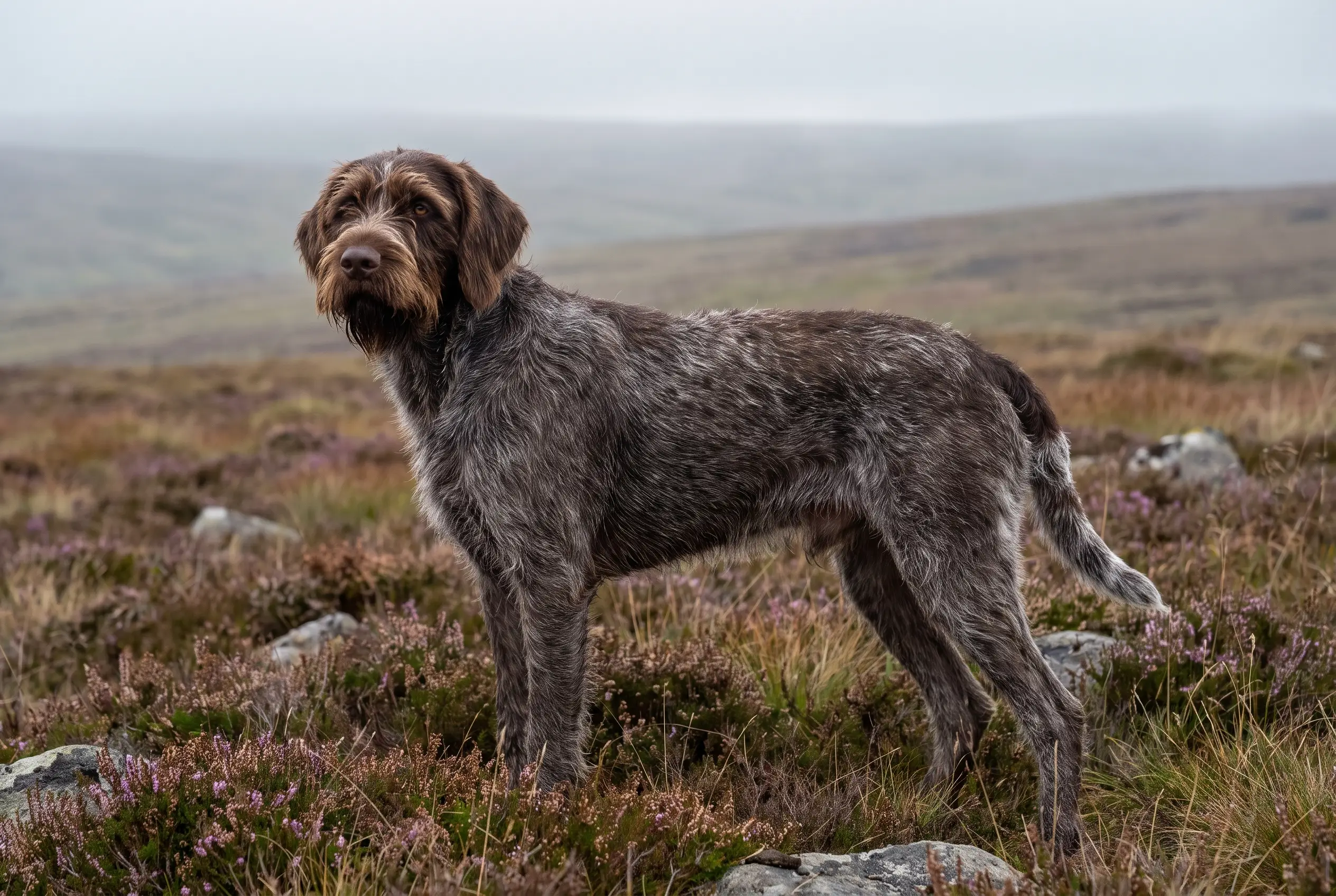
German Roughhaired Pointer
Germany's oldest rough-coated pointing dog, bristling eyebrows and all — and now one of its rarest.
Vital stats
| Size | Large · 60–70 cm (dogs), 58–68 cm (bitches) |
| Weight | About 25–34 kg — breed literature; the standard sets none |
| Life expectancy | 12–14 years — breed literature, not survey data |
| Energy | High — a working gundog that expects a job |
| Shedding | Moderate — a harsh coat with, often, a barely visible undercoat |
| Coat | Stiff, harsh and bristly, about 4 cm · brown, brown roan or light roan |
| Group | Sporting · Continental Pointing Dogs (FCI №232, Group 7) |
| Origin | Germany |
| FCI group | 7 — Pointing Dogs · FCI 232 |
Breed traits
Friendliness
Care
Mind
The German Roughhaired Pointer by the numbers
The German Roughhaired Pointer facts owners search for most — price, lifespan, weight, shedding and colours, in one place.
Less common, so expect a waitlist and some travel to a reputable breeder — which pushes the price up. Ongoing costs run high — more food, bigger doses at the vet, and pricier insurance.
We don't quote a single figure: the real price swings with breeder, region, bloodline and health testing — and a rescue costs a fraction of a breeder's litter. Adopting is almost always the cheapest route.
Temperament
The standard asks for a dog that is balanced, calm, resistant, courageous but self-controlled, neither shy nor aggressive — and then repeats itself: the temperament is calm and even. The utilization line calls it a versatile, easily tractable working gundog, and that word 'tractable' is doing real work: this is a pointer meant to take direction in the field, in the woods and in water. Selection has been ruthless about nerves, because weak temperament and gun or game shyness are disqualifying faults, not blemishes. What the standard does not describe is a pet. Nearly the whole population lives and works in hunting homes, so honest accounts of the breed around children, cats or city streets are thin; expect a steady, serious working companion, reserved rather than gushing, and plan its life around work rather than hoping it will settle for walks.
Habits & quirks
The grim look
Bushy, strong eyebrows standing off in an oblique arch, a moderate beard, and a head the standard wants free of anything soft, woolly or silky. The stern expression is written into the breed; the calm underneath it is too.
Bristles, not wire
Stichelhaar means prickle-hair: stiff, harsh, bristly coat about 4 cm long, lying loosely with every hair growing the same way. A coat parted along the back is a severe fault, and a soft coat anywhere but beard and brows disqualifies.
Brown, roan, and that is all
Three colours: brown with or without a white chest patch, brown roan, and light roan, each with or without brown patches. A black coat disqualifies, and so do yellow or red markings on head and limbs.
Purebred on principle
The club founded in 1892 — Verein Deutsch Stichelhaar since 1976 — committed itself to pure breeding from the beginning and refused every cross with the English pointing breeds. The Stichelhaar was not invented; it was re-developed from the last few dogs of an old type.
Health
No breed-wide health survey exists for the German Roughhaired Pointer, and the population is small enough that pedigree depth deserves real attention — ask breeders about inbreeding coefficients as well as health, which is standard practice among German gundog clubs. Ask about hip screening too. As a large, deep-chested gundog it is worth knowing the signs of bloat and treating a suddenly swollen belly as an emergency, and the hanging ears want a routine check, especially after water. The harsh coat, for its part, asks almost nothing.
Nutrition
| Exercise | The standard's job description is field, woods and water, before and after the shot, judged with a working trial. In a hunting home the exercise question answers itself; anywhere else, budget a serious daily outing plus pointing-dog work — tracking, dummy retrieves, nose games — or the dog will invent a season of its own. |
| Grooming | One of the cheaper coats in the gundog group: a weekly brush-through, a wipe of the beard after meals and marshes, and a check of the hanging ears. The harsh jacket sheds dirt and needs no trimming — softness, not scruffiness, is what the standard penalises. |
| Training | Easily tractable is the standard's own phrase, and hunters value the breed for taking direction. It still carries full pointing and game drive, so start recall and steadiness early and keep sessions purposeful; a calm, even dog is not the same thing as an idle one. |
| Health | No breed-wide health survey exists, and the population is small enough that pedigree depth deserves real attention. Ask breeders about hip screening and inbreeding coefficients — standard practice among German gundog clubs — and treat the 12–14 years in breed literature as a habit of the type, not study data. |
Feed a Stichelhaar to the work it does, and this is a breed that expects a lot of it — a gundog in the field burns through far more than one waiting for the season, so match the ration to the workload rather than a habit. Keep it lean and fit the way a working dog should be, weigh the meals, and count trail and training treats in the day. As a deep-chested dog it is sensible to split the food into smaller meals and keep things calm around eating rather than feeding big before hard exercise.
Puppy guide
A Roughhaired Pointer puppy is a working gundog in miniature, and it needs a first year that builds a steady, biddable adult. Keep exercise low-impact while the joints grow, and spend the energy on the mind instead — short, fair lessons, wide socialisation, and gentle early foundations for the nose. Because almost the whole breed lives in hunting homes, a pet puppy needs its socialisation to children, other animals and everyday town life planned rather than assumed. Start recall and steadiness early — the pointing and game drive is already there — and get it used to having the beard and ears handled so grooming is routine for life.
Training
Easily tractable is the standard's own phrase, and it is why hunters value the breed: this is a pointer bred to take direction. Use that early. Start recall and steadiness while the puppy is young and keep the sessions purposeful, because the full pointing and game drive sits right under the calm surface — a settled, even-tempered dog is not an idle one. Give the nose real work and a clear job, and the tractability the standard promises is what you get.
Life expectancy
German Roughhaired Pointers live 12–14 years — breed literature, not survey data. The life expectancy in breed literature is a tendency of the type rather than survey data, and with a breed this rare the biggest lever is where the dog comes from: a deep, carefully bred pedigree, hips screened, and a working home that keeps a serious gundog lean, busy and sound well into its later years.
Similar breeds
Breeds with a similar build and background — worth a look if this one isn't quite the fit.
Breeds that look like this
Common questions
How is it different from the German Wirehaired Pointer?
The Stichelhaar is older, and it is in the Drahthaar's pedigree: the Wirehaired standard's own history names the rough-coated types it was built from around 1900, the 'German Broken Coated Pointing Dog' among them — the Stichelhaar under an older English name. The two clubs then went opposite ways: the Drahthaar was bred pragmatically for performance and became Germany's most popular gundog, while the Stichelhaar club kept its line closed and stayed small. In the coat you can see the split — bristly hair about 4 cm long lying loosely on the Stichelhaar, a tighter wire jacket on the Drahthaar.
Is it a good family dog?
The temperament is right on paper — calm, even, neither shy nor aggressive — and hunting families live well with them. But this is a working breed in working hands: breeders place puppies almost exclusively with hunters, the breed is judged with a working trial, and a home that cannot offer real work will struggle first to get one and then to occupy it.
Why is it so rare?
Its own descendant outcompeted it. The Drahthaar, built partly from Stichelhaar blood but bred openly for performance, swept the German hunting world a century ago, and the Stichelhaar's closed, purist breeding kept numbers small. Today a few litters a year, mostly in Germany, sustain the breed — which is why it counts among the rarest of the German pointing dogs.
Does the German Roughhaired Pointer shed a lot?
Moderately. The German Roughhaired Pointer sheds a fair amount, steadily through the year with heavier seasonal patches. A weekly brush keeps most of the loose hair off your floors and clothes.
Is the German Roughhaired Pointer hypoallergenic?
Not really. No dog is truly hypoallergenic, and the German Roughhaired Pointer's shedding coat releases plenty of the dander that sets off allergies. If someone at home is allergic, this isn't the easiest breed to live with — spend time around one first.
Is the German Roughhaired Pointer easy to train?
Yes. The German Roughhaired Pointer is one of the more trainable breeds — quick to learn and keen to work with you, which makes reward-based training straightforward. Start early, keep it positive, and it picks things up fast.